Volume 10, Number 10—October 2004
Research
Genetic and Transmission Analysis of Helicobacter pylori Strains within a Family1
Josette Raymond* , Jean-Michel Thiberge†, Catherine Chevalier†, Nicolas Kalach‡, Michel Bergeret*, Agnès Labigne†2, and Catherine Dauga†2
, Jean-Michel Thiberge†, Catherine Chevalier†, Nicolas Kalach‡, Michel Bergeret*, Agnès Labigne†2, and Catherine Dauga†2
Figure 5
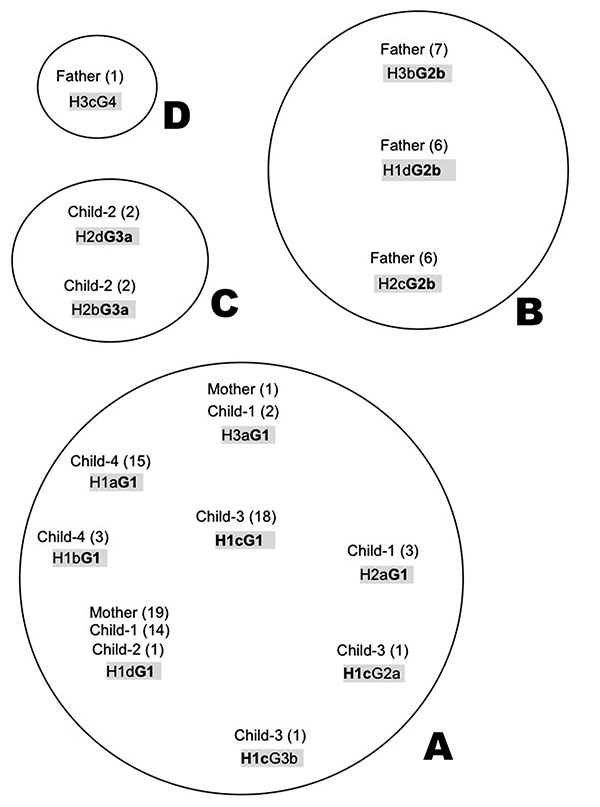
Figure 5. Multilocus sequence typing (MLST) analysis of family isolates. Clonal complexes were defined according to the alleles found associated with the highest number of different combinations among family strains. The names of clones are indicated by a letter: A, B, C or D. Alleles in bold are shared.
1Abstract presented at the 42nd Interscience Conference on Antimicrobial Agents and Chemotherapy, San Diego, CA; September 27–30, 2002 (G-440).
2These authors share senior authorship.
Page created: April 11, 2011
Page updated: April 11, 2011
Page reviewed: April 11, 2011
The conclusions, findings, and opinions expressed by authors contributing to this journal do not necessarily reflect the official position of the U.S. Department of Health and Human Services, the Public Health Service, the Centers for Disease Control and Prevention, or the authors' affiliated institutions. Use of trade names is for identification only and does not imply endorsement by any of the groups named above.