Volume 10, Number 7—July 2004
Perspective
Estimating Time and Size of Bioterror Attack
Johan Walden* and Edward H. Kaplan*†
Figure 1
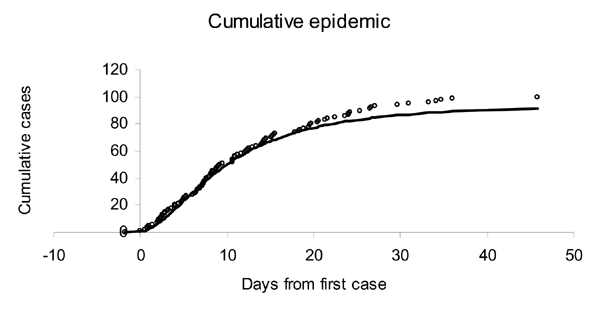
Figure 1. . Simulated actual (open dots) and forecasted (solid curve) cumulative cases in an anthrax bioterror attack that infects 100 persons 1.8 days before the first symptomatic case is observed. The cases were simulated from a lognormal distribution with median 11 days and dispersion 2.04 days, which corresponds to the incubation time estimated for anthrax based on the Swerdlovsk outbreak (3).
References
- Kaplan EH, Craft DL, Wein LM. Emergency response to a smallpox attack: the case for mass vaccination. Proc Natl Acad Sci U S A. 2002;99:10935–40. DOIPubMedGoogle Scholar
- Wein LM, Craft DL, Kaplan EH. Emergency response to an anthrax attack. Proc Natl Acad Sci U S A. 2003;100:4346–51. DOIPubMedGoogle Scholar
- Brookmeyer R, Gail MH. AIDS epidemiology: a quantitative approach. New York: Oxford University Press; 1994.
- Brookmeyer R, Blades N, Hugh-Jones M, Henderson DA. The statistical analysis of truncated data: application to the Swerdlovsk anthrax outbreak. Biostatistics. 2001;2:233–47. DOIPubMedGoogle Scholar
- Fenner F, Henderson DA, Arita I, Jezek Z, Ladnyi ID. Smallpox and its eradication. Geneva: World Health Organization; 1988.
- Centers for Disease Control and Prevention. Biological agents/diseases: category A. Atlanta: The Centers; 2003. Available from: http://www.bt.cdc.gov/agent/agentlist-category.asp#a
- Box GEP, Tiao GC. Bayesian inference in statistical analysis. Reading (MA): Addison-Wesley Pub. Co.; 1973.
- Brookmeyer R, Blades N. Prevention of inhalational anthrax in the U.S. outbreak. Science. 2002;295:1861. DOIPubMedGoogle Scholar
- Brookmeyer R, Johnson E, Bollinger R. Modeling the optimum duration of antibiotic prophylaxis in an anthrax outbreak. Proc Natl Acad Sci U S A. 2003;100:10129–32. DOIPubMedGoogle Scholar
- David HA. Order statistics. New York: John Wiley & Sons, Inc.; 1970.
- Brookmeyer R, Blades N, Hugh-Jones M, Henderson DA. The statistical analysis of truncated data: application to the Swerdlovsk anthrax outbreak. Biostatistics. 2001;2:233–47. DOIPubMedGoogle Scholar
Page created: April 23, 2012
Page updated: April 23, 2012
Page reviewed: April 23, 2012
The conclusions, findings, and opinions expressed by authors contributing to this journal do not necessarily reflect the official position of the U.S. Department of Health and Human Services, the Public Health Service, the Centers for Disease Control and Prevention, or the authors' affiliated institutions. Use of trade names is for identification only and does not imply endorsement by any of the groups named above.