Volume 4, Number 4—December 1998
Synopsis
Insecticide Resistance and Vector Control
 and Janet C. McAllister
Figure 1
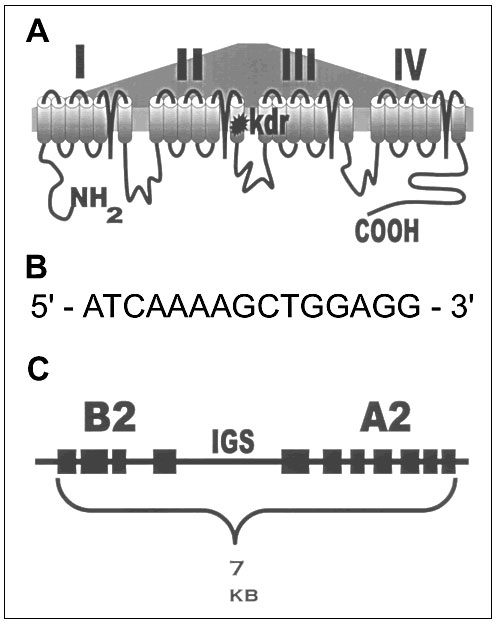
Figure 1. Examples (drawn from references cited in the text) of biochemical resistance mechanisms on the molecular level. A. Single amino acid mutation in the IIS6 membrane-spanning region of the sodium channel gene that confers target-site DDT-pyrethroid resistance in Anopheles gambiae. The same mutated codon produces resistance in insects as diverse as mosquitoes, cockroaches, and flies. B. Regulatory element (found upstream of coding sequence) termed the "Barbie Box" that allows induction of insecticide detoxifying oxidase and esterase resistance genes. Many such putative control elements have been found associated with vector resistance enzymes. C. Esterase A2-B2 amplicon. These resistance esterase genes lie 5' end to 5' end within the same amplification unit. More than 100 copies of this amplicon may be present in a single mosquito. This is one example of a family of amplified esterase genes.