South Africa
CDC Yellow Book 2024
Popular ItinerariesDestination Overview
South Africa is “a world in one country.” Diverse geography that ranges from lush subtropical regions, old hardwood forests, and sweeping Highveld vistas to the deep desert of the Kalahari, along with expansive game reserves, are one part of this world. The people who live in South Africa, whose origins are in Africa, Europe, India, and Southeast Asia, make up another; they bring a vibrant, artistic, and culinary global culture to the country. All these, combined with access to the modern conveniences of a developed infrastructure, make the country truly unique.
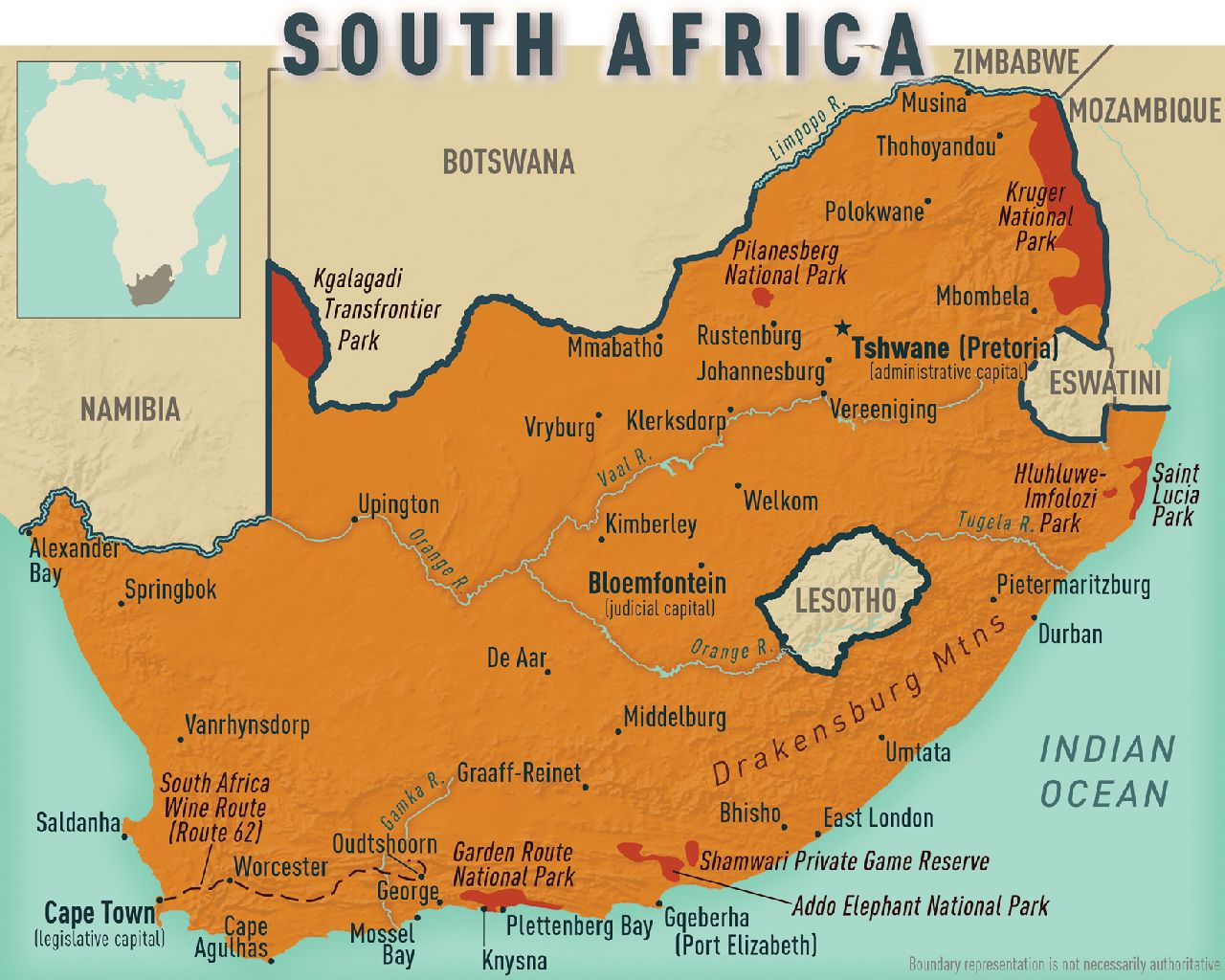
South Africa is the only country in the world with 3 capital cities. Cape Town, the seat of Parliament, is the legislative capital. The president and cabinet and most foreign embassies have their offices in the administrative capital, Tshwane (Pretoria). South Africa’s Supreme Court of Appeal is in Bloemfontein, the judicial capital. And although not considered a capital, Johannesburg, the most populous city in the country, is the seat of the Constitutional Court of South Africa.
South Africa has experienced a surge in both business and pleasure travel in the past 2 decades; visitors arrive from within the African continent as well as from North America and Europe. Business travelers typically head to the commercial centers of Cape Town, Durban, and Johannesburg. Tourist itineraries are as diverse as the country itself. From Cape Town, for example, visitors can follow the wine route of the Western Cape, exploring the many vineyards along the way, or they can drive along the spectacular coast. Going east from Cape Town, travelers can visit the southernmost point of Africa at Cape Agulhas—where the Indian and Atlantic Oceans meet in a roar of foam—and continue on to the small scenic towns of Knysna and Plettenberg Bay. South Africa is also a common destination for humanitarian aid workers, missionaries, and students. A sizable number of South Africans live outside the country; those returning home for a visit are considered VFR travelers (see Sec. 9, Ch. 9, Visiting Friends & Relatives: VFR Travel).
Game reserves located throughout the country attract many tourists (see Map 10-04). The largest, the Kruger National Park, is a world famous, highly accessible game reserve in the far northeast of the country along the border with Mozambique. KwaZulu-Natal has a fair number of game parks, including Hluhluwe Imfolozi Park and Saint Lucia, set inland from Durban; and the Eastern Cape has several parks, including Addo Elephant Park and Shamwari Private Game Reserve, easily accessed from Gqeberha (Port Elizabeth) on the southern coast. Many small, luxury game reserves have emerged to cater to high-end travelers.
Infectious Disease Risks
All travelers to South Africa should be up to date on routine vaccinations, including diphtheria-tetanus-pertussis and measles-mumps-rubella.
Enteric Infections & Diseases
Listeriosis
During 2017–2018 a very large outbreak of listeriosis was linked to a contaminated processed meat product from a single producer. The outbreak ended after the plant was closed, decontaminated, and refurbished.
Travelers’ Diarrhea
As with most destinations, the risk for travelers’ diarrhea in South Africa depends on style of travel and travelers’ food choices (see Sec. 2, Ch. 6, Travelers’ Diarrhea, and Sec. 2, Ch. 8, Food & Water Precautions). In most major cities, tap water is safe to drink, but in more rural areas, travelers should consume only bottled water. The usual spectrum of bacterial, viral, and parasitic infections exists in South Africa. Educate travelers about the prevention and self-treatment of travelers’ diarrhea.
Typhoid Fever
Sporadic cases of typhoid are reported in South Africa, but overall, the risk for this disease to travelers is low.
Respiratory Infections & Diseases
Coronavirus Disease 2019
All travelers going to South Africa should be up to date with their COVID-19 vaccines.
Influenza
Influenza viruses typically circulate during the winter months in South Africa, with peak transmission occurring during June–August. The burden of influenza in South Africa is significant, with ≈40,000 hospitalizations and ≈12,000 deaths each year. Travelers should have an influenza vaccination with the recommended Southern Hemisphere formulation, if available.
Sexually Transmitted Infections & HIV
South Africa has the largest estimated number of people living with HIV of any country in the world. The prevalence of HIV infection is ≈19% among people aged 15–49 years, and the prevalence among sex workers is considerably higher. Other sexually transmitted infections (STIs) also are present at high rates, including antimicrobial-resistant gonorrhea (ciprofloxacin resistance in 70%–80% of cases). Dual therapy with azithromycin and ceftriaxone is recommended for travelers returning from South Africa who are diagnosed with gonorrhea. Make travelers aware of the significant HIV and STI risks in South Africa and the importance of using condoms when having sex with someone whose HIV or STI status is unknown. Additionally, counsel travelers planning to engage in high-risk sexual encounters while in South Africa about preexposure prophylaxis (PrEP). For more information see Sec. 5, Part 2, Ch. 11, Human Immunodeficiency Virus / HIV; Sec. 9, Ch. 12, Sex & Travel; and Sec. 11, Ch. 10, Sexually Transmitted Infections.
Soil- & Waterborne Infections
Schistosomiasis
Schistosoma spp. parasites, found throughout Africa, can be present in any body of unchlorinated, fresh water (see Sec. 5, Part 3, Ch. 20, Schistosomiasis). Schistosoma haematobium is the dominant species in South Africa, but S. mansoni occasionally has been detected. Advise travelers to avoid swimming in lakes, streams, and along dams in Limpopo, Mpumalanga, North West, KwaZulu-Natal, the Eastern Cape, and Gauteng provinces. By contrast, the provinces of Western Cape, Northern Cape, and most of Free State are considered schistosomiasis-free.
Vectorborne Diseases
Malaria
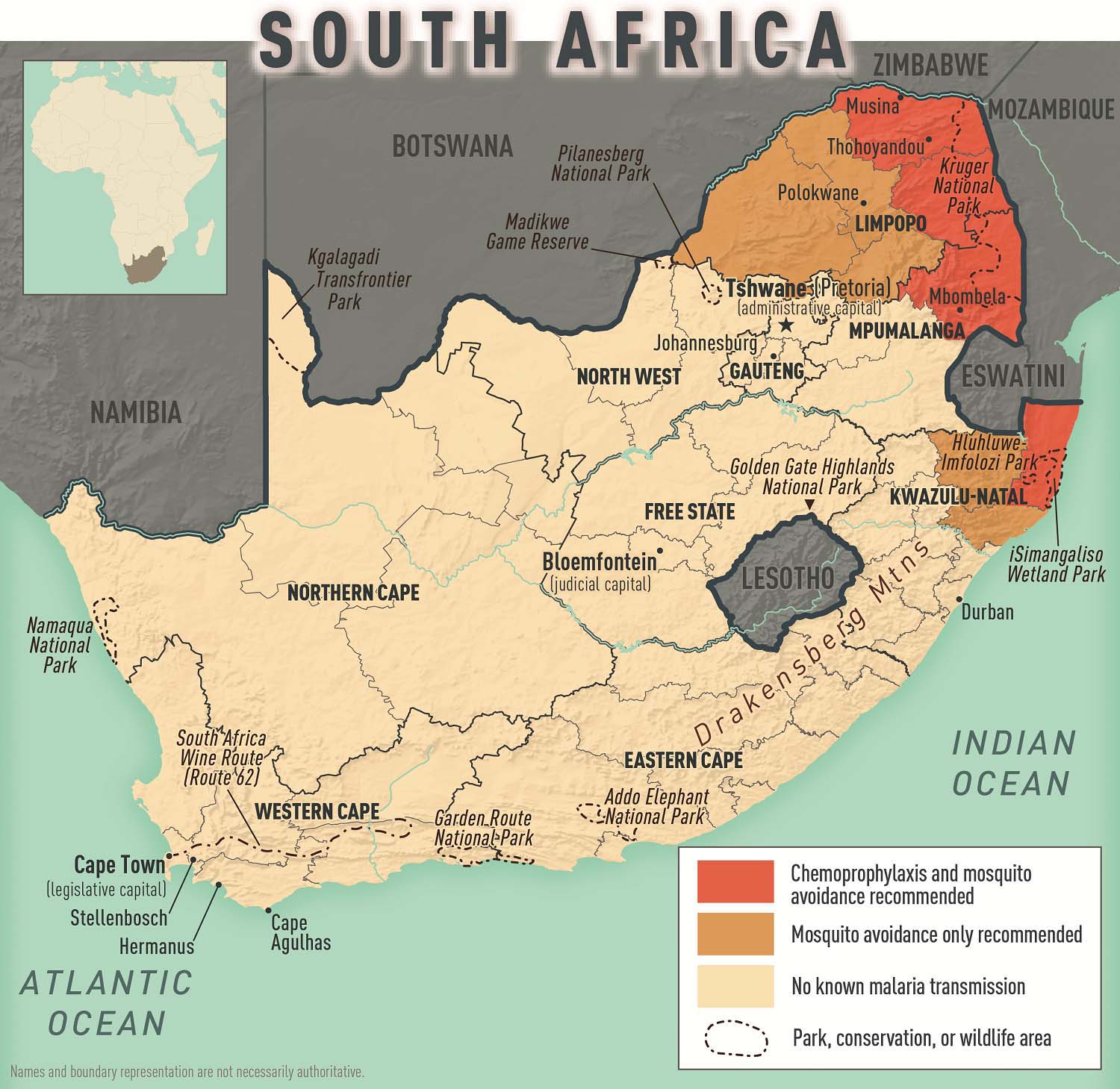
Plasmodium falciparum malaria occurs along the border with Zimbabwe and Mozambique in the Mopani and Vhembe Districts of Limpopo Province; in the Ehlanzeni District of Mpumalanga Province; and in the uMkhanyakude District of KwaZulu-Natal Province. Kruger National Park spans 2 provinces, Mpumalanga and Limpopo, and is considered endemic for malaria with seasonal transmission. Visitors to these areas should take malaria chemoprophylaxis and use mosquito bite precautions; preventing mosquito bites is the first line of defense against malaria (see Sec. 4, Ch. 6, Mosquitoes, Ticks & Other Arthropods; Sec. 5, Part 3, Ch. 16, Malaria).
In March 2017, after a seasonal malaria outbreak in Limpopo Province, the Centers for Disease Control and Prevention (CDC) received reports of malaria in the western Waterberg District, an area with historic malaria transmission. Subsequent sporadic cases have been reported there (see Sec. 2, Ch. 5, Yellow Fever Vaccine & Malaria Prevention Information, by Country).
The South African National Department of Health recommends that travelers practice mosquito avoidance year-round in malaria risk areas and take malaria chemoprophylaxis during September–May. CDC, however, recommends chemoprophylaxis at all times of the year. Artemisinin combination therapy remains effective for treatment; artemether lumefantrine is the first-line therapy for uncomplicated infection, and artesunate is widely available for severe malaria treatment. Rare cases of so-called Odyssean, “taxi,” or “suitcase” malaria have been reported in Gauteng province, likely related to relocation of infected mosquitoes from endemic areas.
Rickettsial Diseases
African tick-bite fever is common in South Africa (see Sec. 5, Part 1, Ch. 18, Rickettsial Diseases). The disease is characterized by an acute febrile illness, eschar at the bite site, regional adenopathy, and in some cases a maculopapular or petechial rash. The spectrum of illness varies from mild to, rarely, more severe disease resulting in hemorrhage and multisystem pathology. Campers and hikers in rural areas are especially at risk and should take measures to prevent tick bites (see Sec. 4, Ch. 6, Mosquitoes, Ticks & Other Arthropods). Travelers taking doxycycline for malaria chemoprophylaxis might have some protection against tick-bite fever, but no studies exist to support or refute this viewpoint. Taking doxycycline solely as prophylaxis for tick-bite fever (as opposed to taking it for malaria chemoprophylaxis) is not recommended.
Yellow Fever
There is no risk for yellow fever in South Africa.
Yellow Fever Vaccine Requirements
South Africa requires a valid International Certificate of Vaccination or Prophylaxis (ICVP) documenting yellow fever vaccination ≥10 days before arrival in South Africa for all travelers aged ≥1 year, traveling from or transiting for >12 hours through the airport of a country with risk for yellow fever virus transmission. South Africa considers a one-time dose of yellow fever vaccine (properly documented with an ICVP) to be valid for the life of the traveler. Any traveler not meeting this requirement can be refused entry to South Africa or quarantined for ≤6 days. Unvaccinated travelers presenting a medical waiver signed by a licensed health care provider are generally allowed entry.
Travelers going to, or transiting through, South Africa are advised to seek the most current information by consulting the CDC Travelers’ Health website, the websites of the US embassy and consulates in South Africa, and the embassy of South Africa in Washington, DC.
Viral Hemorrhagic Fevers
Rare cases of Crimean-Congo hemorrhagic fever have been reported in travelers visiting farms and rural areas of South Africa. It remains an occupational disease in animal health workers, farmers, and hunters.
Environmental Hazards & Risks
Animal Bites & Rabies
Rabies is endemic to South Africa and dogs are the major source for human rabies cases. The KwaZulu-Natal and Eastern Cape provinces have the highest incidence of rabies. Travelers have no way of telling whether an animal is rabid and should avoid all contact with animals. Instruct travelers to wash any bite or scratch from an animal with soap and water immediately and to see a clinician as soon as possible.
Rabies vaccine and rabies immunoglobulin are available for postexposure prophylaxis in the main centers, but access and availability will vary, and these treatments will likely be less available in rural areas. Consider preexposure rabies prophylaxis for travelers spending time in rural areas (see Sec. 4, Ch. 7, Zoonotic Exposures: Bites, Stings, Scratches & Other Hazards, and Sec. 5, Part 2, Ch. 18, Rabies). Most of the new formulations of equine rabies immune globulin (RIG) used in the South African public health system are potent, highly purified, and safe. Some private medical centers stock human RIG.
Climate & Sun Exposure
Latitude and elevation are major factors in the amount of solar ultraviolet radiation (UVR) that reaches the Earth’s surface. South Africa’s latitude spans 22°S to 34°S, and its elevation ranges from sea level to 3,482 m (≈11,500 ft), although the average height of Highveld plateau in the interior of the country is around 1,200 m (≈4000 ft). In some areas of South Africa (e.g., Durban, Pretoria), the UV index exceeds 11 in the summer months, which is considered very high. Given the frequent cloud-free skies, travelers should wear a broad-brimmed hat, sunglasses, a broad-spectrum sunscreen of ≥30 SPF on exposed skin, and sun-protective clothing to lessen the likelihood of sun damage and sun burn (see Sec. 4, Ch. 1, Sun Exposure, for more guidance).
Safety & Security
Crime
Over the past several years, South Africa has experienced a rise in violent crime, including armed robberies, car jackings, home invasions, and rape (see Sec. 4, Ch. 11, Safety & Security Overseas). Stress awareness for personal safety and security with all travelers. Travelers should also seek local guidance on appropriate security precautions to take in specific areas.
Political Unrest
In mid-2021, in the context of a struggling economy, made worse by the COVID-19 pandemic and the arrest of former President Jacob Zuma, South Africa experienced major political unrest. Violent clashes between protesters and police, along with looting, occurred primarily in metropolitan areas, especially Durban and Johannesburg.
With a significant unemployment rate, especially among youth, unrest is a perpetual threat. To stay informed and avoid being accidently caught in areas of potential unrest, travelers should enroll in the US Department of State’s Smart Traveler Enrollment Program before traveling, and follow the local news while in South Africa.
Traffic-Related Injuries
South Africa has a modern road system, which frequently leads to travel at high speeds. Drivers should be alert for dangerous driving practices, stray animals, and poor-quality roads in remote rural areas (see Sec. 8, Ch. 5, Road & Traffic Safety).
Availability & Quality of Medical Care
Although South Africa has a wide range of living standards, most visitors experience standards comparable to those in high-income countries. Fewer visitors go to rural areas or to the lower-income townships found outside most towns and cities. Adventure-seekers, hikers, and missionaries will experience a wider range of living standards. Similarly, the availability and quality of health care is variable. Middle- and upper-income South Africans have a standard of health comparable to that of North Americans, with access to private sector, world-class medical facilities, many of which also cater to an increasing number of visitors coming to South Africa for medical tourism. By contrast, many South Africans live in areas with limited amenities, experience significant disease transmission, and rely on frequently under-resourced public sector facilities for treatment.
Medical Tourism
Because of the affordable and high-quality private health sector in South Africa, medical tourism is steadily on the rise. Travelers to South Africa for medical tourism frequently access cancer treatment, cosmetic surgery, dental, fertility, or transplant services (see Sec. 6, Ch. 4, Medical Tourism).
The following authors contributed to the previous version of this chapter: Gary W. Brunette