Volume 10, Number 2—February 2004
THEME ISSUE
2004 SARS Edition
SARS Epidemiology
Introduction of SARS in France, March–April, 2003
 , Sylvie van der Werf†, Isabelle Bonmarin*, Daniel Levy-Bruhl*, Yazdan Yazdanpanah‡, Bruno Hoen§, Julien Emmanuelli*, Olivier Lesens¶, Michel Dupon#, François Natali**, Christian Michelet††, Jacques Reynes‡‡, Benoit Guery‡, Christine Larsen*, Caroline Semaille*, Yves Mouton‡, Daniel Christmann¶, Michel André**, Nicolas Escriou†, Anna Burguière†, Jean-Claude Manuguerra†, Bruno Coignard*, Agnés Lepoutre*, Christine Meffre*, Dounia Bitar*, Bénédicte Decludt*, Isabelle Capek*, Denise Antona*, Didier Che*, Magid Herida*, Andréa Infuso*, Christine Saura*, Gilles Brücker*, Bruno Hubert§§, Dominique LeGoff¶¶, and Suzanne Scheidegger##
Figure 2
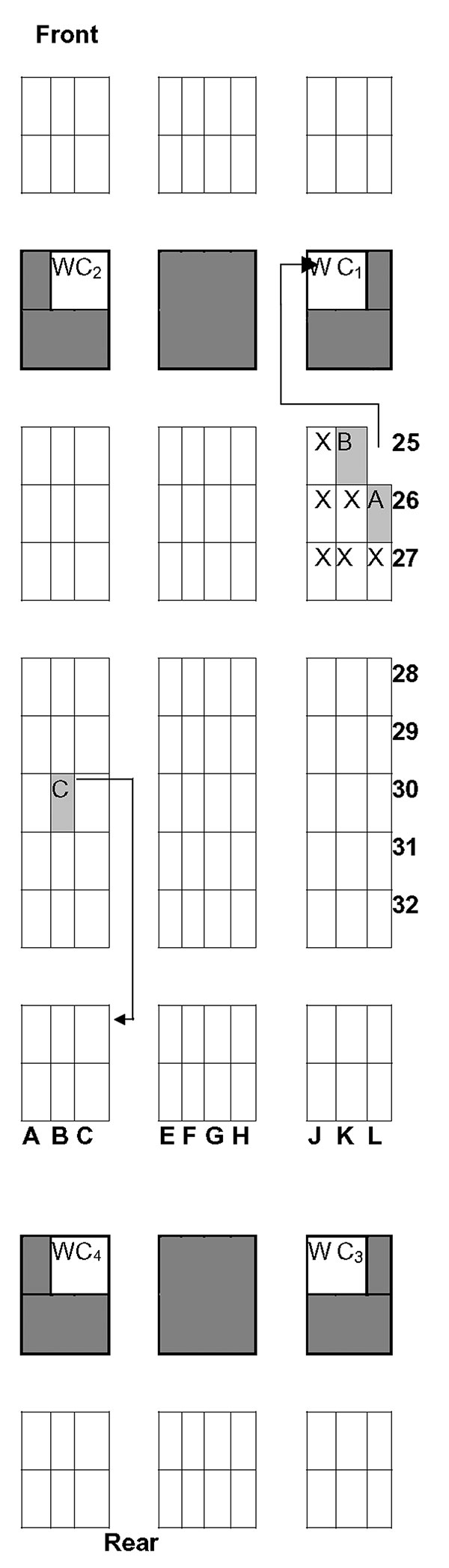
Figure 2. Seats occupied by Probable case of SARS and close contacts to patient A, Air France Flight 171, Hanoi-Paris, 22-23 March, 2003. Numbers and letters in bold indicate seat lanes and rows, respectively. Patient A occupied seat 26L (next to the window). Seats of close passengers who were followed for 10 days are indicated by an X. They included two passengers who sat in the row ahead (25K and 25J, there was no seat at 25L), two passengers who occupied seats 26K and 26J, and three passengers who sat in the row behind (27J, 27K and 27L). A row with no seats separated row 27 from row 28; a partition separated row 25 from the rest of the cabin. Consequently, passengers seated in rows 28 and 24 were excluded. The lavatories are indicated (WC). Patient A and B used the front lavatory (WC1) while patient C used the one in the back (WC4). The arrow between seat 26L and the lavatory WC1 indicates that patient A passed through the empty space between the plane wall and seat 25K where patient B was seated.