Volume 12, Number 2—February 2006
Perspective
HIV Drug-resistant Strains as Epidemiologic Sentinels
 , Robert M. Grant†, Travis C. Porco‡, and Wayne M. Getz*
Figure 2
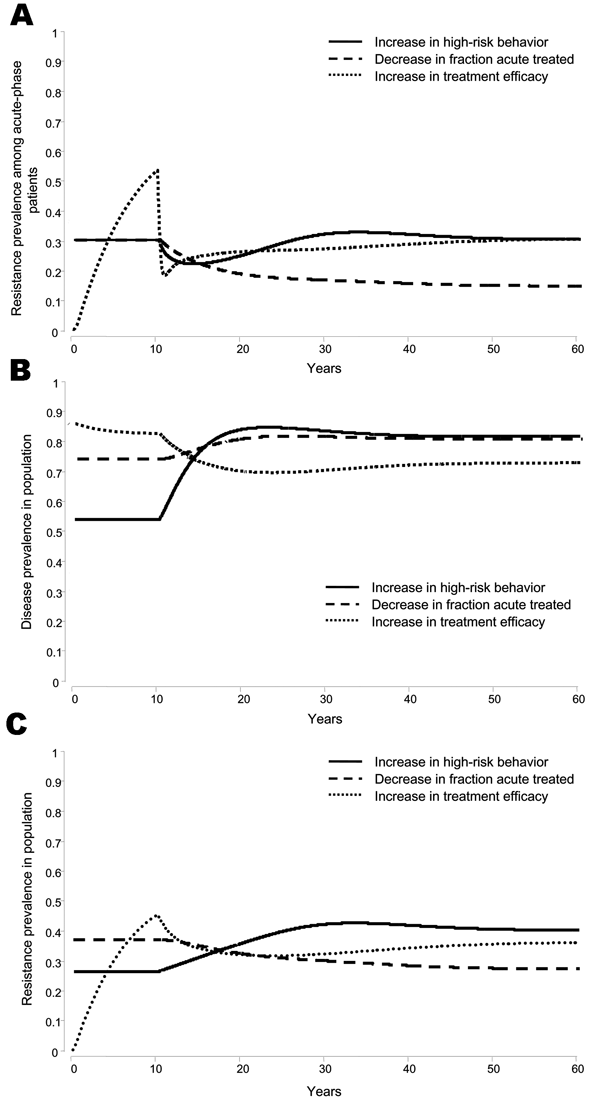
Figure 2. Time trends for A) proportion of persons in the acute phase infected with a resistant viral strain, B) disease prevalence in the population, and C) resistance prevalence in the population. At time t = 10 years we introduce a 1) increase in high-risk behavior from 2 to 4 contacts/person/year, or 2) decrease in the yearly fraction of acutely infected persons on treatment from 0.4 to 0.1, or 3) increase in treatment efficacy from monotherapy with zidovudine (AZT) to highly active antiretroviral therapy (HAART). All other parameter values and conditions are as reported by Sánchez et al. (35). At t = 0, there is 1 infected person in a population of 100,000. For the first 2 processes, we let the simulations reach equilibrium and then introduced the change. The graphs show the trajectories starting at equilibrium and the changes occurring after 10 years. The third process reconstructs San Francisco's historical time frame for the treatment regimen change. Now the epidemic runs without treatment for 30 years, monotherapy with AZT follows for 10 years, and HAART begins at t = 40. To facilitate the comparison with the first 2 processes, we graphed the dynamics of the treatment change from the moment AZT was introduced.
References
- Goudsmit J, Weverling GJ, van der Hoek L, de Ronde A, Miedema F, Coutinho RA, Carrier rate of zidovudine-resistant HIV-1: the impact of failing therapy on transmission of resistant strains. AIDS. 2001;15:2293–301. DOIPubMedGoogle Scholar
- Yerly S, Vora S, Rizzardi P, Chave JP, Vernazza PL, Flepp M, Acute HIV infection: impact on the spread of HIV and transmission of drug resistance. AIDS. 2001;15:2287–92. DOIPubMedGoogle Scholar
- de Mendoza C, del Romero J, Rodríguez C, Corral A, Soriano V. Decline in the rate of genotypic resistance to antiretroviral drugs in recent HIV seroconverters in Madrid. AIDS. 2002;16:1830–2. DOIPubMedGoogle Scholar
- Simon V, Vanderhoeven J, Hurley A, Ramratnam B, Louie M, Dawson K, Evolving patterns of HIV-1 resistance to antiretroviral agents in newly infected individuals. AIDS. 2002;16:1511–9. DOIPubMedGoogle Scholar
- Ammaranond P, Cunningham P, Oelrichs R, Suzuki K, Harris C, Leas L, No increase in protease resistance and a decrease in reverse transcriptase resistance mutations in primary HIV-1 infection: 1992–2001. AIDS. 2003;17:264–7. DOIPubMedGoogle Scholar
- Bezemer D, Jurriaans S, Prins M, van der Hoek L, Prins JM, de Wolf F, Declining trend in transmission of drug-resistant HIV-1 in Amsterdam. AIDS. 2004;18:1571–7. DOIPubMedGoogle Scholar
- Routy JP, Machouf N, Edwardes MD, Brenner BG, Thomas R, Trottier B, Factors associated with a decrease in the prevalence of drug resistance in newly HIV-1 infected individuals in Montreal. AIDS. 2004;18:2305–12. DOIPubMedGoogle Scholar
- de Mendoza C, Rodríguez C, Eiros JM, Colomina J, García F, Leiva P, Antiretroviral recommendations may influence the rate of transmission of drug-resistant HIV type 1. Clin Infect Dis. 2005;41:227–32. DOIPubMedGoogle Scholar
- Boden D, Hurley A, Zhang L, Cao Y, Guo Y, Jones E, HIV-1 drug resistance in newly infected individuals. JAMA. 1999;282:1135–41. DOIPubMedGoogle Scholar
- Harzic M, Pellegrin I, Deveau C, Chaix ML, Dubeaux B, Garrigue I, Genotypic drug resistance during HIV-1 primary infection in France (1996–1999): Frequency and response to treatment. AIDS. 2002;16:793–6. DOIPubMedGoogle Scholar
- Little SJ, Holte S, Routy JP, Daar ES, Markowitz M, Collier AC, Antiretroviral-drug resistance among patients recently infected with HIV. N Engl J Med. 2002;347:385–94. DOIPubMedGoogle Scholar
- Grant RM, Hecht FM, Warmerdam M, Liu L, Liegler T, Petropoulos CJ, Time trends in primary HIV-1 drug resistance among recently infected persons. JAMA. 2002;288:181–8. DOIPubMedGoogle Scholar
- Grant RM, Liegler T, Spotts G, Hecht FM. Declining nucleoside reverse transcriptase inhibitor primary resistance in San Francisco, 2000–2003. In: XII International HIV Drug Resistance Workshop: Basic Principles and Clinical Implications, Los Cabos, Mexico, 2003.
- Violin M, Velleca R, Cozzi-Lepri A, Riva C, Grossi PA, Carnevale G, Prevalence of HIV-1 primary drug resistance in seroconverters of the ICONA cohort over the period 1996–2001. J Acquir Immune Defic Syndr. 2004;36:761–4. DOIPubMedGoogle Scholar
- Basu P. Aggressive HIV strain sets off dubious public health measure. Nat Med. 2005;11:360. DOIPubMedGoogle Scholar
- Briones C, Perez-Olmeda M, Rodriguez C, del Romero J, Hertogs K, Soriano V. Primary genotypic and phenotypic HIV-1 drug resistance in recent seroconverters in Madrid. J Acquir Immune Defic Syndr. 2001;26:145–50. DOIPubMedGoogle Scholar
- Holodniy M, Charlebois ED, Bangsberg DR, Zolopa AR, Schulte M, Moss AR. Prevalence of antiretroviral drug resistance in the HIV-1-infected urban indigent population in San Francisco: a representative study. Int J STD AIDS. 2004;15:543–51. DOIPubMedGoogle Scholar
- Leigh Brown AJ, Frost SD, Mathews WC, Dawson K, Hellmann NS, Daar ES, Transmission fitness of drug-resistant human immunodeficiency virus and the prevalence of resistance in the antiretroviral-treated population. J Infect Dis. 2003;187:683–6. DOIPubMedGoogle Scholar
- de Mendoza C, Rodríguez C, Corral A, del Romero J, Gallego O, Soriano V. Evidence for differences in the sexual transmission efficiency of HIV strains with distinct drug resistance genotypes. Clin Infect Dis. 2004;39:1231–8. DOIPubMedGoogle Scholar
- Nowak MA, May RM. Virus dynamics: mathematical principles of immunology and virology. Oxford, UK: Oxford University Press; 2000.
- Anderson RM, Gupta S, May RM. Potential of community-wide chemotherapy or immunotherapy to control the spread of HIV-1. Nature. 1991;350:356–9. DOIPubMedGoogle Scholar
- Garnett GP, Anderson RM. Antiviral therapy and the transmission dynamics of HIV-1. J Antimicrob Chemother. 1996;37:135–50.PubMedGoogle Scholar
- Levin BR, Bull JJ, Stewart FM. The intrinsic rate of increase of HIV AIDS: Epidemiological and evolutionary implications. Math Biosci. 1996;132:69–96. DOIPubMedGoogle Scholar
- Zaric GS, Brandeau ML, Bayoumi AM, Owens DK. The effects of protease inhibitors on the spread of HIV and the development of drug-resistant HIV strains: a simulation study. Simulation. 1998;71:262–75. DOIGoogle Scholar
- Blower SM, Gershengorn HB, Grant RM. A tale of two futures: HIV and antiretroviral therapy in San Francisco. Science. 2000;287:650–4. DOIPubMedGoogle Scholar
- Blower S, Ma L, Farmer P, Koenig S. Predicting the impact of antiretrovirals in resource-poor settings: preventing HIV infections whilst controlling drug resistance. Curr Drug Targets Infect Disord. 2003;3:345–53. DOIPubMedGoogle Scholar
- Velasco-Hernández JX, Gershengorn HB, Blower SM. Could widespread use of combination antiretroviral therapy eradicate HIV epidemics? Lancet Infect Dis. 2002;2:487–93. DOIPubMedGoogle Scholar
- Blower SM, Aschenbach AN, Gershengorn HB, Kahn JO. Predicting the unpredictable: transmission of drug-resistant HIV. Nat Med. 2001;7:1016–20. DOIPubMedGoogle Scholar
- Law MG, Prestage G, Grulich A, van de Ven P, Kippax S. Modelling the effect of combination antiretroviral treatments on HIV incidence. AIDS. 2001;15:1287–94. DOIPubMedGoogle Scholar
- Law MG, Prestage G, Grulich A, van de Ven P, Kippax S. Modelling HIV incidence in gay men: increased treatment, unsafe sex and sexually transmissible infections. AIDS. 2002;16:499–501. DOIPubMedGoogle Scholar
- Clements MS, Prestage G, Grulich A, van de Ven P, Kippax S, Law MG. Modeling trends in HIV incidence among homosexual men in Australia 1995–2006. J Acquir Immune Defic Syndr. 2004;35:401–6. DOIPubMedGoogle Scholar
- Dangerfield BC, Fang YX, Roberts CA. Model-based scenarios for the epidemiology of HIV/AIDS: the consequences of highly active antiretroviral therapy. Syst Dyn Rev. 2001;17:119–50. DOIGoogle Scholar
- Blower S, Volberding P. What can modeling tell us about the threat of antiviral drug resistance? Curr Opin Infect Dis. 2002;15:609–14. DOIPubMedGoogle Scholar
- Blower SM, Aschenbach AN, Kahn JO. Predicting the transmission of drug-resistant HIV: comparing theory with data. Lancet Infect Dis. 2003;3:10–1. DOIPubMedGoogle Scholar
- Sánchez MS, Grant RM, Porco TC, Gross KL, Getz WM. A decrease in drug resistance levels of the HIV epidemic can be bad news. Bull Math Biol. 2005;67:761–82. DOIPubMedGoogle Scholar
- de Mendoza C, Martín-Carbonero L, Gallego O, Corral A, González-Lahoz J, Soriano V. Relationship between drug resistance mutations, plasma viremia, and CD4(+) T-cell counts in patients with chronic HIV infection. J Med Virol. 2005;76:1–6. DOIPubMedGoogle Scholar
- Duwe S, Brunn M, Altmann D, Hamouda O, Schmidt B, Walter H, Frequency of genotypic and phenotypic drug-resistant HIV-1 among therapy-naive patients of the German seroconverter study. J Acquir Immune Defic Syndr. 2001;26:266–73. DOIPubMedGoogle Scholar
- UK Collaborative Group on Monitoring the Transmission of HIV Drug Resistance. Analysis of prevalence of HIV-1 drug resistance in primary infections in the United Kingdom. BMJ. 2001;322:1087–8. DOIPubMedGoogle Scholar
- Weinstock HS, Zaidi I, Heneine W, Bennett D, Garcia-Lerma JG, Douglas JM, The epidemiology of antiretroviral drug resistance among drug-naive HIV-1-infected persons in 10 US cities. J Infect Dis. 2004;189:2174–80. DOIPubMedGoogle Scholar
- Chaix ML, Descamps D, Harzic M, Schneider W, Deveau C, Tamalet C, Stable prevalence of genotypic drug resistance mutations but increase in non-B virus among patients with primary HIV-1 infection in France. AIDS. 2003;17:2635–43. DOIPubMedGoogle Scholar