Volume 13, Number 3—March 2007
Dispatch
Environmental Burkholderia cepacia Complex Isolates from Human Infections
Adam Baldwin*, Eshwar Mahenthiralingam†, Pavel Drevinek†, Peter Vandamme‡, John R. Govan§, David J. Waine*, John J. LiPuma¶, Luigi Chiarini#, Claudia Dalmastri#, Deborah A. Henry**, David P. Speert**, David Honeybourne††, Martin C. J. Maiden‡‡, and Chris G. Dowson*
Figure
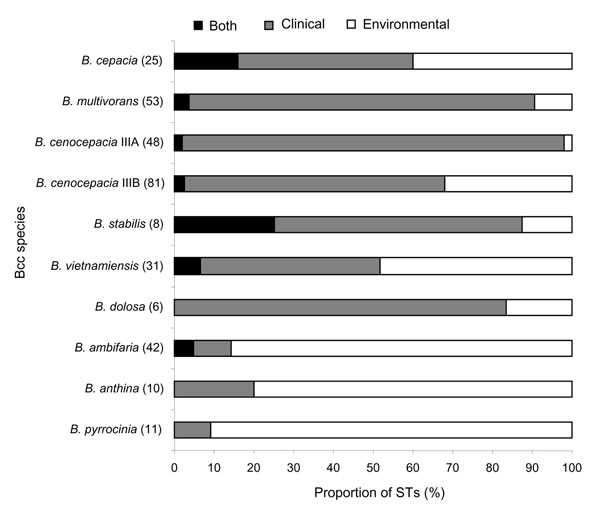
Figure. Proportion of sequence types (STs) within each Burkholderia cepacia complex (Bcc) species from clinical, environmental, or both sources. The bar chart shows the proportion of STs derived from the environment (white), clinical (gray), and both sources (black shading). The total number of STs examined for each B. cepacia species is in parentheses.
Page created: June 29, 2010
Page updated: June 29, 2010
Page reviewed: June 29, 2010
The conclusions, findings, and opinions expressed by authors contributing to this journal do not necessarily reflect the official position of the U.S. Department of Health and Human Services, the Public Health Service, the Centers for Disease Control and Prevention, or the authors' affiliated institutions. Use of trade names is for identification only and does not imply endorsement by any of the groups named above.