Volume 15, Number 10—October 2009
Dispatch
Molecular Epidemiology of Clade 1 Influenza A Viruses (H5N1), Southern Indochina Peninsula, 2004–2007
 , Mathieu Fourment, Sek Mardy, San Sorn, Davun Holl, Sowath Ly, Sirenda Vong, Vincent Enouf, J.S. Malik Peiris, and Silvie van der Werf
Figure 1
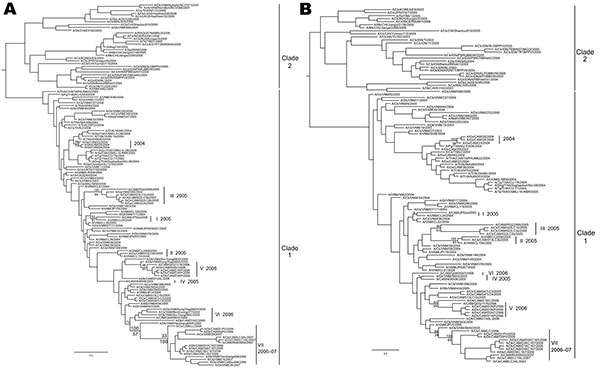
Figure 1. Phylogenetic relationships of the hemagluttinin (HA) (A) and neuraminidase (NA) (B) genes of 33 Cambodian strains and of representative influenza A viruses (H5N1). Trees were generated by Bayesian analysis using MrBayes v3.1 software (2). Numbers above and below branches indicate Bayesian posterior probability and maximum likelihood bootstrap values (PHYML v2.4 software, www.atgc-montpellier.fr/phyml), respectively. Analysis was based on nucleotides 28–1578 of the HA gene and 67 to 1248 of the NA gene. Both trees were rooted to A/goose/Guangdong/6/96. Scale bar indicates 0.3 and 0.2 substitutions per site for HA and NA genes, respectively. Dk, duck; Ck, chicken; Gs, goose; Bhg, bar headed goose; Pg, pigeon; Gh, gray heron; Ql, quail; Mall, Mallard duck; Tg, tiger; CAM, Cambodia, VNM, Vietnam, THA, Thailand, MAL, Malaysia, CHI, People’s Republic of China; TRK, Turkey; RUS, Russia, JPN, Japan. Cambodian subtype H5N1 viruses that are grouped in closely related phylogenetic sublineages and are denoted by sublineage number (arbitrarily numbered I–VII for purposes of molecular epidemiology) and these sublineages are also denoted in the map (Figure 2) to show where these viruses have found and the likely virus introduction routes. It is to be emphasized that all these viruses are within the World Health Organization (WHO) clade 1, and these sublineage numbers are not to be confused with the WHO clade/subclade nomenclature.
References
- Guindon S, Gascuel O. A simple, fast, and accurate algorithm to estimate large phylogenies by maximum likelihood. Syst Biol. 2003;52:696–704. DOIPubMedGoogle Scholar
- Huelsenbeck JP, Ronquist FR. MRBAYES: Bayesian inference of phylogenetic trees. Bioinformatics. 2001;17:754–5. DOIPubMedGoogle Scholar
- World Health Organization/World Organisation for Animal Health/Food and Agriculture Organization H5N1 Evolution Working Group. Toward a unified nomenclature system for highly pathogenic avian influenza virus (H5N1) [conference summary]. Emerg Infect Dis [serial on the Internet]. 2008 Jul [cited 2009 Sep 14]. Available from http://www.cdc.gov/EID/content/14/7/e1.htm
- Buchy P, Mardy S, Vong S, Toyoda T, Aubin JT, Miller M, Influenza A/H5N1 infections in human in Cambodia. J Clin Virol. 2007;39:164–8. DOIPubMedGoogle Scholar
- Savill NJ, St Rose SG, Keeling MJ, Woolhouse ME. Silent spread of H5N1 in vaccinated poultry. Nature. 2006;442:757. DOIPubMedGoogle Scholar
- Gilbert M, Xiao X, Pfeiffer DU, Epprecht M, Boles S, Czarnecki C, Mapping H5N1 highly pathogenic avian influenza risk in Southeast Asia. Proc Natl Acad Sci U S A. 2008;105:4769–74. DOIPubMedGoogle Scholar
- Pfeiffer DU, Minh P, Martin V, Epprecht M, Otte J. An analysis of the spatial and temporal patterns of highly pathogenic avian influenza occurrence in Vietnam using national surveillance data. Vet J. 2007;174:302–9. DOIPubMedGoogle Scholar
- Gilbert M, Chaitaweesub P, Parakamawongsa T, Premashthira S, Tiensin T, Kalpravidh W, Free-grazing ducks and highly pathogenic avian influenza, Thailand. Emerg Infect Dis. 2006;12:227–34.PubMedGoogle Scholar
- Vétérinaires Sans Frontières. Review of the poultry production and assessment of the socio-economic impact of the highly pathogenic avian influenza epidemic in Cambodia. FAO. 2004 [cited 2009 Sep 14]. Available from http://www.livestockworkinggroup.org/Documents/HPAI_Poultry/AVSF-FAO%20AI%20Review%20Cambodia%202004%20(en).pdf
- Department of Agriculture. Forestry, and Fishery Statistics, Agricultural atlas of Viet Nam. A depiction of the 2001 rural agriculture and fisheries census. 2001 [cited 2009 Sep 14]. Available from http://www.fao.org/ag/AGAInfo/programmes/en/pplpi/maps/vnm_435_poultry.pdf