Volume 4, Number 2—June 1998
Dispatch
Molecular Characterization of a Novel Rickettsia Species from Ixodes scapularis in Texas
Figure 2
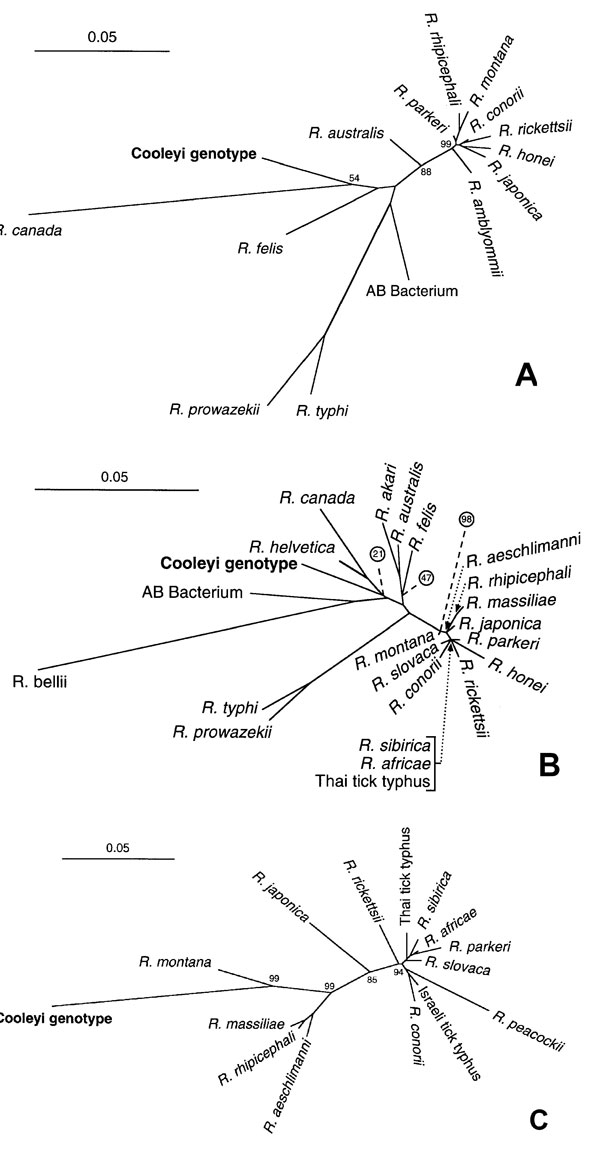
Figure 2. Unrooted phylogenetic trees showing relationship of Cooleyi genotype to other rickettsiae. Scale bar represents genetic distance of 5% by using the Jukes-Cantor formula. Bootstrap values were derived by using the Fitch algorithm. Circled bootstrap values are for nodes indicated by the dashed line. Dotted lines show the actual position of some closely related spotted fever group species. A. 17 kDa. B. gltA. C. rompA. A 10-μl aliquot of phenol:chloroform-extracted DNA was used as a template to amplify portions of four rickettsial genes: 17 kDa protein gene, gltA (citrate synthase), rickettsial outer membrane protein A (rompA), and rickettsial outer membrane protein B (rompB). In all amplification reactions, R. rickettsii DNA was used as a positive control. A 434 bp-portion of the Rickettsia genus-specific 17 kDa protein was amplified (16). A 381 bp-portion of the rickettsial gltA gene was amplified from extracted DNA by using primer pairs Rp CS.877p and Rp CS.1258n (17). A 532 bp-portion of the rickettsial rompA gene was amplified from extracted tick DNA by using primer pairs Rr190.70n and Rr190.602p (17). Primer pair BG1-21 and BG2-20 (BG-12) was used in a polymerase chain reaction (PCR) for the amplification of a 650 bp-portion of the rompB gene (18). GenBank accession numbers for the portions of the I. scapularis rickettsia 17 kDa, rompA, and gltA gene sequences are AFO31534, AFO31535, and AFO31536, respectively. GenBank accession numbers for the available 17 kDa gene sequences included in phylogenetic analyses are R. canada, M82879; R. felis, M82878; R. prowazekii, M28482; R. typhi, M28481; AB Bacterium, U04162; R. amblyommii, U11013; R. japonica, D16515; R. honei, M99391; R. rickettsii, M16486; R. conorii, M28480; R. montana, U11017; R. rhipicephali, U11020; R. parkeri, U17008; and R. australis, M74042. GenBank accession numbers for the available gltA sequences included in phylogenetic analyses are AB Bacterium, U20242; R. bellii, U59716; R. typhi, U20245; R. prowazekii, U20244; R. montana, U74756; R. slovaca, U59725; R. conorii, U20243; R. sibirica, U59734; R. africae, U59733; Thai tick typhus rickettsia, U59726; R. rickettsii, U59729; R. honei, AFO22817; R. parkeri, U59732; R. japonica, U59724; R. massiliae, U59719; R. rhipicephali, U59721; R. aeschlimanni, U74757; R. felis, U33922; R. australis, U59718; R. akari, U59717; R. canada, U20241; and R. helvetica, U59723. GenBank accession numbers for the rompA sequences included in phylogenetic analyses are R. massiliae, U43793; R. rhipicephali, U43803; R. aeschlimanni, U43800; R. conorii, U43794; Israeli tick typhus rickettsia, U43797; R. peacockii, U55821; R. slovaca, U43808; R. parkeri, U43802; R. africae, U43790; R. sibirica, U43807; Thai tick typhus rickettsia, U43809; R. rickettsii, U55822; R. japonica, U43795; and R. montana, U43801.
References
- Neibylski ML, Schrumpf ME, Burgdorfer W, Fischer ER, Gage KL, Schwan TG. Rickettsia peacockii sp. nov., a new species infecting wood ticks, Dermacentor andersoni, in Western Montana. Int J Syst Bacteriol. 1997;47:446–52. DOIPubMedGoogle Scholar
- Burgdorfer W, Hayes SF, Marvos AJ. Nonpathogenic rickettsiae in Dermacentor andersoni: a limiting factor for the distribution of Rickettsia rickettsii. In: Burgdorfer W, Anacker RL, editors. Rickettsiae and rickettsial diseases. New York: Academic Press, Inc.; 1981; p. 585.
- Loving SM, Smith AB, DiSalvo AF, Burgdorfer WB. Distribution and prevalence of spotted fever group rickettsiae in ticks from South Carolina, with an epidemiological survey of persons bitten by infected ticks. Am J Trop Med Hyg. 1978;27:1255–60.PubMedGoogle Scholar
- Magnarelli LA, Anderson JF, Philip RN, Burgdorfer W. Antibodies to spotted fever-group rickettsiae in dogs and prevalence of infected ticks in southern Connecticut. Am J Vet Res. 1982;43:656–9.PubMedGoogle Scholar
- Elliott LB, Fournier PV, Teltow GJ. Rickettsia in Texas. Ann N Y Acad Sci. 1990;590:221–6. DOIPubMedGoogle Scholar
- Magnarelli LA, Andreadis TG, Stafford KC, Holland CJ. Rickettsiae and Borrelia burgdorferi in ixodid ticks. J Clin Microbiol. 1991;29:2798–804.PubMedGoogle Scholar
- Taylor JB, Tanner WB, Rawlings JA, Buck J, Elliott LB, Dewlett HJ, Serological evidence of subclinical Rocky Mountain spotted fever in Texas. J Infect Dis. 1985;151:367–8.PubMedGoogle Scholar
- Noda H, Munderloh UG, Kurtii TJ. Endosymbionts of ticks and their relationship to Wolbachia spp. and tick-borne pathogens of human and animals. Appl Environ Microbiol. 1997;63:3926–32.PubMedGoogle Scholar
- Hebert AG, Tzianabos T, Gamble WC, Chappell WA. Development and characterization of high-titered, group-specific fluorescent-antibody reagents for direct identification of rickettsiae in clinical specimens. J Clin Microbiol. 1980;11:503–7.PubMedGoogle Scholar
- Sambrook J, Fritsch EF, Maniatis T. Molecular cloning. A Laboratory Manual. Cold Spring Harbor (NY): Cold Spring Harbor Laboratory Press; 1989.
- Devereux J, Haeberli P, Smithies O. A comprehensive set of sequence analysis programs for the VAX. Nucleic Acids Res. 1984;12:387–95. DOIPubMedGoogle Scholar
- Swofford DL. PAUP: phylogenetic analysis using parsimony [computer program]. Version 3.0. Champaign (IL): Illinois Natural History Survey; 1991.
- Felsenstein J. PHYLIP (Phylogeny Inference Package [computer program]). Version 3.5p. Seattle: Department of Genetics, University of Washington; 1993.
- Jukes TH, Cantor CR. Evolution of protein molecules. In: Munro HN, editor. Mammalian protein metabolism. New York: Academic Press; 1969; p. 21-132.
- Webb L, Carl M, Malloy DC, Dasch GA, Azad AF. Detection of murine typhus infection in fleas by using the polymerase chain reaction. J Clin Microbiol. 1990;28:530–4.PubMedGoogle Scholar
- Regnery RL, Spruill CL, Plikaytis BD. Genotypic identification of rickettsiae and estimation of intraspecies sequence divergence for portions of two rickettsial genes. J Bacteriol. 1991;173:1576–89.PubMedGoogle Scholar
- Eremeeva M, Yu X, Raoult D. Differentiation among spotted fever group rickettsiae species by analysis of restriction fragment length polymorphism of PCR-amplified DNA. J Clin Microbiol. 1994;32:803–10.PubMedGoogle Scholar
- Beati L, Peter O, Burgdorfer W, Aeschlimann A, Raoult D. Confirmation that Rickettsia helvetica sp. nov. is a distinct species of the spotted fever group of rickettsiae. Int J Syst Bacteriol. 1993;43:521–6. DOIPubMedGoogle Scholar