Volume 6, Number 6—December 2000
Dispatch
Mass Die-Off of Caspian Seals Caused by Canine Distemper Virus
Seamus Kennedy* , Thijs Kuiken†, Paul D. Jepson‡, Robert Deaville‡, Morag Forsyth§, Tom Barrett§, Marco W.G. van de Bildt†, Albert D.M.E. Osterhaus†, Tariel Eybatov¶, Callan Duck#, Aidyn Kydyrmanov**, Igor Mitrofanov††, and Susan Wilson‡‡
, Thijs Kuiken†, Paul D. Jepson‡, Robert Deaville‡, Morag Forsyth§, Tom Barrett§, Marco W.G. van de Bildt†, Albert D.M.E. Osterhaus†, Tariel Eybatov¶, Callan Duck#, Aidyn Kydyrmanov**, Igor Mitrofanov††, and Susan Wilson‡‡
Figure 1
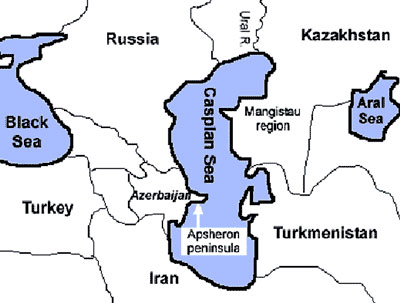
Figure 1. Map of the Caspian Sea region. Seal samples were collected from Kazakhstan, Turkmenistan, and the Apsheron peninsula, Azerbaijan.
Page created: December 17, 2010
Page updated: December 17, 2010
Page reviewed: December 17, 2010
The conclusions, findings, and opinions expressed by authors contributing to this journal do not necessarily reflect the official position of the U.S. Department of Health and Human Services, the Public Health Service, the Centers for Disease Control and Prevention, or the authors' affiliated institutions. Use of trade names is for identification only and does not imply endorsement by any of the groups named above.