Volume 10, Number 3—March 2004
Research
Genomic Changes of Chagas Disease Vector, South America
 , Jean Pierre Dujardin†, Paula Nicolini*, María Noel Caraccio*, Virginia Rose*, Tatiana Tellez‡, Hernán Bermúdez‡, María Dolores Bargues§, Santiago Mas-Coma§, José Enrique O’Connor§, and Ruben Pérez*
Figure 2
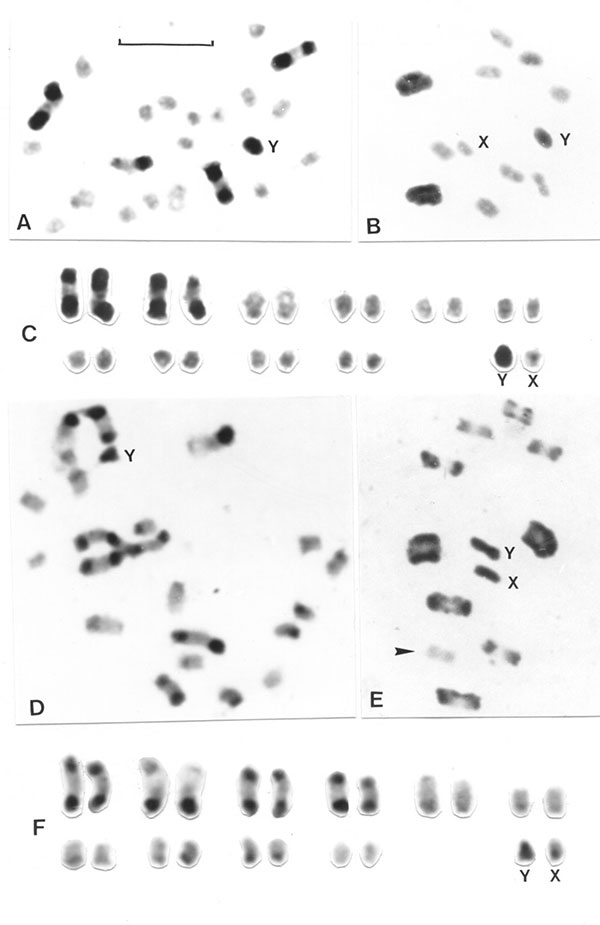
Figure 2. Representative C-banding patterns observed in male Triatoma infestans: 2n = 22 (20 autosomes plus XY in males/ XX females) coming from non-Andean (A-C) and Andean regions (D-F). Scale bar = 10 μm. A: Spermatogonial mitotic prometaphase. This specimen from Argentina presents the lowest number of C-banded autosomes (four chromosomes). B: First meiotic metaphase. Only two heterochromatic bivalents, formed by the pairing of the four C-banded autosomes showed in 2A, are observed. The Y (heterochromatic) and X (euchromatic) chromosomes appear as univalents, as typically observed in hemipteran insects. C: Karyotype obtained from 2A. Heterochromatic C-bands are clearly detected in four autosomes and in the Y sex chromosome. D: Mitotic prometaphase in male specimen from Andean Bolivia. Almost all chromosomes present C-bands in one or both chromosomal ends. E: First meiotic metaphase of the same insect shown in 2D. All bivalents except one (arrowhead) are formed by chromosome with C-bands. As observed in other hemipterans, the bivalents form a ring with the univalent sex chromosomes (X and Y) in the center. F: Karyotype obtained from 2D. Chromosome size and C-banding pattern are clearly different from those observed in 2C. Heterochromatic blocks are localized in most autosomes and in both sex chromosomes.