Volume 10, Number 5—May 2004
Research
Endemic Venezuelan Equine Encephalitis in Northern Peru
Patricia V. Aguilar*, Ivorlyne P. Greene*, Lark L. Coffey*, Gladys Medina*1, Abelardo C. Moncayo*2, Michael Anishchenko*, George V. Ludwig†, Michael J. Turell‡, Monica L. O’Guinn‡, John Lee‡, Robert B. Tesh*, Douglas M. Watts†, Kevin L. Russell†, Christine Hice*, Stephen Yanoviak*, Amy C. Morrison§, Terry A. Klein‡, David J. Dohm‡, Hilda Guzman*, Amelia P.A. Travassos da Rosa*, Carolina Guevara†, Tadeusz J. Kochel†, James Olson†, Cesar Cabezas¶, and Nikos Vasilakis*
Figure 1
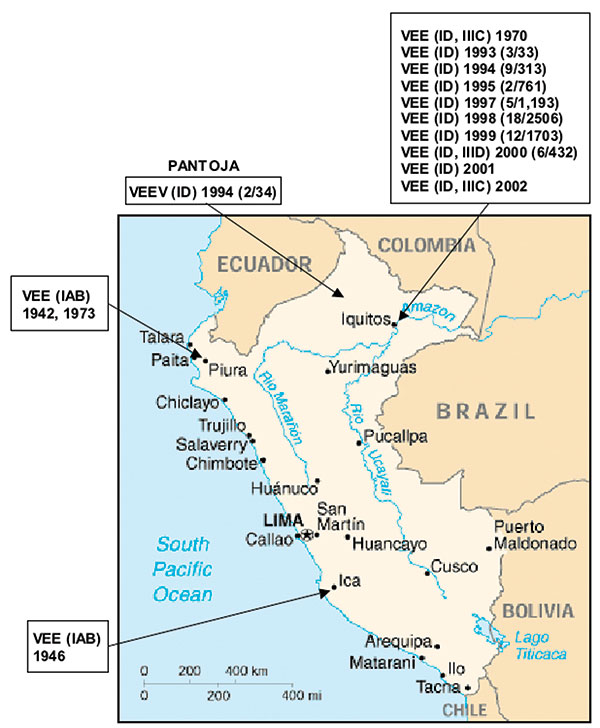
Figure 1. Map of Peru showing the geographic distribution of the Venezuelan equine encephalitis virus (VEEV) complex isolates included in the study. Numbers in parenthesis indicate the number of isolates compared to the total number of febrile cases during the year. ID, IAB, IIIC, IIID correspond to VEEV subtypes isolated during the indicated year.
1Current affiliation is Instituto Venezolano de Investigaciones Científicas, Caracas, Venezuela.
2Current affiliation is Department of Biological Sciences, Ohio Northern University, Ada, Ohio.
Page created: February 22, 2011
Page updated: February 22, 2011
Page reviewed: February 22, 2011
The conclusions, findings, and opinions expressed by authors contributing to this journal do not necessarily reflect the official position of the U.S. Department of Health and Human Services, the Public Health Service, the Centers for Disease Control and Prevention, or the authors' affiliated institutions. Use of trade names is for identification only and does not imply endorsement by any of the groups named above.