Evolutionary Relationships between Bat Coronaviruses and Their Hosts
Jie Cui*†
1, Naijian Han‡
1, Daniel Streicker§, Gang Li‡, Xianchun Tang*, Zhengli Shi¶, Zhihong Hu¶, Guoping Zhao#, Arnaud Fontanet**, Yi Guan††, Linfa Wang‡‡, Gareth Jones§§, Hume E. Field¶¶, Shuyi Zhang*

, and Peter Daszak##
Author affiliations: *East China Normal University, Shanghai, People’s Republic of China; †Hebei Normal University, Hebei, People’s Republic of China; ‡Chinese Academy of Sciences, Beijing, People’s Republic of China; §University of Georgia, Athens, Georgia, USA;; ¶Wuhan Institute of Virology, Wuhan, People’s Republic of China; #Shanghai Institutes of Biological Sciences, Shanghai, People’s Republic of China; **Insitut Pasteur, Paris, France; ††University of Hong Kong, Hong Kong Special Administrative Region, People’s Republic of China; ‡‡Australian Animal Health Laboratory, Geelong, Victoria, Australia; §§University of Bristol, Bristol, United Kingdom; ¶¶Department of Primary Industries and Fisheries, Yeerongpilly, Queensland, Australia; ##Consortium for Conservation Medicine, New York, New York, USA;
Main Article
Figure 4
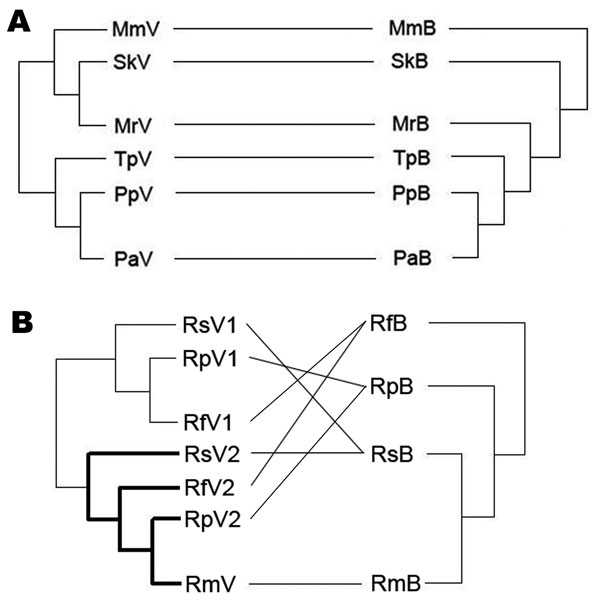
Figure 4. Phylogenetic relationships between coronaviruses (CoVs) (left) and bats (right) in the A) Vespertilionidae and B) Rhinolophidae. Abbreviations on both sides denote viruses harbored by bats (marked as V on the left) and bats (marked as B on the right). Mm, Miniopterus magnater; Sk, Scotophilus kuhlii; Mr, Myotis ricketti; Tp, Tylonycteris pachypus; Pp, Pipistrellus pipistrellus; Pa, P. abramus; Rs, Rhinolophus sinicus; Rf, R. ferrumequinum; Rp, R. pearsoni; Rm, R. macrotis. Boldface branches in panel B contain severe acute respiratory syndrome–like CoVs reported. Lines between bat and virus trees were added to help visualize congruence or incongruence. Although this figure implies differences in propensity for host shifts between these families, all but 1 of the vespertilionid CoVs are from different genera, whereas all rhinolophid CoVs are from the same genera, which make meaningful comparisons difficult. Overall mean genetic differences are much greater between vespertilionid species than between rhinolophid species.
Main Article
Page created: July 02, 2010
Page updated: July 02, 2010
Page reviewed: July 02, 2010
The conclusions, findings, and opinions expressed by authors contributing to this journal do not necessarily reflect the official position of the U.S. Department of Health and Human Services, the Public Health Service, the Centers for Disease Control and Prevention, or the authors' affiliated institutions. Use of trade names is for identification only and does not imply endorsement by any of the groups named above.