Volume 13, Number 9—September 2007
Dispatch
Risk Factors for Hantavirus Infection in Germany, 2005
Muna Abu Sin*, Klaus Stark*, Ulrich van Treeck†, Helga Dieckmann‡, Helmut Uphoff§, Wolfgang Hautmann¶, Bernhard Bornhofen#, Evelin Jensen**, Günter Pfaff††, and Judith Koch*
Figure 2
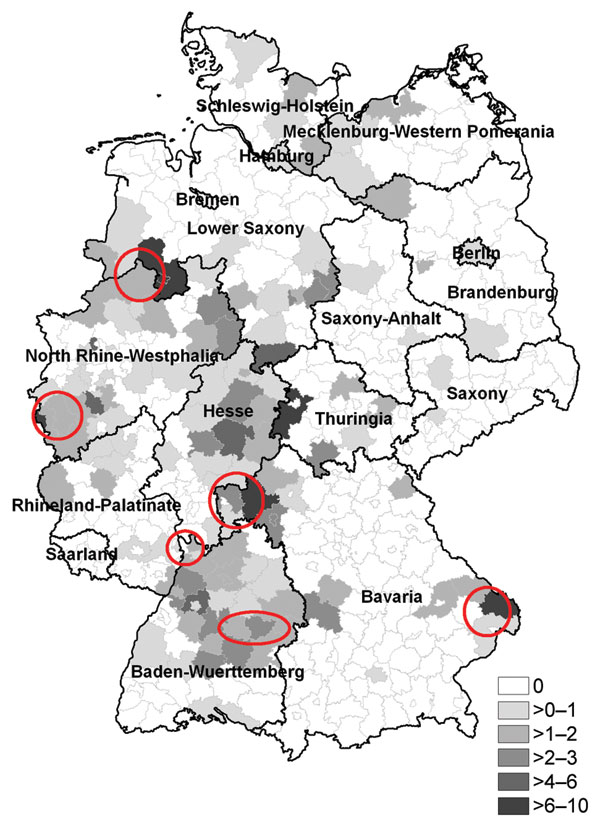
Figure 2. Incidences of reported hantavirus infections per 100,000 inhabitants by administrative district, Germany, 2005. Circles represent areas in which hantaviruses were known to be endemic.
Page created: July 01, 2010
Page updated: July 01, 2010
Page reviewed: July 01, 2010
The conclusions, findings, and opinions expressed by authors contributing to this journal do not necessarily reflect the official position of the U.S. Department of Health and Human Services, the Public Health Service, the Centers for Disease Control and Prevention, or the authors' affiliated institutions. Use of trade names is for identification only and does not imply endorsement by any of the groups named above.