Volume 14, Number 10—October 2008
Research
Risk Factors for Nipah Virus Encephalitis in Bangladesh1
Joel M. Montgomery2 , Mohamed J. Hossain, E. Gurley, D.S. Carroll, A. Croisier, E. Bertherat, N. Asgari, P. Formenty, N. Keeler, J. Comer, M.R. Bell, K. Akram, A.R. Molla, K. Zaman, Mohamed R. Islam, K. Wagoner, J.N. Mills, P.E. Rollin, T.G. Ksiazek, and R.F. Breiman
, Mohamed J. Hossain, E. Gurley, D.S. Carroll, A. Croisier, E. Bertherat, N. Asgari, P. Formenty, N. Keeler, J. Comer, M.R. Bell, K. Akram, A.R. Molla, K. Zaman, Mohamed R. Islam, K. Wagoner, J.N. Mills, P.E. Rollin, T.G. Ksiazek, and R.F. Breiman
Figure 2
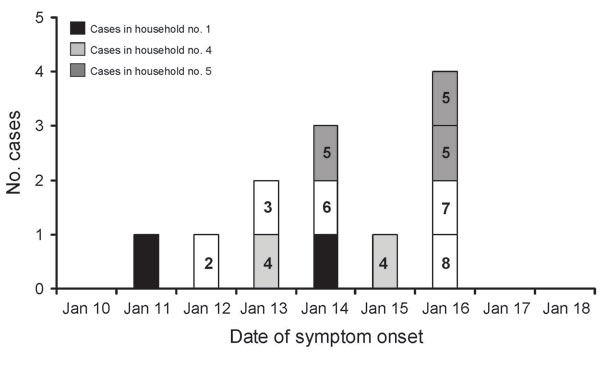
Figure 2. Epidemic curve of Nipah virus outbreak in Goalando, Bangladesh, in 2004, demonstrating household clustering. Households 1 and 4 each had 2 cases, household 5 had 3 cases, and all other households, single cases.
1Presented in part at the 54th Annual Meeting of the American Society of Tropical Medicine and Hygiene, 2004 Nov 7–11, Miami, Florida, USA.
Page created: July 13, 2010
Page updated: July 13, 2010
Page reviewed: July 13, 2010
The conclusions, findings, and opinions expressed by authors contributing to this journal do not necessarily reflect the official position of the U.S. Department of Health and Human Services, the Public Health Service, the Centers for Disease Control and Prevention, or the authors' affiliated institutions. Use of trade names is for identification only and does not imply endorsement by any of the groups named above.