Volume 15, Number 4—April 2009
THEME ISSUE
The Amazon Region
Research
Human Febrile Illness Caused by Encephalomyocarditis Virus Infection, Peru
Figure 2
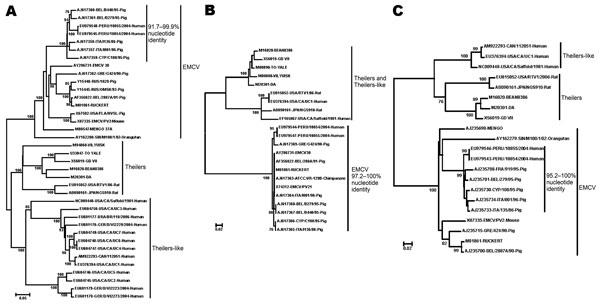
Figure 2. Phylogenetic relationships among viruses detected in Peru and other encephalomyocarditis viruses (EMCVs), and their relationship to the Theiler and Theiler-like cardioviruses. A) Viral protein 1 (VP1); 737 nucleotides (90% of the VP1 gene). The missing portion of the VP1 gene is at the 3’ end. B) 5′ nontranslated region; 145 nucleotides consisting of a highly conserved portion of the internal ribosome entry site, sequence coordinates 558 to 699 relative to EMCV GenBank accession no. AX786477. C) 3D; 210 nucleotides (15% of the 3D gene). The use of this portion of the 3D gene for phylogenetic analysis has been described elsewhere (25). Phylogenies were reconstructed with the neighbor-joining method implemented in ClustalX version 1.83 (27). Genetic distances were estimated by the Kimura 2-parameter method. To assess the confidence of branching patterns, 1,000 bootstrap replicates were performed. Cardioviruses are identified by GenBank accession number and strain name; when available, complete virus information is given, using the following convention: GenBank accession number, country of origin/strain name/year of isolation-host species. Country abbreviations: BEL, Belgium; BRA, Brazil; CAN, Canada; CYP, Cyprus; FRA, France; GER, Germany; GRE, Greece; ITA, Italy; JPN, Japan; RUS, Russia; SIN, Singapore; USA, United States. Scale bars indicate number of nucleotide substitutions per site.
References
- Tesh RB, Wallace GD. Observations on the natural history of encephalomyocarditis virus. Am J Trop Med Hyg. 1978;27:133–43.PubMedGoogle Scholar
- Grobler DG, Raath JP, Braack LE, Keet DF, Gerdes GH, Barnard BJ, An outbreak of encephalomyocarditis-virus infection in free-ranging African elephants in the Kruger National Park. Onderstepoort J Vet Res. 1995;62:97–108.PubMedGoogle Scholar
- Helwig FC, Schmidt CH. A filter-passing agent producing interstitial myocarditis in anthropoid apes and small animals. Science. 1945;102:31–3. DOIPubMedGoogle Scholar
- Hubbard GB, Soike KF, Butler TM, Carey KD, Davis H, Butcher WI, An encephalomyocarditis virus epizootic in a baboon colony. Lab Anim Sci. 1992;42:233–9.PubMedGoogle Scholar
- Reddacliff LA, Kirkland PD, Hartley WJ, Reece RL. Encephalomyocarditis virus infections in an Australian zoo. J Zoo Wildl Med. 1997;28:153–7.PubMedGoogle Scholar
- Roca-Garcia M, Sanmartin-Barber C. The isolation of encephalomyocarditis virus from Aotus monkeys. Am J Trop Med Hyg. 1957;6:840–52.PubMedGoogle Scholar
- Jones P, Mahamba C, Rest J, André C. Fatal inflammatory heart disease in a bonobo (Pan paniscus). J Med Primatol. 2005;34:45–9. DOIPubMedGoogle Scholar
- Murnane TG, Craighead JE, Mondragon H, Shelokov A. Fatal disease of swine due to encephalomyocarditis virus. Science. 1960;131:498–9. DOIPubMedGoogle Scholar
- Seaman JT, Boulton JG, Carrigan MJ. Encephalomyocarditis virus disease of pigs associated with a plague of rodents. Aust Vet J. 1986;63:292–4. DOIPubMedGoogle Scholar
- Dick GWA, Best AM, Haddow AJ, Smithburn KC. Mengo encephalomyelitis, a hitherto unknown virus affecting man. Lancet. 1948;252:286–9. DOIGoogle Scholar
- Gajdusek DC. Encephalomyocarditis virus infection in childhood. Pediatr. 1955;16:902–6.
- Verlinde JD, Tongeren V. Human infection with viruses of the Columbia SK group. Arch Gesamte Virusforsch. 1953;5:217–27. DOIPubMedGoogle Scholar
- Jones MS, Lukashov VV, Ganac RD, Schnurr DP. Discovery of a novel human picornavirus in a stool sample from a pediatric patient presenting with fever of unknown origin. J Clin Microbiol. 2007;45:2144–50. DOIPubMedGoogle Scholar
- Abed Y, Boivin G. New Saffold cardioviruses in 3 children, Canada. Emerg Infect Dis. 2008;14:834–6. DOIPubMedGoogle Scholar
- Drexler JF, Luna LK, Stöcker A, Silva Almeida PS, Medrado Ribeiro TC, Petersen N, Circulation of 3 lineages of a novel human Saffold cardiovirus in humans. Emerg Infect Dis. 2008;14:1398–405. DOIPubMedGoogle Scholar
- Chiu CY, Greninger AL, Kanada K, Kwok T, Fisher KF, Runckel C, Identification of cardioviruses related to Theiler's murine encephalomyelitis virus in human infections. Proc Natl Acad Sci U S A. 2008;105:14124–9. DOIPubMedGoogle Scholar
- Jonkers AH. Serosurvey of encephalomyocarditis virus neutralizing antibodies in southern Louisiana and Peruvian Indian populations. Am J Trop Med Hyg. 1961;10:593–8.PubMedGoogle Scholar
- Jungblut CW, Bautista G Jr. Antibodies against Col-SK virus in Mexican sera. Am J Trop Med Hyg. 1954;3:466–74.PubMedGoogle Scholar
- Gajdusek DC, Rogers NG. Specific serum antibodies to infectious disease agents in Tarahumara Indian adolescents of northwestern Mexico. Pediatr. 1955;16:819–35.
- Seligmann E, Jungblut CW. Neutralization of SK murine poliomyelitis virus and of Theiler's virus of mouse encephalomyelitis by human sera. Am J Public Health. 1943;33:1326–32. DOIGoogle Scholar
- Smithburn KC. Neutralizing antibodies against certain recently isolated viruses in the sera of human beings residing in East Africa. J Immunol. 1952;69:223–34.PubMedGoogle Scholar
- Tesh RB. The prevalence of encephalomyocarditis virus neutralizing antibodies among various human populations. Am J Trop Med Hyg. 1978;27:144–9.PubMedGoogle Scholar
- Gubler DJ, Kuno G, Sather GE, Velez M, Oliver A. Mosquito cell cultures and specific monoclonal antibodies in surveillance for dengue viruses. Am J Trop Med Hyg. 1984;33:158–65.PubMedGoogle Scholar
- Koenen F, Vanderhallen H, Dickenson ND, Knowles NJ. Phylogenetic analysis of European encephalomyocarditis viruses: comparison of two genomic regions. Arch Virol. 1999;144:893–903. DOIPubMedGoogle Scholar
- Thompson JD, Gibson TJ, Plewniak F, Jeanmougin F, Higgins DG. The ClustalX windows interface: flexible strategies for multiple sequence alignment aided by quality analysis tools. Nucleic Acids Res. 1997;25:4876–82. DOIPubMedGoogle Scholar
- Sutter RW, Pallansch MA, Sawyer LA, Cochi SL, Hadler SC. Defining surrogate serologic tests with respect to predicting protective vaccine efficacy: poliovirus vaccination. Ann N Y Acad Sci. 1995;754:289–99. DOIPubMedGoogle Scholar
- Finney DJ. Statistical methods in biological assays. 2nd ed. New York: Hafner Publishing; 1964.
- Kuno G, Gomez I, Gubler DJ. Detecting artificial anti-dengue IgM immune complexes using an enzyme-linked immunosorbent assay. Am J Trop Med Hyg. 1987;36:153–9.PubMedGoogle Scholar
- Bienz K, Egger D, Pasamontes L. Association of polioviral proteins of the P2 genomic region with the viral replication complex and virus-induced membrane synthesis as visualized by electron microscopic immunocytochemistry and autoradiography. Virology. 1987;160:220–6. DOIPubMedGoogle Scholar
- Hirasawa K, Takeda M, Matsuzaki H, Doi K. Encephalomyocarditis (EMC) virus-induced orchitis in Syrian hamsters. Int J Exp Pathol. 1991;72:617–22.PubMedGoogle Scholar
- Altman R. Clinical aspects of enterovirus infection. Postgrad Med. 1964;35:451–9.PubMedGoogle Scholar
- Harb JM, Hiramoto Y, Burch GE. Phagocytosis of injured hepatocytes following inoculation with encephalomyocarditis virus. Exp Mol Pathol. 1974;20:199–207. DOIPubMedGoogle Scholar
- Thoren A, Robinson AJ, Maguire T, Jenkins R. Two-step PCR in the retrospective diagnosis of enteroviral viraemia. Scand J Infect Dis. 1992;24:137–41. DOIPubMedGoogle Scholar
- Prather SL, Dagan R, Jenista JA, Menegus MA. The isolation of enteroviruses from blood: a comparison of four processing methods. J Med Virol. 1984;14:221–7. DOIPubMedGoogle Scholar