Volume 15, Number 6—June 2009
Dispatch
Phocine Distemper Virus in Northern Sea Otters in the Pacific Ocean, Alaska, USA
 , Jonna A.K. Mazet, Verena A. Gill, Angela M. Doroff, Kathy A. Burek, and John A. Hammond1
Figure 1
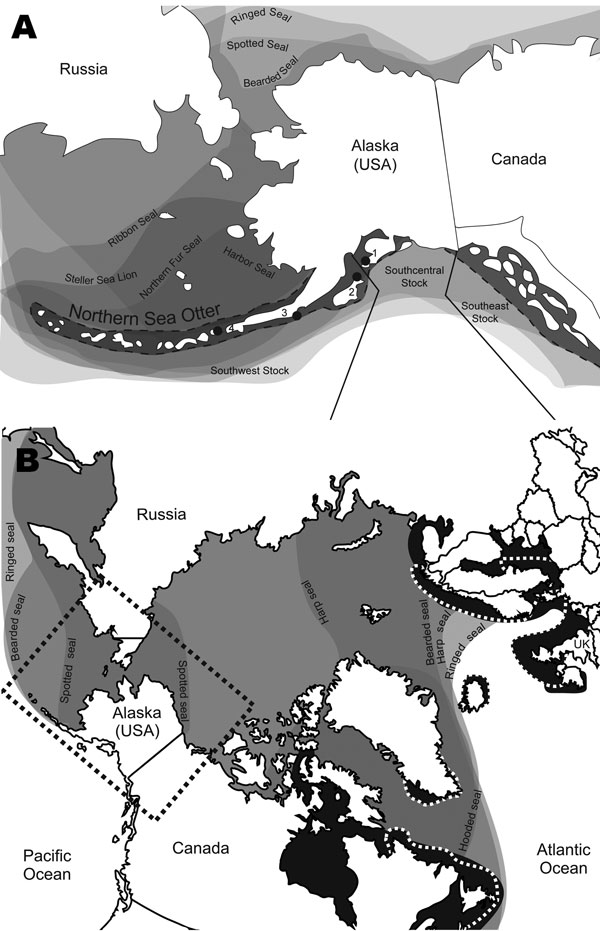
Figure 1. Distribution of Arctic and sub-Arctic pinnipeds in relation to Arctic ice coverage representing a unique area where distribution ranges of multiple seal species overlap (7,8). A) North Pacific Ocean region showing the range of the northern sea otter (Enhydra lutris kenyoni) in Alaska, its population stock delineations, and sample collection locations for the study. 1, Kachemak Bay; 2, Kodiak Archipelago; 3, South Alaska Peninsula; 4, Fox Island; seal species ranges overlap. This overlap indicates potential for phocine distemper virus disease transmission among Arctic and sub-Arctic pinniped species in this highly productive region. B) Circumpolar Arctic region showing species overlap among Arctic pinnipeds and the potential for disease transmission from the Atlantic Ocean through the Arctic Ocean to Alaska (outlined) by migrating seal species. The black areas indicate ranges of Atlantic harbor and gray seals; the areas exclusive to gray seal are bordered with a broken line. The boxed region corresponds to the Arctic region containing sea otter populations shown in panel A.
References
- Harkonen T, Dietz R, Reijnders P, Teilmann J, Harding K, Hall A, The 1988 and 2002 phocine distemper virus epidemics in European harbour seals. Dis Aquat Organ. 2006;68:115–30. DOIPubMedGoogle Scholar
- Duignan PJ, Sadove S, Saliki JT, Geraci JR. Phocine distemper in harbor seals (Phoca vitulina) from Long Island, New York. J Wildl Dis. 1993;29:465–9.PubMedGoogle Scholar
- Zarnke RL, Saliki JT, Macmillan AP, Brew SD, Dawson CE, Ver Hoef JM, Serologic survey for Brucella spp., phocid herpesvirus-1, phocid herpesvirus-2, and phocine distemper virus in harbor seals from Alaska, 1976–1999. J Wildl Dis. 2006;42:290–300.PubMedGoogle Scholar
- Burek KA, Gulland FMD, Sheffield G, Beckmen KB, Keyes E, Spraker TR, Infectious disease and the decline of Steller sea lions (Eumetopias jubatus) in Alaska, USA: insights from serologic data. J Wildl Dis. 2005;41:512–24.PubMedGoogle Scholar
- York AE. Status, biology, and ecology of fur seals. In: Proceedings of an International Symposium and Workshop. Croxall JP, Gentry RL, editors. Seattle, Washington. Washington: National Oceanic Atmospheric Administration. Tech Rep NMFS 51; 1987. p. 9–21.
- Small RJ, Boveng PL, Byrd VG, Withrow DE. Harbor seal population decline in the Aleutian Archipelago. Mar Mamm Sci. 2008;24:845–63.
- US Fish and Wildlife Service. Stock assessment for sea otters (Enhydra lutris): Southwest Alaska stock. In: Marine mammal protection act stock assessment report 8. Washington: The Service; 2002.
- Angliss RP, Outlaw RB. Alaska marine mammal stock assessments. US Department of Commerce: NOAA Technical Memos, NMFS-TM-AFSC-168 (2007) and NMFS-TM-AFSC 180. Washington: The Department; 2008.
- Doroff AM, Estes JA, Tinker MT, Burn DM, Evans JA. Sea otter population declines in the Aleutian Archipelago. J Mammal. 2003;84:56–64. DOIGoogle Scholar
- Mylonakis E, Calderwood SB. Infective endocarditis in adults. N Engl J Med. 2001;345:1318–30. DOIPubMedGoogle Scholar
- Barrett T, Visser KG, Mamaev L, Goatley L, van Bressum M-F, Osterhaus AD. Dolphin and porpoise morbilliviruses are genetically distinct from phocine distemper virus. Virology. 1993;193:1010–2. DOIPubMedGoogle Scholar
- Hammond JA, Pomeroy PP, Hall AJ, Smith VJ. Identification and real-time PCR quantification of phocine distemper virus from two colonies of Scottish grey seals in 2002. J Gen Virol. 2005;86:2563–7. DOIPubMedGoogle Scholar
- National Snow and Ice Data Center. Sea ice index [cited 2009 Mar 18]. Available from http://nsidc.org/data/seaice_index
- Lindsay RW, Zhang J. The thinning of Arctic sea ice, 1988–2003: have we passed a tipping point? J Clim. 2005;18:4879–94. DOIGoogle Scholar
- Philippa JD, Leighton FA, Daoust PY, Nielsen O, Pagliarulo M, Schwantje H, Antibodies to selected pathogens in free-ranging terrestrial carnivores and marine mammals in Canada. Vet Rec. 2004;155:135–40.PubMedGoogle Scholar