Volume 15, Number 9—September 2009
Dispatch
Monitoring of Putative Vectors of Bluetongue Virus Serotype 8, Germany
Bernd Hoffmann, Burkhard Bauer, Christian Bauer, Hans-Joachim Bätza, Martin Beer, Peter-Henning Clausen, Martin Geier, Jörn M. Gethmann, Ellen Kiel, Gabriele Liebisch, Arndt Liebisch, Heinz Mehlhorn, Günter A. Schaub, Doreen Werner, and Franz J. Conraths
Figure 2
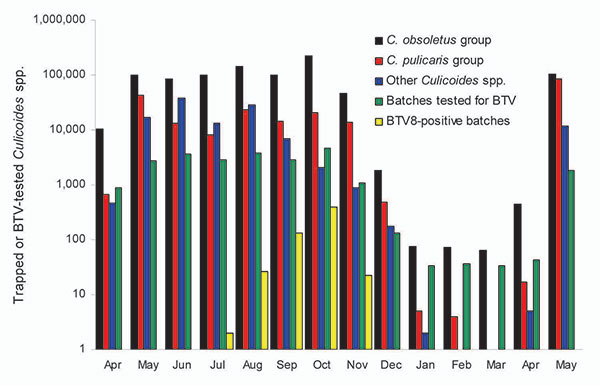
Figure 2. Monthly catches of midges of the Culicoides obsoletus group (black), C. pulicaris group (red), and other Culicoides spp. (blue) captured with 89 black light traps in Germany during 7 consecutive nights in the first week of each month during the study period (April 2007–May 2008). Batches consisting of <50 female biting midges were tested for bluetongue virus (BTV) by real-time reverse transcription–PCR. The total number of batches (green) and the number of batches positive for BTV (gold) are shown.
Page created: December 07, 2010
Page updated: December 07, 2010
Page reviewed: December 07, 2010
The conclusions, findings, and opinions expressed by authors contributing to this journal do not necessarily reflect the official position of the U.S. Department of Health and Human Services, the Public Health Service, the Centers for Disease Control and Prevention, or the authors' affiliated institutions. Use of trade names is for identification only and does not imply endorsement by any of the groups named above.