Volume 18, Number 8—August 2012
Letter
Factors Influencing Emergence of Tularemia, Hungary, 1984–2010
Miklós Gyuranecz , Jenő Reiczigel, Katalin Krisztalovics, László Monse, Gabriella Kükedi Szabóné, Andrásné Szilágyi, Bálint Szépe, László Makrai, Tibor Magyar, Mangesh Bhide, and Károly Erdélyi
, Jenő Reiczigel, Katalin Krisztalovics, László Monse, Gabriella Kükedi Szabóné, Andrásné Szilágyi, Bálint Szépe, László Makrai, Tibor Magyar, Mangesh Bhide, and Károly Erdélyi
Figure
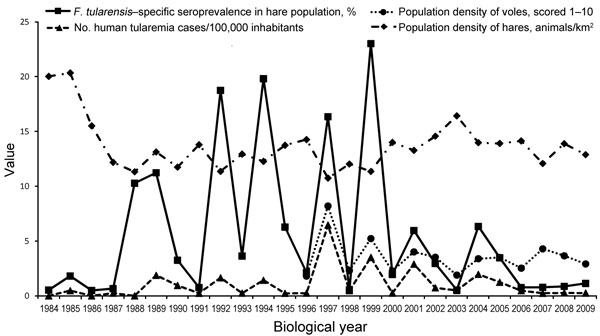
Figure. . Correlation between the seroprevalence of Francisella tularensis in the European brown hare (Lepus europaeus) population, the population density of European brown hares and common voles (Microtus arvalis), and the number of tularemia cases in humans eastern Hungary, 1984–2010. Values were determined on the basis of biological years (March–February). Median values from the records of 3 counties were used for analysis.
Page created: July 20, 2012
Page updated: July 20, 2012
Page reviewed: July 20, 2012
The conclusions, findings, and opinions expressed by authors contributing to this journal do not necessarily reflect the official position of the U.S. Department of Health and Human Services, the Public Health Service, the Centers for Disease Control and Prevention, or the authors' affiliated institutions. Use of trade names is for identification only and does not imply endorsement by any of the groups named above.