Tuberculosis
CDC Yellow Book 2024
Travel-Associated Infections & DiseasesINFECTIOUS AGENT: Mycobacterium tuberculosis complex
ENDEMICITY
Worldwide, but with wide variations by region and social context
TRAVELER CATEGORIES AT GREATEST RISK FOR EXPOSURE & INFECTION
PREVENTION METHODS
Avoid high-risk social contexts
Obtain pre- and posttravel testing and preventive treatment for new infections
Get fit-tested and use respiratory protection (e.g., N95 respirators) in high-risk occupational settings
Consider vaccination with bacillus Calmette-Guérin (no longer available in the United States)
DIAGNOSTIC SUPPORT
Infectious Agent
Mycobacterium tuberculosis complex is a group of closely related rod-shaped, nonmotile, slow-growing, acid-fast bacteria, which includes M. bovis and M. tuberculosis hominis, the most common cause of human tuberculosis (TB), usually referred to as M. tuberculosis.
Transmission
TB transmission occurs when a patient with a contagious form of the infection coughs, spreading bacilli through the air. People can acquire bovine TB (caused by M. bovis) by consuming unpasteurized dairy products from infected cattle.
The risk for M. tuberculosis transmission on an airplane is low, but instances of in-flight TB transmission have occurred. The risk of transmission is dependent on the contagiousness of the person with TB, seating proximity, flight duration, and host factors. To prevent transmission, people with contagious TB should not travel by commercial airplanes or other commercial conveyances. Typically, only TB of the lung or airway is contagious in community contexts, and health department authorities determine whether TB is contagious based on a person’s chest radiograph, sputum tests, symptoms, and treatment received. The World Health Organization (WHO) issued guidelines for notifying passengers potentially exposed to TB on airplanes. Passengers concerned about possible TB exposure should see their primary health care provider or visit their local health department clinic for evaluation.
Bovine TB is a risk for travelers who consume unpasteurized dairy products in countries (e.g., Mexico) where M. bovis in cattle is common. M. bovis risk in some African countries has been postulated, but human M. bovis statistics are unavailable for those countries.
Epidemiology
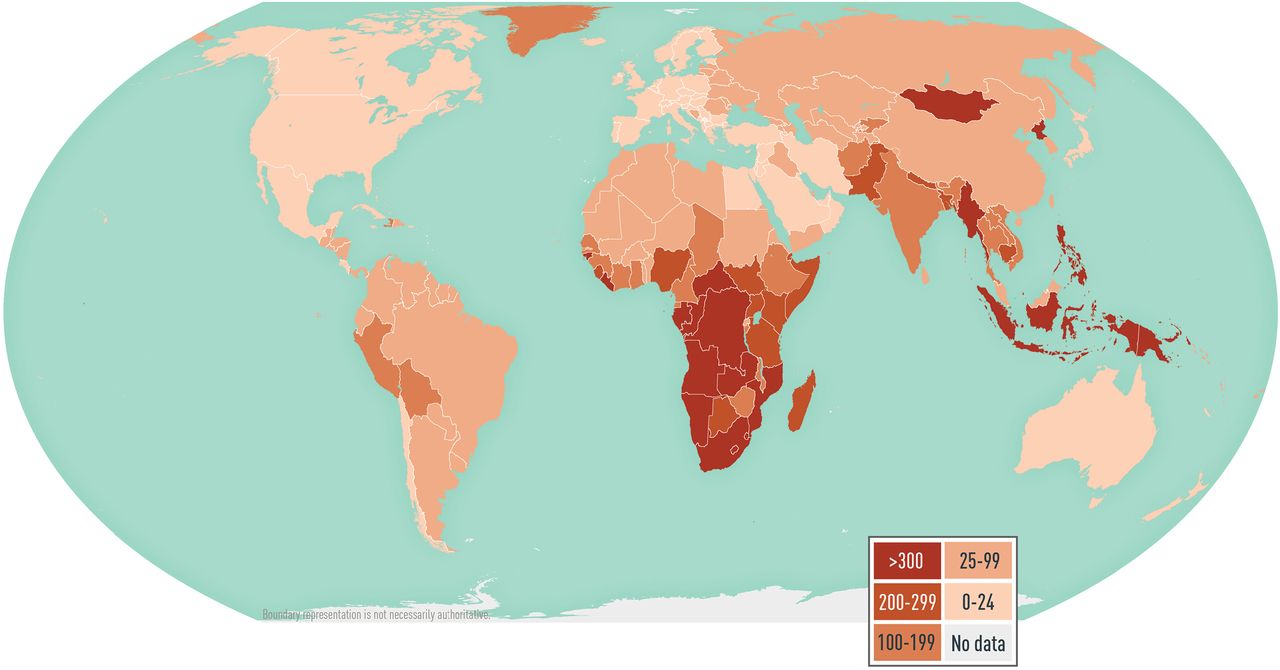
According to the World Health Organization, ≈10 million new TB cases and ≈1.2 million TB-related deaths occurred in 2019. TB occurs throughout the world, but the incidence varies (see Map 5-02). In some countries in sub-Saharan Africa and Asia, the annual incidence is several hundred per 100,000 population. In the United States, the annual incidence is <3 per 100,000 population, but immigrants from countries with a high TB burden and long-term residents of high-burden countries have a 10× greater incidence of TB than the US national average. Of note, US surveillance does not capture travel-related cases of TB.
Drug-resistant TB is an increasing concern. Multidrug-resistant (MDR) TB is resistant to at least the 2 most effective drugs, isoniazid and rifampin. MDR TB is less common than drug-susceptible TB, but globally ≈363,000 cases of MDR TB were diagnosed in 2019, and MDR TB accounts for >25% of TB cases in some countries (Table 5-06). MDR and higher-order resistance are of particular concern among HIV-infected or other immunocompromised people.
Map 5-02 Estimated tuberculosis incidence rates per 100,000 population
Disease data sources: World Health Organization. Global tuberculosis report 2020 (https://apps.who.int/iris/bitstream/handle/10665/336069/9789240013131-eng.pdf [PDF]); for French Guiana, Tableau 5: Taux de déclaration de tuberculose maladie par Nouvelles régions (taux pour 100 000), France entière, 2015–2020; Santé publique France; La tuberculose: données (Table 5: Tuberculosis disease reporting rate by New regions [rate per 100,000], Whole France, 2015–2020, Public Health France, Tuberculosis: data; www.santepubliquefrance.fr/maladies-et-traumatismes/maladies-et-infections-respiratoires/tuberculose/donnees/#tabs); for Taiwan, Statistics of Communicable Diseases and Surveillance Report 2019, Centers for Disease Control, Ministry of Health and Welfare, R.O.C. (Taiwan), November 2020 (www.cdc.gov.tw/En/File/Get/0nnMQjC37VAuhzVY3Vuq-A).
Table 5-06 Estimated proportion of multidrug-resistant (MDR) tuberculosis (TB) cases in countries with high MDR TB burden, 2019
|
COUNTRY |
% OF NEW TB CASES THAT ARE MDR |
% OF RETREATMENT MDR TB CASES |
|---|---|---|
|
Angola |
2.5% |
14% |
|
Azerbaijan |
11% |
24% |
|
Bangladesh |
0.7% |
11% |
|
Belarus |
38% |
60% |
|
China |
7.1% |
23% |
|
DPR Korea |
2.2% |
16% |
|
DR Congo |
1.8% |
11% |
|
Ethiopia |
0.7% |
12% |
|
India |
2.8% |
14% |
|
Indonesia |
2.4% |
13% |
|
Kazakhstan |
27% |
44% |
|
Kenya |
1.3% |
4.6% |
|
Kyrgyzstan |
29% |
60% |
|
Mozambique |
3.7% |
13% |
|
Myanmar |
4.9% |
18% |
|
Nigeria |
4.3% |
14% |
|
Pakistan |
4.2% |
7.3% |
|
Papua New Guinea |
3.4% |
26% |
|
Peru |
6.3% |
20% |
|
Philippines |
1.8% |
28% |
|
Republic of Moldova |
33% |
60% |
|
Russian Federation |
35% |
71% |
|
Somalia |
8.7% |
88% |
|
South Africa |
3.4% |
7.1% |
|
Tajikistan |
29% |
40% |
|
Thailand |
1.7% |
10% |
|
Ukraine |
27% |
43% |
|
Uzbekistan |
12% |
22% |
|
Vietnam |
3.6% |
17% |
|
Zimbabwe |
3.1% |
14% |
Clinical Presentation
M. tuberculosis infection can be detected by a positive tuberculin skin test (TST) or interferon-γ release assay (IGRA) 8–10 weeks after exposure. Overall, only 5%–10% of otherwise healthy people who are infected progress to TB disease during their lifetimes. Progression to TB disease can take weeks to decades after initial infection. People with TB disease have symptoms or other manifestations of illness (e.g., an abnormal chest radiograph). For most people who become infected, M. tuberculosis remains in an inactive state (latent TB infection or LTBI) in which the infected person has no symptoms and cannot spread the infection to others.
TB disease can affect any organ, but affects the lungs in 70%–80% of cases. Typical TB symptoms include prolonged cough, fever, hemoptysis, night sweats, decreased appetite, and weight loss. The most common sites for TB outside the lungs (i.e., extrapulmonary TB) are the bladder, bones and joints, brain and meninges, genitalia, kidneys, lymph nodes, and pleura.
The risk for progression to disease is much higher in immunosuppressed people; for example, progression is 8%–10% per year in HIV-infected people not receiving antiretroviral therapy. People receiving tumor necrosis factor blockers to treat rheumatoid arthritis and other chronic inflammatory conditions also are at increased risk for disease progression.
Diagnosis
Pretravel & Posttravel Testing
Before leaving the United States, travelers who anticipate possible prolonged exposure to TB (e.g., people who will care for patients, or who will work in health care facilities, prisons or jails, refugee camps, or homeless shelters) and those planning prolonged stays in TB-endemic countries should have a pretravel IGRA (e.g., QuantiFERON-TB Gold Plus, T-SPOT.TB, 2-step tuberculin skin test [TST]). For details, see the following chapter in this section, . . . perspectives: Testing Travelers for Mycobacterium tuberculosis Infection.
If the predeparture test is negative, repeat IGRA or single TST 8–10 weeks after the traveler returns. The predeparture test and follow-up test should be the same test type to facilitate interpretation of results. People with HIV infection or other immunocompromising conditions are more likely to have an impaired response to either a skin or a blood test; be sure to ask travelers about such underlying conditions.
Travelers who suspect they have been exposed to TB should inform their health care provider of the possible exposure and receive a medical evaluation. Because drug resistance is relatively common in some parts of the world, consult with experts in infectious diseases or pulmonary medicine regarding proper management and coordinate consultations with input from the public health department.
Diagnostic Testing Recommendations
The Centers for Disease Control and Prevention (CDC), the American Thoracic Society (ATS), and the Infectious Diseases Society of America (IDSA) jointly published diagnostic recommendations for both TB disease and LTBI. Collect sputum or other respiratory specimens for culture and smears for acid-fast bacilli (AFB) from people being examined for pulmonary TB.
Although diagnosis of TB disease can be made using clinical criteria in the absence of microbiologic confirmation, perform laboratory testing to confirm the diagnosis, guide treatment decisions, and provide bacterial DNA for molecular epidemiology. Molecular tests for mutations that confer drug resistance can be performed directly on specimens and can guide initial treatment while culture results are pending. Culture-based susceptibility testing is recommended for all patients with a positive culture result, to help determine the appropriate drug regimen.
Culture Methods
Culture methods, with referral to a public health reference laboratory in some instances, are necessary to identify the M. tuberculosis complex species responsible for infection. Culture and identification of M. tuberculosis takes ≈2 weeks, even with rapid culture techniques.
Microscopy
A preliminary diagnosis of TB can be made when AFB are seen by microscopy on a sputum smear or in other body tissues or fluids. Microscopy cannot distinguish M. tuberculosis from nontuberculous mycobacteria, however, which is particularly problematic in countries like the United States, where the prevalence of infections with nontuberculous mycobacteria is greater than that of TB.
Nucleic Acid Amplification Tests
Less sensitive than culture but more sensitive than AFB smear, nucleic acid amplification tests (NAAT) are specific for the M. tuberculosis complex. NAAT methods detect all members of the M. tuberculosis complex. Thus, a positive NAAT result can rapidly confirm a diagnosis and help guide initial treatment until culture results return.
The availability of NAAT methods and the policies for ordering these tests are locally determined, and clinicians should consult their state health department. Diagnosis of extrapulmonary TB disease can be confirmed with a NAAT positive for M. tuberculosis complex or a culture positive for M. tuberculosis from affected body tissues or fluids.
Diagnostic Support
TB disease is a nationally notifiable condition in the United States. LTBI is also notifiable in many jurisdictions. LTBI is diagnosed by a positive result from an IGRA or TST after further examinations (e.g., chest radiograph, symptom review) have excluded TB disease.
Expertise in the diagnosis of TB and its specialty laboratory services, or local referral for such expertise, is available from the health departments of cities, counties, and states. In most settings, contact tracing is managed by public health officials. General information and expert medical consultation also are available from the CDC-sponsored US TB Centers of Excellence for Training, Education, and Medical Consultation.
Treatment
Latent Tuberculosis Infection
People with LTBI can be treated, and treatments are effective at preventing progression to TB disease. Clinicians must exclude TB disease before starting LTBI treatment. In the United States, several regimens exist for the treatment of drug-susceptible LTBI, including 3 months of once-weekly isoniazid and rifapentine; 4 months of daily rifampin; 3 months of daily isoniazid and rifampin; and 6–9 months of daily isoniazid. Given the low completion rates of the 6- to 9-month isoniazid regimen, shorter duration regimens are preferred.
Choose a regimen for patients based on coexisting medical conditions, potential for drug interactions, and drug-susceptibility results of the presumed source of exposure, if known. For example, rifampin has interactions with oral contraceptives and certain antiretroviral medications taken by people with HIV/AIDS. Individuals at especially high risk for TB disease who might have difficulty adhering to treatment, or who are given an intermittent dosing regimen, might be candidates for directly observed therapy for LTBI.
Tuberculosis Disease
CDC/ATS/IDSA published guidelines for treating drug-susceptible TB disease with a multiple-drug regimen administered by directly observed therapy for 6–9 months. Usually, the regimen is isoniazid, rifampin, ethambutol, and pyrazinamide for 2 months, then isoniazid and rifampin for an additional 4 months. Drug-resistant TB is more difficult to treat, historically requiring 4–6 drugs for 18–24 months and best managed by an expert. In a randomized controlled trial, a newer 6-month all-oral regimen of bedaquiline, pretomanid, and linezolid was effective in treating highly drug-resistant TB or patients who could not tolerate other regimens. This and other new regimens are being used in the United States.
Prevention
Travelers should avoid exposure to people with TB disease in crowded and enclosed environments (e.g., health care facilities, prisons or jails, or homeless shelters). Advise travelers who will be caring for patients, or who will be working in health care facilities where people with TB are likely to be patients, to consult infection control or occupational health experts about baseline LTBI screening, procedures for obtaining personal respiratory protective devices (e.g., N95 respirators), and recommendations for respirator selection and training.
Based on WHO recommendations, bacillus Calmette-Guérin (BCG) vaccine is used once, at birth, in countries with higher TB burdens to reduce the severe consequences of TB in infants and children. BCG vaccine has low and variable efficacy in preventing TB in adults, however. Some experts advocate vaccinating health care providers likely to be exposed to drug-resistant TB in settings where infection control measures like those recommended in the United States are not fully implemented; US Food and Drug Administration–approved vaccine formulations of BCG are no longer available in the United States. All people, including those who have received BCG vaccination, must follow recommended TB infection control precautions to the greatest extent possible. IGRA is preferred over the TST for pretravel and posttravel testing in those vaccinated with BCG, because BCG might induce false-positive TST results. No BCG effects on IGRA results have been detected in multiple studies.
To prevent infections from M. bovis and other foodborne pathogens, travelers should avoid consuming unpasteurized dairy products.
CDC website: Tuberculosis
The following authors contributed to the previous version of this chapter: Neela D. Goswami, Philip A. LoBue