Volume 18, Number 3—March 2012
Research
Pathogenic Potential to Humans of Bovine Escherichia coli O26, Scotland
Margo E. Chase-Topping , Tracy Rosser, Lesley J. Allison, Emily Courcier, Judith Evans, Iain J. McKendrick, Michael C. Pearce, Ian Handel, Alfredo Caprioli, Helge Karch, Mary F. Hanson, Kevin G.J. Pollock, Mary E. Locking, Mark E.J. Woolhouse, Louise Matthews, J. Chris Low, and David L. Gally
, Tracy Rosser, Lesley J. Allison, Emily Courcier, Judith Evans, Iain J. McKendrick, Michael C. Pearce, Ian Handel, Alfredo Caprioli, Helge Karch, Mary F. Hanson, Kevin G.J. Pollock, Mary E. Locking, Mark E.J. Woolhouse, Louise Matthews, J. Chris Low, and David L. Gally
Figure 2
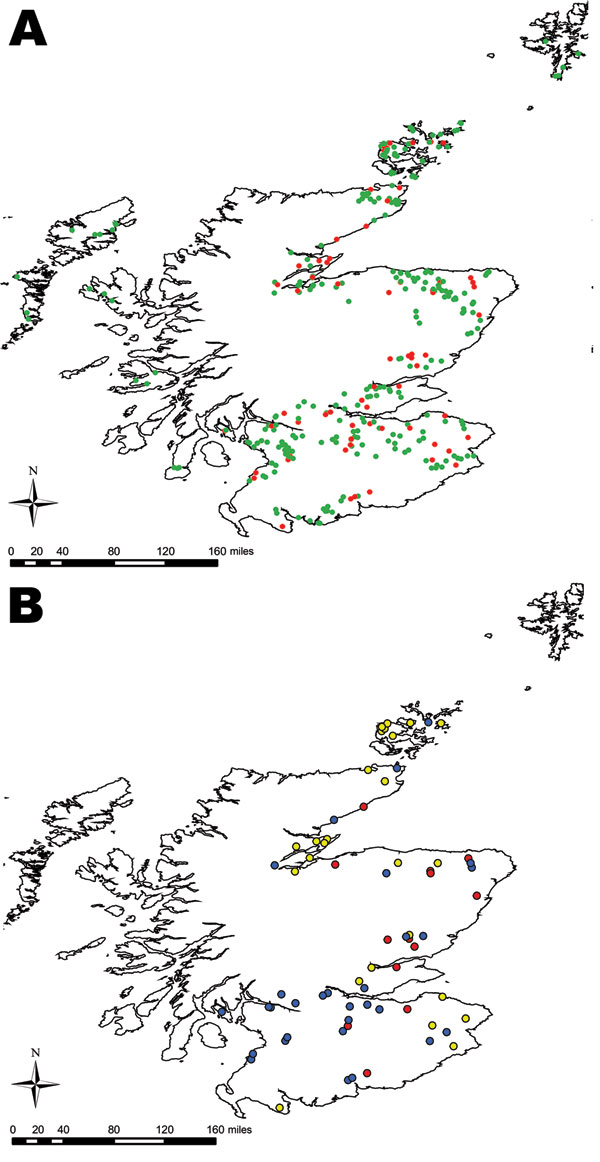
Figure 2. Location of farms sampled in 2002–2004 field survey for Escherichia coli O26, Scotland. A) Farms that were positive for E. coli O26 are shown in red; farms negative for E. coli O26 are shown in green. B) The positive farms were subdivided according to differences in virulent properties of E. coli O26 (farm status) based on the possession of stx. Farms were designated as stx– (blue), stx1+ (yellow), or stx1+stx2+ (red).
Page created: February 16, 2012
Page updated: February 16, 2012
Page reviewed: February 16, 2012
The conclusions, findings, and opinions expressed by authors contributing to this journal do not necessarily reflect the official position of the U.S. Department of Health and Human Services, the Public Health Service, the Centers for Disease Control and Prevention, or the authors' affiliated institutions. Use of trade names is for identification only and does not imply endorsement by any of the groups named above.