Volume 18, Number 2—February 2012
Dispatch
Phylogeography of Francisella tularensis subsp. holarctica, Europe

Figure 2
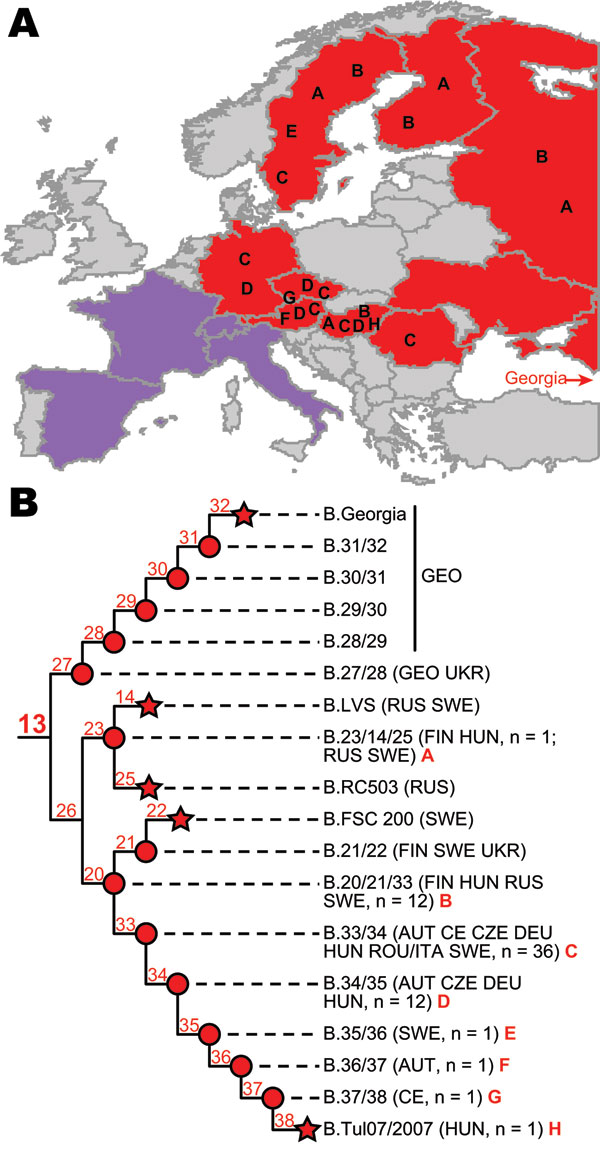
Figure 2. Detailed geographic distribution and phylogeny of Francisella tularensis subsp. holarctica subclades within group B.13. A) Countries from which groups B.13 and B.FTNF002–00 have been reported. Countries of origin for isolates assigned to select subclades within group B.13 are indicated by the letters A–H. Red and purple shading indicates the known geographic distributions of groups B.13 and B.FTNF002–00, respectively, in this and previous studies (5–9). The country of Georgia, which also contains isolates from group B.13 but is not depicted in the map, is indicated by red text and a red arrow pointing toward its location. Isolates assigned to other phylogenetic groups within F. tularensis subsp. holarctica have been reported from some of these countries (5,8), but most isolates from these countries are from groups B.13 and B.FTNF002–00. B) Single nucleotide polymorphism–based phylogeny of previously (5,6,8) and newly identified subclades within the B.13 group of F. tularensis subsp. holarctica. Terminal subgroups representing sequenced strains are shown as stars, and intervening nodes representing collapsed branches are indicated by circles. The countries of origin for isolates assigned to each subclade are indicated: AUT, Austria; CE, central Europe, unknown country; CZE, Czech Republic; DEU, Germany; FIN, Finland; GEO, Georgia; HUN, Hungary; ITA, Italy; ROU, Romania; RUS, Russia; SWE, Sweden; UKR, Ukraine). For mapping purposes, letters are assigned to a previously identified subclade that contains a new isolate from Hungary now assigned to that subclade (A) and newly identified subclades (B–H). The number of isolates listed for each subclade refers only to isolates examined directly in this study (Table A1).
References
- Dennis DT, Inglesby TV, Henderson DA, Bartlett JG, Ascher MS, Eitzen E, Tularemia as a biological weapon: medical and public health management. JAMA. 2001;285:2763–73. DOIPubMedGoogle Scholar
- Rotz LD, Khan AS, Lillibridge SR, Ostroff SM, Hughes JM. Public health assessment of potential biological terrorism agents. Emerg Infect Dis. 2002;8:225–30. DOIPubMedGoogle Scholar
- Keim P, Johansson A, Wagner DM. Molecular epidemiology, evolution, and ecology of Francisella. Ann N Y Acad Sci. 2007;1105:30–66. DOIPubMedGoogle Scholar
- Keim PS, Wagner DM. Humans and evolutionary and ecological forces shaped the phylogeography of recently emerged diseases. Nat Rev Microbiol. 2009;7:813–21. DOIPubMedGoogle Scholar
- Vogler AJ, Birdsell D, Price LB, Bowers JR, Beckstrom-Sternberg SM, Auerbach RK, Phylogeography of Francisella tularensis: global expansion of a highly fit clone. J Bacteriol. 2009;191:2474–84. DOIPubMedGoogle Scholar
- Chanturia G, Birdsell DN, Kekelidze M, Zhgenti E, Babuadze G, Tsertsvadze N, Phylogeography of Francisella tularensis subspecies holarctica from the country of Georgia. BMC Microbiol. 2011;11:139. DOIPubMedGoogle Scholar
- Pilo P, Johansson A, Frey J. Identification of Francisella tularensis cluster in central and western Europe. Emerg Infect Dis. 2009;15:2049–51. DOIPubMedGoogle Scholar
- Svensson K, Granberg M, Karlsson L, Neubauerova V, Forsman M, Johansson A. A real-time PCR array for hierarchical identification of Francisella isolates. PLoS ONE. 2009;4:e8360. DOIPubMedGoogle Scholar
- Vogler AJ, Birdsell DN, Lee J, Vaissaire J, Doujet CL, Lapalus M, Phylogeography of Francisella tularensis ssp. holarctica in France. Lett Appl Microbiol. 2011;52:177–80. DOIPubMedGoogle Scholar
1These authors contributed equally to this article.