Disclaimer: Early release articles are not considered as final versions. Any changes will be reflected in the online version in the month the article is officially released.
Volume 32, Number 1—January 2026
About the Cover
Nocardia and the Death of Raphael (1520)
 , Geneviève Héry-Arnaud, Kira Kofoed, and Jean Armengaud
Suggested citation for this article
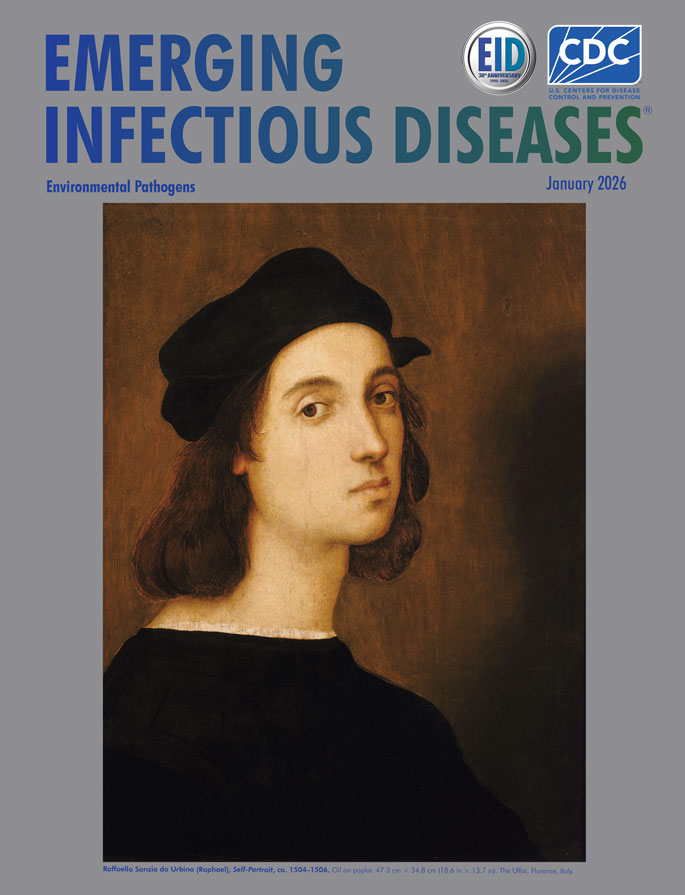
Raffaello Sanzio da Urbino (Raphael), Self-Portrait, ca. 1504–1506. Oil on poplar. 47.3 cm × 34.8 cm (18.6 in × 13.7 in). The Uffizi, Florence, Italy.
Raphael (Raffaello Sanzio da Urbino) was one of the greatest artists of the Italian Renaissance. Active in Perugia, Siena, Florence, Rome, and Urbino (his birthplace), he is responsible for numerous masterpieces of Western art, including the fresco of the School of Athens in the Vatican rooms and the painting of the Sistine Madonna accompanied by 2 cherubs (preserved in Dresden, Germany). He died at the age of 37 in Rome, Italy, on April 6, 1520, after a short chest infection with fever. Several hypotheses have been proposed to explain his premature death, including syphilis, typhoid, malaria, and even excessive bloodletting (1). The paleoproteomic study of his remains might be capable of revealing the exact cause of his death.
Figure 1
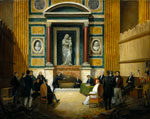
Figure 1. Francesco Diofebi, The 1833 Opening of Raphael’s Tomb in Pantheon, 1836. Oil on canvas, 54.9 × 70 cm, Thorvaldsens Museum inv. no. B73. Photograph by Hans Petersen.
Raphael’s body was placed in one of the walls of the Pantheon in Rome, where his remains are entombed to this day. However, in 1833, an opening of the grave was carried out at the request of the Pope Gregory XVI to check the condition of the corpse and place it in a marble sarcophagus from the Vatican museums (Figure 1). On that occasion, casts of the skull and right hand were made, a piece of the heart was given to a Russian diplomat to the Holy See (2), and the Danish sculptor Bertel Thorvaldsen was given a fragment of the mortar hanging from the original coffin: he kept the fragment and later donated it to his Danish house servant (now at the Thorvaldsen Museum in Copenhagen, inv. no. N87). The French painter Jean-Auguste-Dominique Ingres, who was not present at the opening of the tomb, was given permission by the pope to have a piece of Raphael’s bones (3). Keeping bone fragments as relics had been a practice for hundreds of years, especially when associated with religious figures. Raphael was highly venerated as an artist, to such an extent that he was considered almost a saint (2,3).
Figure 2

Figure 2. General view of samples from Raphael’s grave and cadaver analyzed for investigation of possible Nocardia infection. Ingres Museum, Montauban, France. Photograph by Philippe Charlier.
In the archives of Dominique Ingres, in Montauban (France), we found envelopes and a glass frame holding what were described by Ingres himself as “remains of the divine Raphael” (bone splinters and sediments; Figure 2). Because of the small amount of remaining bone material, no carbon-dating of the remains has been conducted to possibly confirm their authenticity. Apart from tradition (not questioned by art historians) and archives relating to the relics belonging to the Thorvaldsen Museum in Copenhagen (4), no conclusive evidence exists to confirm the authenticity of the Montauban’s remains.
Nevertheless, the fragments were the subject of a sampling for a proteomic study, according to a now well-established paleopathological protocol (paleo-proteotyping) (5). The analysis revealed a significant proteomic signature for Nocardia niigatensis (50 peptides assigned, 11 of them species-specific peptides, and high redundancy of 91 spectra by tandem mass spectrometry), the bacterium was detected only in the sample of bone marrow from a fragment of human rib. In contrast, several other bacteria, typically environmental, were detected in several of the other samples of the grave soil (Pseudonocardia autotrophica, Nonomurae gerenzanensis, Streptomyces albireticuli, Hyphomicrobium sp., Paraburkholderia ribeironi, Lysobacter antibioticus, Blastocatella sp., Paenibacillus koleovorans, Arcicella rosea, Bacillus megaterium, Rhizobium leguminosarum). Finding Nocardia exclusively in the bone marrow supports a conclusion that Nocardia might have been a cause of death, especially since the dead body was placed in an above-ground niche within an ancient Roman monument that had been transformed into a church. No sign of embalming was found at the exhumation (3).
N. niigatensis is not part of the thanatomicrobiome (i.e., microbial communities residing in or moving on the surface of altered remains), so its presence cannot be explained by a process of decomposition/putrefaction (6). However, one may consider the possibility of a burial contamination by the waters of the Tiber during the numerous floods that occurred from the 16th through the 19th Centuries (7). Indeed, the drawings (for example by Vincenzo Camuccini), paintings, and reports of the state of the skeleton during the exhumation of 1833 show a partially disarticulated skeleton, subsequently reassembled by the physician Antonio Trasmondo. The presence of slight deposits on Raphael’s bones, potentially resulting from Tiber River flooding, were described by some witnesses in 1833 (8). However, the peptide signature of N. niigatensis was found only in the bone marrow sample of the rib segment and not in any other samples (e.g., soil, wall, dust), suggesting an intravitam origin for this infectious agent, rather than postmortem contamination by secondary deposition. The detection of environmental bacteria, the presence of deposits on bones attributed to flooding, and difficulty confirming that the bone fragments and sediments were from Raphael and his tomb exemplify some of the challenges to draw conclusions based on a full paleopathological study.
Nocardia spp. bacteria can infect bones through direct extension from a primary lung or skin lesion or via hematogenous dissemination from a pulmonary or soft tissue focus. The clinical manifestations of a Nocardia infection typically begin as a low-level, indolent infection, which then can progress to a febrile illness characterized by pulmonary abscesses, disseminated infection, or both, including osteomyelitis. That clinical course aligns with the symptoms reported for Raphael’s last days of life and agony (9): we know from Vasari that Raphael’s death was preceded by high fever; another source speaks of a 15-day illness (letter from Alf. Pauluzzi to Duke Alfonso d’Este, Rome, April 7, 1520) (10). Whatever the cause of the artist’s death, the profound impact from his work remains for generations. As attributed to German Nazarene painter Johann Friedrich Overbeck, who was among those present in the Pantheon for the opening of Raphael’s tomb, “Alas, the spirit of the great artist remains buried deeper than his bones.”
Acknowledgment
The authors thank Laëtitia Vincent-Genod for the access granted to the remains and M. Adrien Goetz for putting us on this crucial trail.
Bibliography
- Riva MA, Paladino ME, Motta M, Belingheri M. The death of Raphael: a reflection on bloodletting in the Renaissance. Intern Emerg Med. 2021;16:243–4.PubMedGoogle Scholar
- Tiberia V. The collection of the Pontifical Insignia Academy of Fine Arts and Letters of the Virtuosi at the Pantheon: paintings and sculptures [in Italian]. Rome: Scripta Manent Editions; 2016.
- Smithers T. The cults of Raphael and Michelangelo. Artistic sainthood and memorials as a second life. London & New York: Routledge; 2023. p. 220 and 232.
- The Thorvaldsens Museum Archives. No.: 128. Kalk fra Raphaels Grav, skjænket til Undertegnede af Th: der modtog det som medlem af Accademiet St Lucca (1833)? da Raphaels Grav blev aabnet. [Mortar from the tomb of Raphael, given to the undersigned (Thorvaldsen’s servant C.F. Wilckens who collected Thorvaldsen-souvenirs) by Thorvaldsen, who received it as a member of the Accademia di San Luca (1833?) when the tomb was opened] [cited 2025 Nov 26]. https://arkivet.thorvaldsensmuseum.dk/documents/m34,nr.74
- Charlier P, Armengaud J. Did Saint Leonard suffer from Madura foot at the time of death? Infectious disease diagnosis by paleo-proteotyping. J Infect. 2024;88:61–2.PubMedGoogle Scholar
- Javan GT, Finley SJ, Can I, Wilkinson JE, Hanson JD, Tarone AM. Human thanatomicrobiome succession and time since death. Sci Rep. 2016;6:29598.PubMedGoogle Scholar
- Camuffo D, Enzi S. The analysis of two bi-millenary series: Tiber and Po River Floods. In: Jones PD, Bradley RD, Jouzet J, editors. Climatic variations and forcing mechanisms of the last 2000 years. NATO ASI Subseries I: (ASII, vol. 41). Berlin: Springer; 1996. DOIGoogle Scholar
- Nerlich F. La transfiguration de Raphaël. L’année 1833. Studiolo. 2020/2021;17:66–81.
- Ozaras R, Mert A, Hakko E, Tabak F, Ozturk R. Pulmonary, cerebral, and soft tissue nocardiosis. Lancet Infect Dis. 2004;4:222.PubMedGoogle Scholar
- Vasari G. Les vies des plus excellents: peintres sculpteurs, et architectes. Weiss C, translator. Paris: Dorbon-Aîné; 1903.
Figures
Suggested citation for this article: Charlier P, Héry-Arnaud G, Kofoed K, Armengaud J. Nocardia and the death of Raphael (1520). Emerg Infect Dis. 2026 Jan [date cited]. https://doi.org/10.3201/eid3201.AC3201
Original Publication Date: January 21, 2026
Related Links
Table of Contents – Volume 32, Number 1—January 2026
| EID Search Options |
|---|
 Advanced Article Search – Search articles by author and/or keyword.
|
 Articles by Country Search – Search articles by the topic country.
|
 Article Type Search – Search articles by article type and issue.
|
Please use the form below to submit correspondence to the authors or contact them at the following address:
Philippe Charlier, Laboratory Anthropology, Archaeology, Biology (LAAB), UFR of Health Sciences Simone Veil (UVSQ/Paris-Saclay University), 2 avenue de la source de la Bièvre, 78180 Montigny-Le-Bretonneux, France
Top