Volume 32, Number 2—February 2026
Dispatch
Retail Milk Monitoring of Influenza A(H5N1) in Dairy Cattle, United States, 2024–2025

Figure
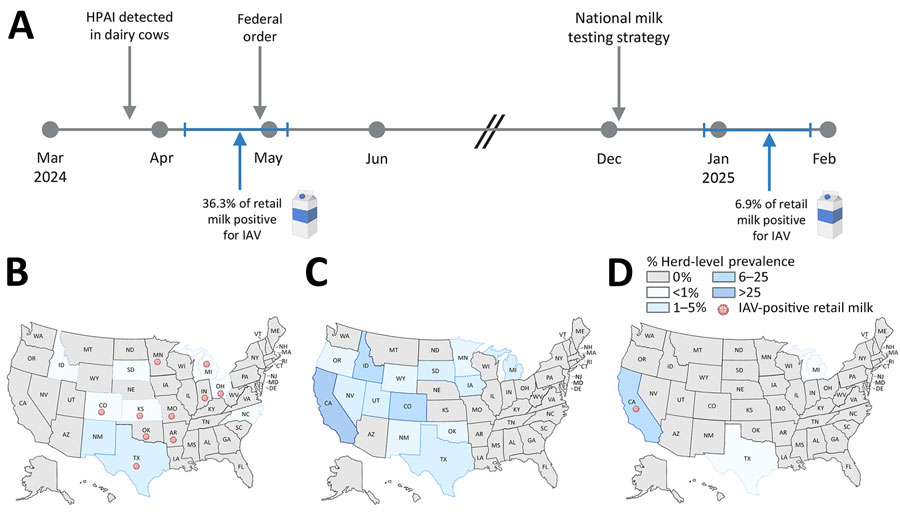
Figure. Timeline and geographic distribution of influenza A(H5N1) outbreaks in dairy cattle herds in study of retail milk monitoring of influenza A(H5N1) in dairy cattle, United States, 2024–2025. A) Timeline of detections and federal interventions. B–D) Locations of confirmed H5N1 outbreaks in dairy herds, standardized as the prevalence of infected herds relative to the total number of herds per state, on the basis of 2022 US Department of Agriculture (USDA) Census of Agriculture data (6). A) USDA reported outbreaks (n = 36), March 25–May 3, 2024; B) USDA reported outbreaks (n = 701), May 4–December 8, 2024); C) USDA reported outbreaks (n = 218), December 9, 2024–January 29, 2025. The red virion marks the state of processing plants where influenza A virus–positive retail milk was identified. Maps were generated using BioRender (https://BioRender.com). HPAI, highly pathogenic avian influenza; IAV, influenza A virus.
References
- Burrough ER, Magstadt DR, Petersen B, Timmermans SJ, Gauger PC, Zhang J, et al. Highly pathogenic avian influenza A(H5N1) clade 2.3.4.4b virus infection in domestic dairy cattle and cats, United States, 2024. Emerg Infect Dis. 2024;30:1335–43. DOIPubMedGoogle Scholar
- Nguyen TQ, Hutter CR, Markin A, Thomas M, Lantz K, Killian ML, et al. Emergence and interstate spread of highly pathogenic avian influenza A(H5N1) in dairy cattle in the United States. Science. 2025;388:eadq0900. DOIGoogle Scholar
- Animal and Plant Health Inspection Service. HPAI confirmed cases in livestock [cited 2025 Dec 14]. https://www.aphis.usda.gov/livestock-poultry-disease/avian/avian-influenza/hpai-detections/hpai-confirmed-cases-livestock
- Spackman E, Jones DR, McCoig AM, Colonius TJ, Goraichuk IV, Suarez DL. Characterization of highly pathogenic avian influenza virus in retail dairy products in the US. J Virol. 2024;98:
e0088124 . DOIPubMedGoogle Scholar - Spackman E, Anderson N, Walker S, Suarez DL, Jones DR, McCoig A, et al. Inactivation of highly pathogenic avian influenza virus with high-temperature short time continuous flow pasteurization and virus detection in bulk milk tanks. J Food Prot. 2024;87:
100349 . DOIPubMedGoogle Scholar - US Department of Agriculture National Agricultural Statistics Services. Quick stats [cited 2025 Jul 1]. https://quickstats.nass.usda.gov
- Animal and Plant Health Inspection Service. Federal orders [cited 2025 Apr 19]. https://www.aphis.usda.gov/livestock-poultry-disease/avian/avian-influenza/hpai-detections/livestock/federal-order
- Wallace HL, Wight J, Baz M, Dowding B, Flamand L, Hobman T, et al. Longitudinal screening of retail milk from Canadian provinces reveals no detections of influenza A virus RNA (April-July 2024): leveraging a newly established pan-Canadian network for responding to emerging viruses. Can J Microbiol. 2025;71:1–7. DOIPubMedGoogle Scholar
- Animal and Plant Health Inspection Service. APHIS confirms D1.1 genotype in dairy cattle in Nevada [cited 2025 Apr 21]. https://www.aphis.usda.gov/news/program-update/aphis-confirms-d11-genotype-dairy-cattle-nevada-0
- Animal and Plant Health Inspection Service. APHIS identifies third HPAI spillover in dairy cattle [cited 2025 Oct 27]. https://www.aphis.usda.gov/news/program-update/aphis-identifies-third-hpai-spillover-dairy-cattle