Characteristics and Transmission Dynamics of Global Travel-Related Mpox Cases Caused by Clade Ib Monkeypox Virus
Henry Laurenson-Schafer
1, Martina McMenamin
1, Lennox Kesington Ebbarnezh, Ioannis Karagiannis, Viema Biaukula, Rosamund Lewis, Masaya Kato, Michel Muteba, Jeremias D. Naiene, Felix Sanni, Tshewang Dorji, Lorenzo Subissi, Marc-Alain Widdowson, Ana Hoxha

, Olivier le Polain de Waroux, and
WHO Mpox Collaborative Surveillance Group2
Author affiliation: World Health Organization (WHO) Health Emergencies Programme, Geneva, Switzerland (H. Laurenson-Schafer, M. McMenamin, L.K. Ebbarnezh, R. Lewis, L. Subissi, A. Hoxha, O. le Polain de Waroux); WHO Health Emergencies Programme, Regional Office for the European Region, Copenhagen, Denmark (I. Karagiannis, M.-A. Widdowson); WHO Health Emergencies Programme, Regional Office for the Western Pacific Region, Manila, Philippines (V. Biaukula); WHO Health Emergencies Programme, Regional Office for the South-East Asian Region, New Delhi, India (M. Kato); WHO Health Emergencies Programme, Regional Office for Africa, Brazzaville, Republic of the Congo (M. Muteba, F. Sanni); WHO Health Emergencies Programme, Regional Office for the Eastern Mediterranean Region, Cairo, Egypt (J.D. Naiene); WHO Health Emergencies Programme, Regional Office for the Americas, Washington, DC, USA (T. Dorji)
Main Article
Figure 2
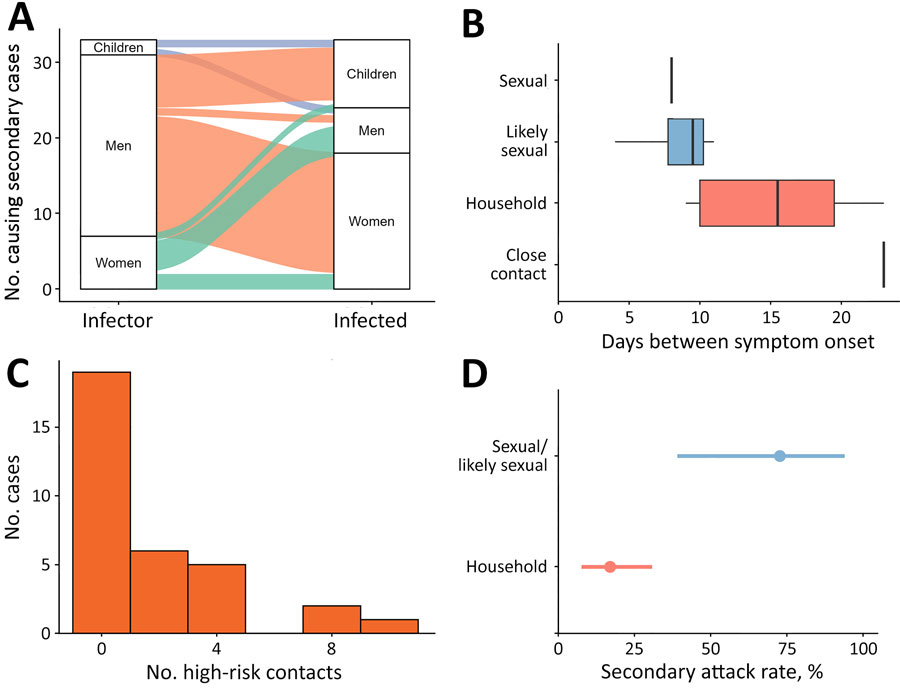
Figure 2. Characteristics and transmission dynamics among global travel-related mpox cases caused by clade Ib monkeypox virus. A) Sankey diagram of secondary transmission events among 33 transmission events and secondarily infected persons. Index cases causing multiple secondary cases were counted per secondary case. Children are persons <17 years of age. B) Box and whisker plot representing the serial interval for symptom onset by reported contact type for 14 case–contact pairs. Close contact is physical nonsexual interaction between the index and secondary case. Box left and right edges represent first and third quartiles, vertical lines indicate medians, and whiskers represent ranges. C) Number of high-risk contacts per each imported MPXV clade Ib case with available data among 33 high-risk contacts. D) Secondary attack rate (with 95% CIs) by reported contact type. Household contacts represent 8 secondary cases from 47 contacts; sexual contacts represent 8 secondary cases from 11 contacts.
Main Article
Page created: January 20, 2026
Page updated: February 19, 2026
Page reviewed: February 19, 2026
The conclusions, findings, and opinions expressed by authors contributing to this journal do not necessarily reflect the official position of the U.S. Department of Health and Human Services, the Public Health Service, the Centers for Disease Control and Prevention, or the authors' affiliated institutions. Use of trade names is for identification only and does not imply endorsement by any of the groups named above.