Skip directly to site content Skip directly to page options Skip directly to A-Z link Skip directly to A-Z link Skip directly to A-Z link

Disclaimer: Early release articles are not considered as final versions. Any changes will be reflected in the online version in the month the article is officially released.

Volume 32, Number 5—May 2026

Dispatch

Retrospective Phylogenetic Analysis of Mayaro Virus, French Guiana, 1996–2024

Alisé Lagrave1Comments to Author , Antoine Enfissi1, Sourakhata Tirera, Loïc Epelboin, Jean-Bernard Duchemin, Tiphanie Succo, Anne Lavergne, and Dominique Rousset
Author affiliation: Institut Pasteur de la Guyane, Arbovirus National Reference Center, Virology Unit, Cayenne, French Guiana (A. Lagrave, A. Enfissi, S. Tirera, A. Lavergne, D. Rousset); CHU de Guyane, Unité des Maladies Infectieuses et Tropicales, Cayenne (L. Epelboin); CHU de Guyane, CIC Inserm, Santé des Populations Amazoniennes, Cayenne (L. Epelboin); Institut Pasteur de la Guyane, Unité Entomologie médicale, Cayenne (J.-B. Duchemin); Santé Publique France, Cellule Guyane, Cayenne (T. Succo)

Main Article

Figure 2

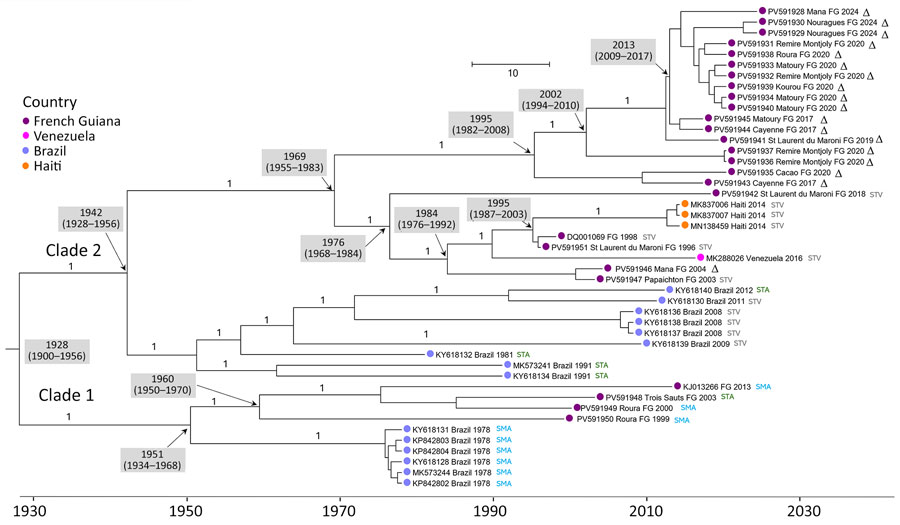
Bayesian phylogeny of 45 selected genotype D sublineage 2 coding sequences from a retrospective phylogenetic analysis of Mayaro virus, French Guiana, 1996–2024. Maximum clade credibility tree inferred by using the general time-reversible with gamma distribution and invariant site substitution model, under a strict clock and Bayesian skyline coalescent prior. The tree was generated by using TreeAnnotator version 1.10.4 (BEAST Developers, https://beast.community/treeannotator), and the resulting time-scaled phylogenies were visualized with FigTree version 1.4.3 (https://tree.bio.ed.ac.uk/software/figtree). Amino acid motifs at positions 1714–1716 are indicated by color at the terminal nodes of each sequence. Gray shaded boxes indicate dates of time to most recent common ancestor (95% highest posterior density). Bootstrap support values are indicated on the corresponding branches; a value of 1 corresponds to 100% bootstrap support. GenBank accession numbers are provided. Scale bar indicates nucleotide substitutions per site.

Figure 2. Bayesian phylogeny of 45 selected genotype D sublineage 2 coding sequences from a retrospective phylogenetic analysis of Mayaro virus, French Guiana, 1996–2024. Maximum clade credibility tree inferred by using the general time-reversible with gamma distribution and invariant site substitution model, under a strict clock and Bayesian skyline coalescent prior. The tree was generated by using TreeAnnotator version 1.10.4 (BEAST Developers, https://beast.community/treeannotator), and the resulting time-scaled phylogenies were visualized with FigTree version 1.4.3 (https://tree.bio.ed.ac.uk/software/figtree). Amino acid motifs at positions 1714–1716 are indicated by color at the terminal nodes of each sequence. Gray shaded boxes indicate dates of time to most recent common ancestor (95% highest posterior density). Bootstrap support values are indicated on the corresponding branches; a value of 1 corresponds to 100% bootstrap support. GenBank accession numbers are provided. Scale bar indicates nucleotide substitutions per site.

Main Article

1These first authors contributed equally to this article.

Page created: March 25, 2026
Page updated: April 27, 2026
Page reviewed: April 27, 2026
The conclusions, findings, and opinions expressed by authors contributing to this journal do not necessarily reflect the official position of the U.S. Department of Health and Human Services, the Public Health Service, the Centers for Disease Control and Prevention, or the authors' affiliated institutions. Use of trade names is for identification only and does not imply endorsement by any of the groups named above.
file_external