Skip directly to site content Skip directly to page options Skip directly to A-Z link Skip directly to A-Z link Skip directly to A-Z link

Disclaimer: Early release articles are not considered as final versions. Any changes will be reflected in the online version in the month the article is officially released.

Volume 32, Number 6—June 2026

Synopsis

Emergence of Klebsiella pneumoniae Carbapenemase–Producing K. pneumoniae with Penicillin-Binding Protein 3 Insertions, Taiwan, 2021

Tengfei Long, Arianne Lovey, Lillie Sanborn, Yanan Zhao, Zackery P. Bulman, Yi-Tsung LinComments to Author , and Liang ChenComments to Author 
Author affiliation: School of Pharmacy and Pharmaceutical Sciences, University at Buffalo, Buffalo, New York, USA (T. Long, A. Lovey, L. Sanborn, Y. Zhao, L. Chen); Retzky College of Pharmacy, University of Illinois Chicago, Chicago, Illinois, USA (Z.P. Bulman); Centre for Infection Control and Division of Infectious Diseases, Department of Medicine, Taipei Veterans General Hospital, Taipei, Taiwan (Y.-T. Lin); Institute of Emergency and Critical Care Medicine, National Yang Ming Chiao Tung University, Taipei (Y.-T. Lin)

Main Article

Figure 2

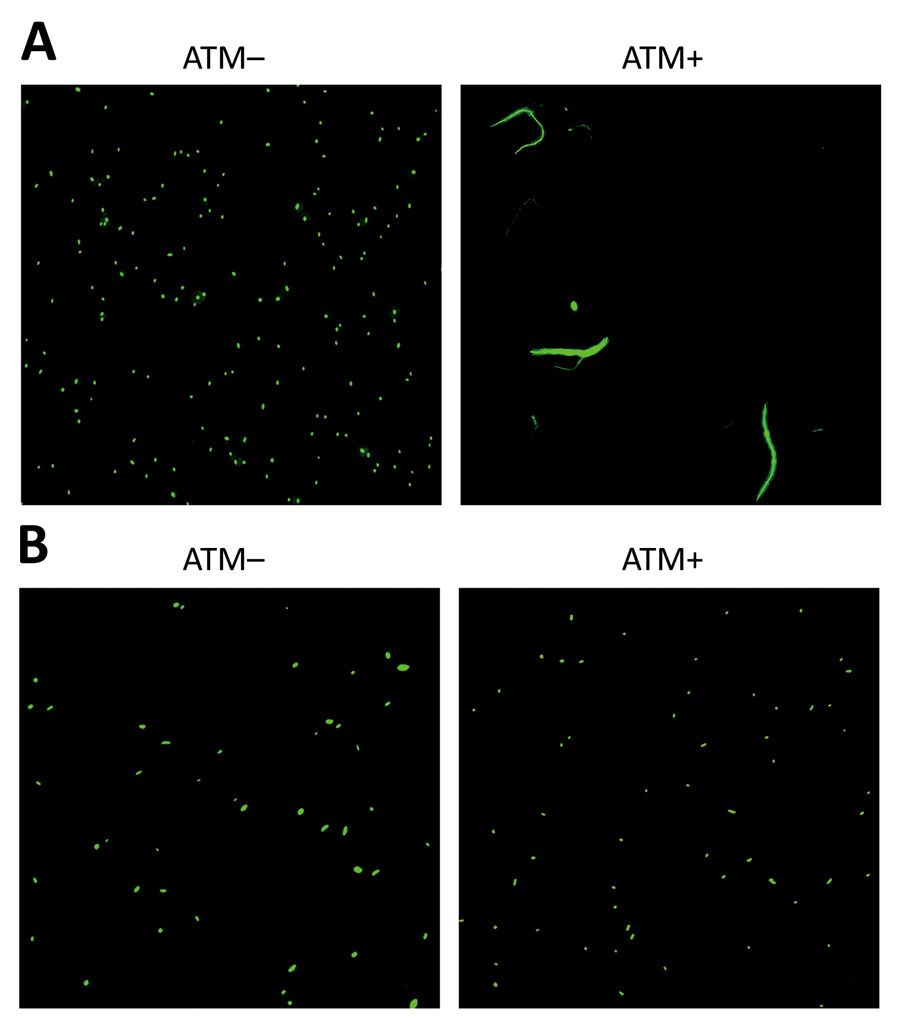
Confocal laser scanning microscopy of Klebsiella pneumoniae carbapenemase (KPC)–producing K. pneumoniae with penicillin-binding protein 3 (PBP3) insertions with and without ATM treatment, Taiwan, 2021. Isolates on the left (ATM–) were not treated with aztreonam and isolates on the right (ATM+) were treated with 64 µg/mL ATM for 6 hours. A) KPC-producing K. pneumoniae with wild-type PBP3 showing elongated and filamentous PBP3 in ATM+, a typical feature of PBP3 inhibition. Isolate used (isolate no. LC6990) was collected from the same hospital as patient isolate in this study (B) and had similar sequence type 11, K locus 47, KPC-2–producing background, and aztreonam MIC (>128 µg/mL). B) KPC-producing K. pneumoniae with PBP3 insertion mutations from isolate LC1491 from this study. Note that ATM+ does not show PBP3 inhibition (filamentation) under the conditions of this experiment. Images were acquired using a 63× objective. ATM, aztreonam.

Figure 2. Confocal laser scanning microscopy of Klebsiella pneumoniae carbapenemase (KPC)–producing K. pneumoniae with penicillin-binding protein 3 (PBP3) insertions with and without ATM treatment, Taiwan, 2021. Isolates on the left (ATM–) were not treated with aztreonam and isolates on the right (ATM+) were treated with 64 µg/mL ATM for 6 hours. A) KPC-producing K. pneumoniae with wild-type PBP3 showing elongated and filamentous PBP3 in ATM+, a typical feature of PBP3 inhibition. Isolate used (isolate no. LC6990) was collected from the same hospital as patient isolate in this study (B) and had similar sequence type 11, K locus 47, KPC-2–producing background, and aztreonam MIC (>128 µg/mL). B) KPC-producing K. pneumoniae with PBP3 insertion mutations from isolate LC1491 from this study. Note that ATM+ does not show PBP3 inhibition (filamentation) under the conditions of this experiment. Images were acquired using a 63× objective. ATM, aztreonam.

Main Article

Page created: April 30, 2026
Page updated: May 08, 2026
Page reviewed: May 08, 2026
The conclusions, findings, and opinions expressed by authors contributing to this journal do not necessarily reflect the official position of the U.S. Department of Health and Human Services, the Public Health Service, the Centers for Disease Control and Prevention, or the authors' affiliated institutions. Use of trade names is for identification only and does not imply endorsement by any of the groups named above.
file_external