Volume 32, Number 8—August 2026
Etymologia
Helicobacter pylori

Cite This Article
Citation for Media
Figure
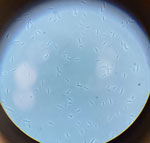
Figure. Representative electron micrograph of Helicobacter pylori, showing its spiral shape and polar flagella, which enable motility in the gastric mucus. Original magnification ×1,000. Photograph provided by the authors.
Helicobacter pylori, a gram-negative, spiral-shaped, microaerophilic bacterium, infects more than half the world’s population. The name derives from helix (spiral), bacter (bacterium), and pylori (Greek for gatekeeper, referring to the pylorus) (Figure). Discovered in 1982 by Barry Marshall and Robin Warren at Royal Perth Hospital in Australia, H. pylori’s role in gastritis was proven when Marshall ingested an inoculum. The scientist stated, “The only person in the world at that time who could make an informed consent about the risk of swallowing the Helicobacter was me.” In 2005, Warren and Marshall won the Nobel Prize in Physiology or Medicine for discovering that H. pylori causes gastropathies.
References
- Bordin DS, Shengelia MI, Ivanova VA, Voynovan IN. The history of the discovery of the Helicobacter pylori [in Russian]. Ter Arkh. 2022;94:283–8. DOIPubMedGoogle Scholar
- de Brito BB, da Silva FAF, Soares AS, Pereira VA, Santos MLC, Sampaio MM, et al. Pathogenesis and clinical management of Helicobacter pylori gastric infection. World J Gastroenterol. 2019;25:5578–89. DOIPubMedGoogle Scholar
- Kusters JG, van Vliet AHM, Kuipers EJ. Pathogenesis of Helicobacter pylori infection. Clin Microbiol Rev. 2006;19:449–90. DOIPubMedGoogle Scholar
- Marshall BJ. Helicobacter connections: Nobel lecture, 2005 Dec 8 [cited 2026 Feb 26]. https://www.nobelprize.org/uploads/2018/06/marshall-lecture.pdf
- Quaglia NC, Dambrosio A. Helicobacter pylori: a foodborne pathogen? World J Gastroenterol. 2018;24:3472–87. DOIPubMedGoogle Scholar
Figure
Cite This ArticleOriginal Publication Date: July 08, 2026
Related Links
Table of Contents – Volume 32, Number 8—August 2026
| EID Search Options |
|---|
 Advanced Article Search – Search articles by author and/or keyword.
|
 Articles by Country Search – Search articles by the topic country.
|
 Article Type Search – Search articles by article type and issue.
|
Please use the form below to submit correspondence to the authors or contact them at the following address:
Mônica Santiago Barbosa, Federal University of Goiás, Setor Leste Universitário, R 235, Goiânia 74605-050, Brazil
Top