Skip directly to site content Skip directly to page options Skip directly to A-Z link Skip directly to A-Z link Skip directly to A-Z link

Disclaimer: Early release articles are not considered as final versions. Any changes will be reflected in the online version in the month the article is officially released.

Volume 31, Number 11—November 2025

Dispatch

Borrelia afzelii Hepatitis in Patient Treated with Venetoclax and Obinutuzumab, Switzerland

Gioele CapoferriComments to Author , Raphael Battegay, Baptiste Hamelin, Peter M. Keller, Kirsten D. Mertz, and Maja Weisser
Author affiliation: University Hospital Basel, Basel, Switzerland

Main Article

Figure 2

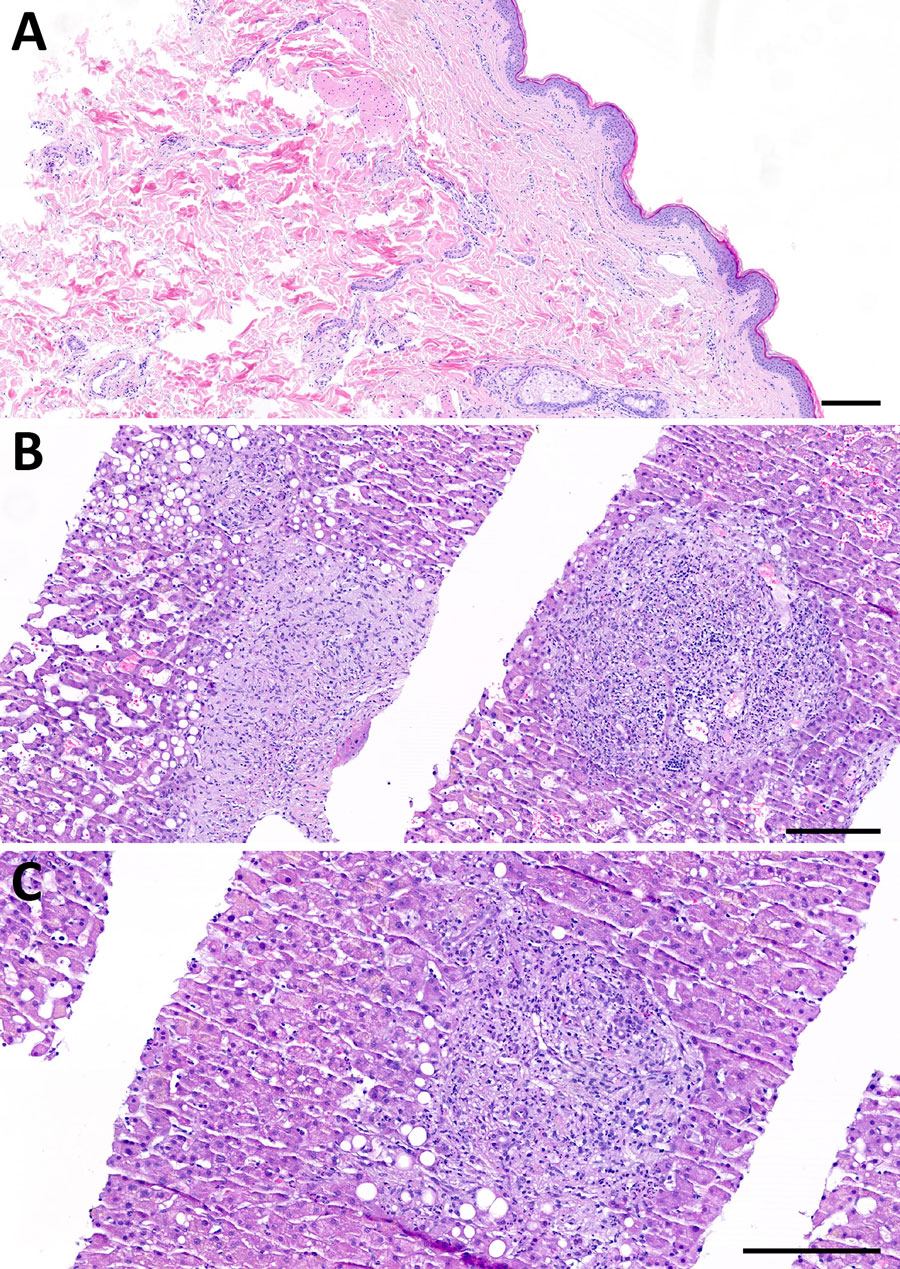
Histopathology of skin and liver for reported case of early disseminated Lyme borreliosis with multiple erythema migrans and hepatitis in a 62-year-old immunosuppressed patient treated with venetoclax and obinutuzumab, Switzerland. A) Skin biopsy from an erythema chronicum migrans lesion on the gluteal region, stained with hematoxylin and eosin. The histology reveals a mild superficial and deep perivascular dermatitis characterized by a sparse, predominantly lymphocytic inflammatory infiltrate, without evidence of plasma cells. B–C) Liver biopsy stained with hematoxylin and eosin showing features of chronic cholestatic hepatitis with superimposed acute cholangitis, while maintaining an overall preserved lobular architecture. Key histological findings include marked sinusoidal dilatation (peliosis); expanded, markedly edematous portal tracts without fibrosis; and prominent ductular proliferates with intraepithelial and intraluminal neutrophilic infiltrates consistent with neutrophilic cholangitis. Neutrophilic infiltrates were also observed within the sinusoids. Additional features included portal ceroid-laden macrophages and microvesicular steatosis. Scale bars indicate 200 µm.

Figure 2. Histopathology of skin and liver for reported case of early disseminated Lyme borreliosis with multiple erythema migrans and hepatitis in a 62-year-old immunosuppressed patient treated with venetoclax and obinutuzumab, Switzerland. A) Skin biopsy from an erythema chronicum migrans lesion on the gluteal region, stained with hematoxylin and eosin. The histology reveals a mild superficial and deep perivascular dermatitis characterized by a sparse, predominantly lymphocytic inflammatory infiltrate, without evidence of plasma cells. B–C) Liver biopsy stained with hematoxylin and eosin showing features of chronic cholestatic hepatitis with superimposed acute cholangitis, while maintaining an overall preserved lobular architecture. Key histological findings include marked sinusoidal dilatation (peliosis); expanded, markedly edematous portal tracts without fibrosis; and prominent ductular proliferates with intraepithelial and intraluminal neutrophilic infiltrates consistent with neutrophilic cholangitis. Neutrophilic infiltrates were also observed within the sinusoids. Additional features included portal ceroid-laden macrophages and microvesicular steatosis. Scale bars indicate 200 µm.

Main Article

Page created: September 18, 2025
Page updated: December 04, 2025
Page reviewed: December 04, 2025
The conclusions, findings, and opinions expressed by authors contributing to this journal do not necessarily reflect the official position of the U.S. Department of Health and Human Services, the Public Health Service, the Centers for Disease Control and Prevention, or the authors' affiliated institutions. Use of trade names is for identification only and does not imply endorsement by any of the groups named above.
file_external