Shifting Dynamics of Dengue Virus Serotype 2 and Emergence of Cosmopolitan Genotype, Costa Rica, 2024
Mauricio González-Elizondo, Dihala Picado Soto, Estela Cordero Laurent, Francisco Duarte Martínez, Luiz Carlos Junior Alcantara, Vagner Fonseca, Jairo Andrés Méndez Rico, Jose Lourenco, Leticia Franco, Marta Giovanetti
1
, and Claudio Soto Garita
1
Author affiliation: Centro Nacional de Referencia de Virología, Tres Ríos, Costa Rica (M. González-Elizondo, D. Picado Soto, E. Cordero Laurent, F. Duarte Martínez, C. Soto Garita); René Rachou Institute, Oswaldo Cruz Foundation, Rio De Janeiro, Brazil (L.C.J. Alcantara); Universidade Federal de Minas Gerais Instituto de Ciencias Biologicas, Belo Horizonte, Brazil (L.C.J. Alcantara); University of the State of Bahia, Salvador, Brazil (V. Fonseca); Centre for Epidemic Response and Innovation (CERI), School of Data Science and Computational Thinking, Stellenbosch University, Stellenbosch, South Africa (V. Fonseca); Pan American Health Organization/World Health Organization, Washington, DC, USA (J.A. Méndez Rico, L. Franco); Universidade Católica Portuguesa, Católica Medical School, Católica Biomedical Research Centre, Lisbon, Portugal (J. Lourenco); Università Campus Bio-Medico di Roma, Rome, Italy (M. Giovanetti); Oswaldo Cruz Institute, Oswaldo Cruz Foundation, Minas Gerais, Brazil (M. Giovanetti)
Main Article
Figure 2
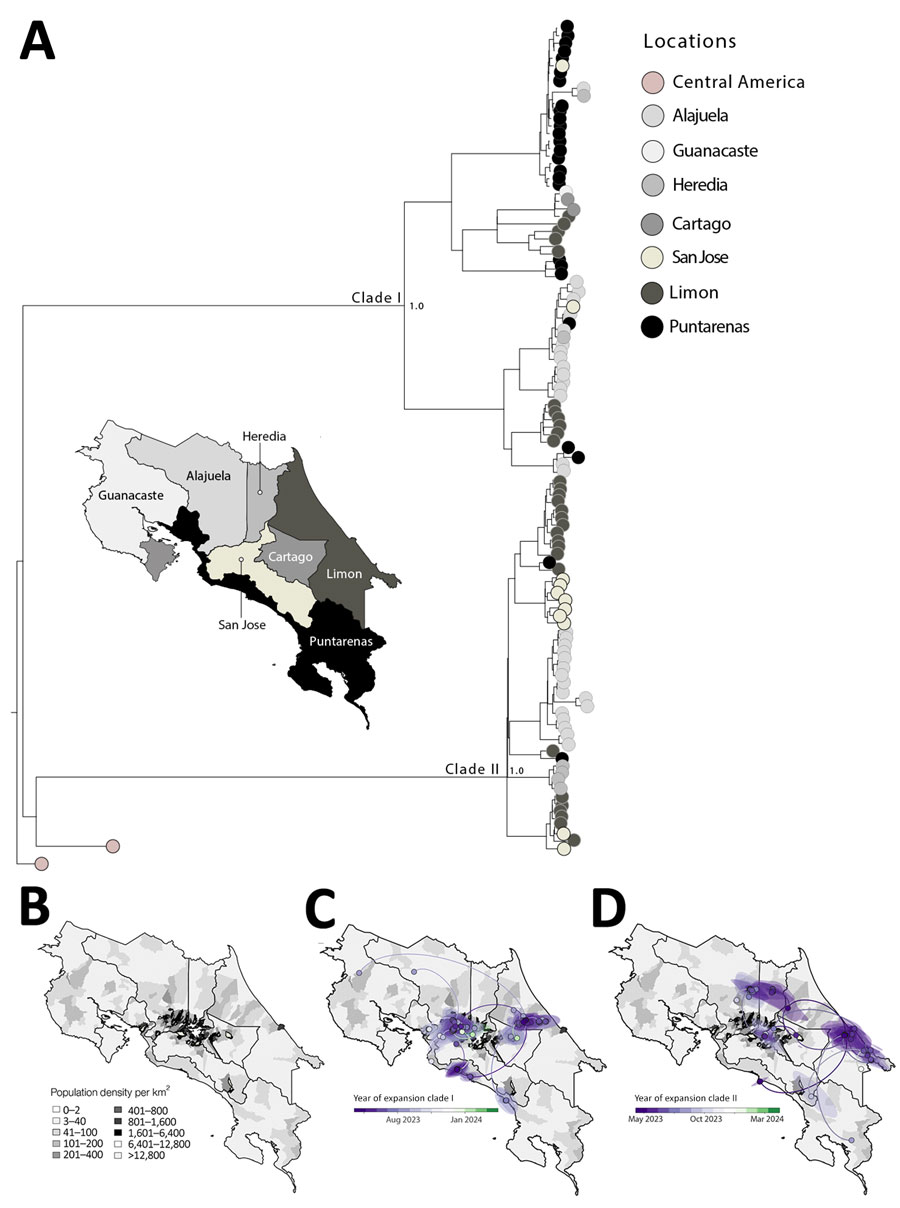
Figure 2. Maximum-likelihood phylogeny and spatiotemporal expansion of dengue virus (DENV) serotype 2 (DENV-2) and emergence of cosmopolitan genotype, Costa Rica, 2024. A) Time-stamped phylogenetic tree of DENV-2 genotype III, showing 2 independent introductions of this genotype into Costa Rica, including 1 major transmission cluster. Tips are colored according to sampling location. Scale bar indicates nucleotide substitutions per site. Full phylogeny shown in Appendix 1 Figure. B) Population density map of Costa Rica, highlighting areas with elevated DENV transmission potential. C, D) Spatiotemporal expansion of DENV-2 genotype III lineage D.1.2, illustrating the progressive spread of 2 distinct clades, clade I (C) and clade II (D), from urban centers to coastal regions between May 2023 and March 2024.
Main Article
Page created: October 01, 2025
Page updated: December 10, 2025
Page reviewed: December 10, 2025
The conclusions, findings, and opinions expressed by authors contributing to this journal do not necessarily reflect the official position of the U.S. Department of Health and Human Services, the Public Health Service, the Centers for Disease Control and Prevention, or the authors' affiliated institutions. Use of trade names is for identification only and does not imply endorsement by any of the groups named above.