Skip directly to site content Skip directly to page options Skip directly to A-Z link Skip directly to A-Z link Skip directly to A-Z link

Disclaimer: Early release articles are not considered as final versions. Any changes will be reflected in the online version in the month the article is officially released.

Volume 31, Number 12—December 2025

Dispatch

Case of Congenital Tularemia with Neuroinvasive Disease, Utah, USA

Brent D. NelsonComments to Author , Amara Finch, Krow Ampofo, Elizabeth L. Ryals, Andrew T. Pavia, Anne J. Blaschke, Jody L. Lin, Benjamin Kalm, Julian A. Villalba, Julu Bhatnagar, Bert Lopansri, and Elizabeth D. Knackstedt
Author affiliation: University of Utah School of Medicine, Salt Lake City, Utah, USA (B.D. Nelson, A. Finch, K. Ampofo, A.T. Pavia, A.J. Blaschke, J.L. Lin, B. Kalm, B. Lopansri, E.D. Knackstedt); Primary Children’s Hospital, Salt Lake City (E.L. Ryals); Centers for Disease Control and Prevention, Atlanta, Georgia, USA (J.A. Villalba, J. Bhatnagar); Intermountain Medical Center, Murray, Utah, USA (B. Lopansri)

Main Article

Figure 2

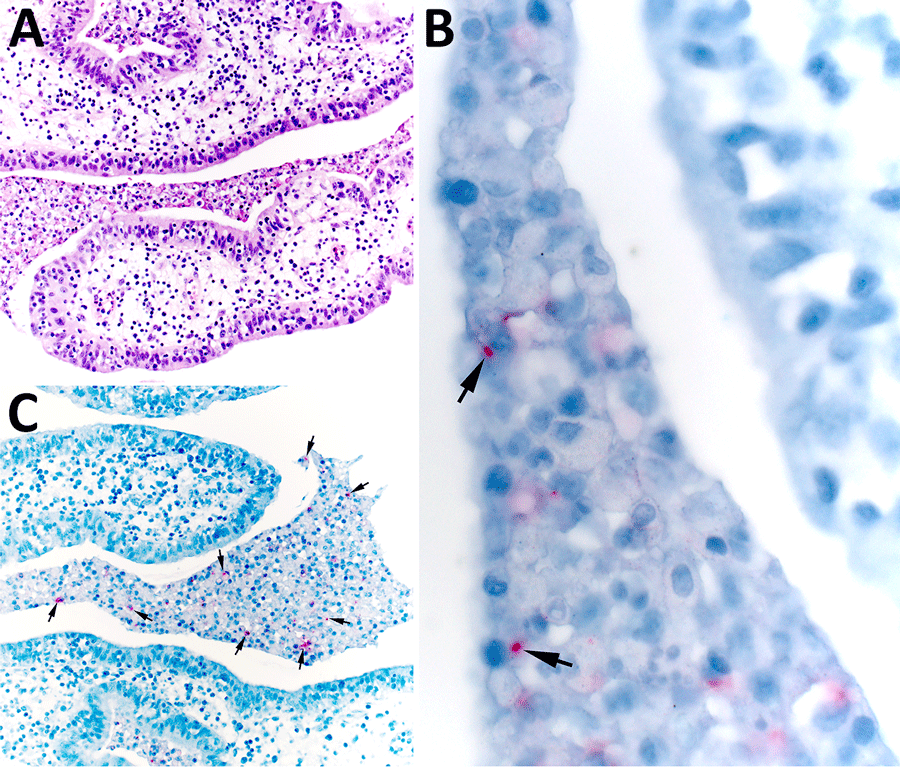
Histopathology in study of congenital tularemia with neuroinvasive disease, Utah, USA. Histopathological evaluation revealed the presence of subacute suppurative salpingitis with serositis. A) Hematoxylin and eosin–stained tissue showing abundant necroinflammatory debris in the lumen of the left fallopian tube. The endosalpinx was edematous, and infiltrating neutrophils and mononuclear cells were seen in the lamina propria and tubal epithelium. Original magnification ×200. B) Higher-power microphotograph highlights immunostaining within intracellular coccobacilli (arrows). Original magnification ×630. C) Francisella tularensis immunohistochemistry showing immunoreactive granular forms of bacterial antigens (arrows) within areas of the luminal necroinflammatory infiltrate. Original magnification ×200.

Figure 2. Histopathology in study of congenital tularemia with neuroinvasive disease, Utah, USA. Histopathological evaluation revealed the presence of subacute suppurative salpingitis with serositis. A) Hematoxylin and eosin–stained tissue showing abundant necroinflammatory debris in the lumen of the left fallopian tube. The endosalpinx was edematous, and infiltrating neutrophils and mononuclear cells were seen in the lamina propria and tubal epithelium. Original magnification ×200. B) Higher-power microphotograph highlights immunostaining within intracellular coccobacilli (arrows). Original magnification ×630. C) Francisella tularensis immunohistochemistry showing immunoreactive granular forms of bacterial antigens (arrows) within areas of the luminal necroinflammatory infiltrate. Original magnification ×200.

Main Article

Page created: November 18, 2025
Page updated: December 12, 2025
Page reviewed: December 12, 2025
The conclusions, findings, and opinions expressed by authors contributing to this journal do not necessarily reflect the official position of the U.S. Department of Health and Human Services, the Public Health Service, the Centers for Disease Control and Prevention, or the authors' affiliated institutions. Use of trade names is for identification only and does not imply endorsement by any of the groups named above.
file_external