Skip directly to site content Skip directly to page options Skip directly to A-Z link Skip directly to A-Z link Skip directly to A-Z link

Disclaimer: Early release articles are not considered as final versions. Any changes will be reflected in the online version in the month the article is officially released.

Volume 31, Number 12—December 2025

Dispatch

Macrolide Resistance and P1 Cytadhesin Genotyping of Mycoplasma pneumoniae during Outbreak, Canada, 2024–2025

Zareen Fatima1, Padman Jayaratne1, Amjad Arrabi, Candy Rutherford, Daniela Leto, Marek Smieja, and Mohammad Rubayet HasanComments to Author 
Author affiliation: McMaster University, Hamilton, Ontario, Canada (Z. Fatima, P. Jayaratne, D. Leto, M. Smieja); Research Institute of St. Joe’s Hamilton, Hamilton (Z. Fatima, A. Arrabi, M. Smieja, M.R. Hasan); Hamilton Regional Laboratory Medicine Program, Hamilton (P. Jayaratne, C. Rutherford, D. Leto, M. Smieja, M.R. Hasan)

Main Article

Figure 1

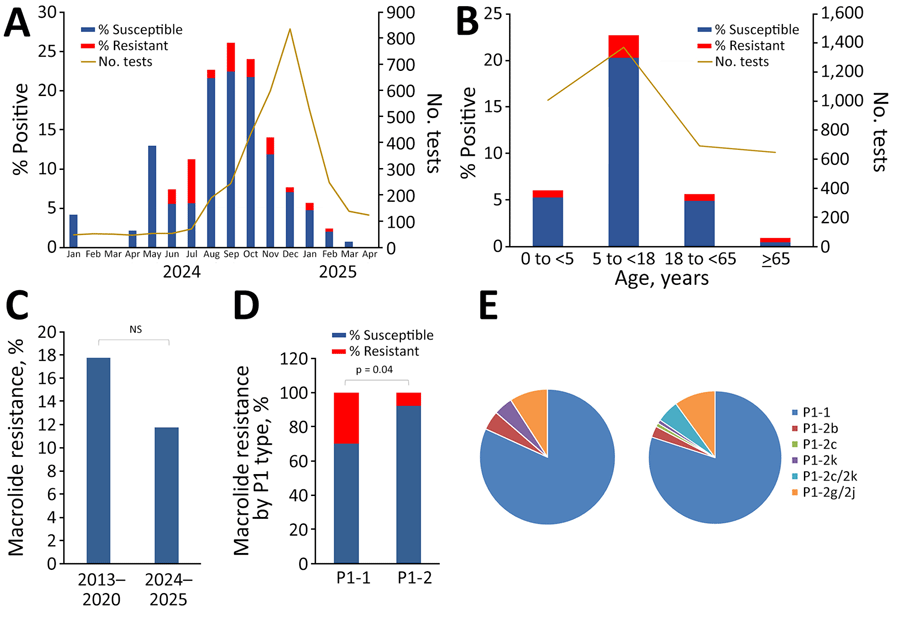
Prevalence, macrolide resistance rates, and P1 genotype distribution of Mycoplasma pneumoniae during 2024–2025 outbreak, Hamilton, Ontario, Canada. A) Monthly detection rates of macrolide-susceptible and -resistant M. pneumoniae during January 2024–April 2025. B) Detection rates of macrolide-susceptible and -resistant M. pneumoniae by age group. C) Comparison of macrolide resistance rates in M. pneumoniae before and after primary COVID-19 pandemic years. D) Macrolide resistance rates among different P1 types of M. pneumoniae. E) Distribution of P1-1 and P1-2 variant types among M. pneumoniae strains before and after primary COVID-19 pandemic years. p value was obtained from χ2 test with Yates correction. NS, not significant.

Figure 1. Prevalence, macrolide resistance rates, and P1 genotype distribution of Mycoplasma pneumoniae during 2024–2025 outbreak, Hamilton, Ontario, Canada. A) Monthly detection rates of macrolide-susceptible and -resistant M. pneumoniae during January 2024–April 2025. B) Detection rates of macrolide-susceptible and -resistant M. pneumoniae by age group. C) Comparison of macrolide resistance rates in M. pneumoniae before and after primary COVID-19 pandemic years. D) Macrolide resistance rates among different P1 types of M. pneumoniae. E) Distribution of P1-1 and P1-2 variant types among M. pneumoniae strains before and after primary COVID-19 pandemic years. p value was obtained from χ2 test with Yates correction. NS, not significant.

Main Article

1These first authors contributed equally to this article.

Page created: December 01, 2025
Page updated: December 23, 2025
Page reviewed: December 23, 2025
The conclusions, findings, and opinions expressed by authors contributing to this journal do not necessarily reflect the official position of the U.S. Department of Health and Human Services, the Public Health Service, the Centers for Disease Control and Prevention, or the authors' affiliated institutions. Use of trade names is for identification only and does not imply endorsement by any of the groups named above.
file_external