Skip directly to site content Skip directly to page options Skip directly to A-Z link Skip directly to A-Z link Skip directly to A-Z link

Disclaimer: Early release articles are not considered as final versions. Any changes will be reflected in the online version in the month the article is officially released.

Volume 31, Number 12—December 2025

Dispatch

Human Infection by Zoonotic Eye Fluke Philophthalmus lacrymosus, South America

Thomas WeitzelComments to Author , Esteban M. Cordero1, Trinidad Mujica1, Carolina Aravena, Brianne E. Phillips, Michael J. Yabsley, Gregory A. Lewbart, Diego Páez-Rosas, María Isabel Jercic, and Sofía Capasso
Author affiliation: Charité–Universitätsmedizin Berlin, Berlin, Germany (T. Weitzel); Clínica Alemana, Universidad del Desarrollo, Santiago, Chile (T. Weitzel, C. Aravena); Instituto de Salud Pública, Santiago (E.M. Cordero, M.I. Jercic), Universidad San Sebastián, Santiago (T. Mujica); Zoo New England, Boston, Massachusetts, USA (B.E. Phillips); University of Georgia, Athens, Georgia, USA (M.J. Yabsley); North Carolina State University, Raleigh, North Carolina, USA (G.A. Lewbart), Universidad San Francisco de Quito, Puerto Baquerizo Moreno, Ecuador (D. Páez-Rosas); Galápagos Conservancy, Puerto Ayora, Ecuador (D. Páez-Rosas); Biologie, Épidémiologie et Analyse de Risque en Santé Animale, Nantes, France (S. Capasso)

Main Article

Figure 2

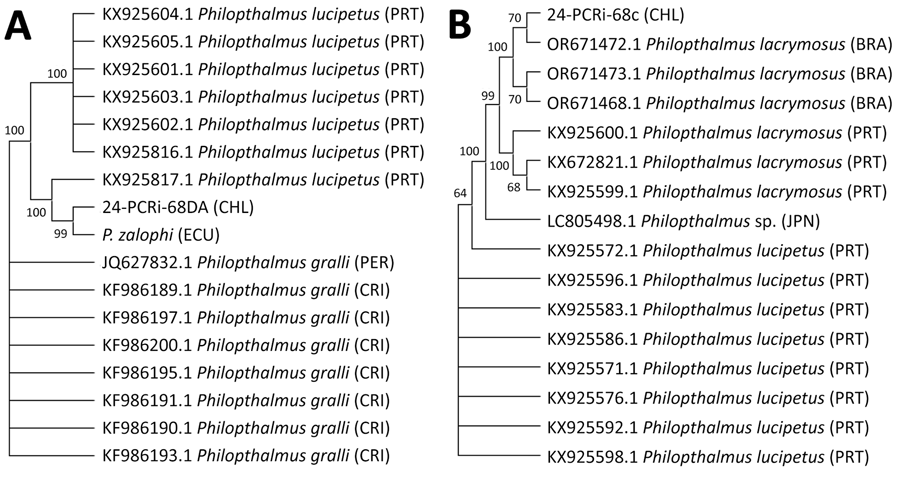
Maximum-likelihood phylogenetic tree constructed from 17 internal transcribed spacer 2 sequences (trimmed alignment 673 bp) (A) and 16 cytochrome c oxidase I sequences (trimmed alignment 365 bp) (B) of Philophthalmus lacrymosus fluke extracted from conjunctiva of a female traveler from England in Chile. Consensus trees were inferred from 1,000 replicates by using the Kimura 2-parameter test in MEGA 11 (https://www.megasoftware.net). Bootstrap values at the nodes indicate the percentages of replicates in which the sequences clustered together. Sequence codes include GenBank accession numbers and parasite information. In parentheses, letter codes indicate the country of origin. Sequences from this case report are 24-PCRi-68DA_CHL (GenBank accession no. PX240011) and 24-PCRi-68c_CHL (accession no. PX238763). BRA, Brazil; CHL, Chile; CRI, Costa Rica; ECU, Ecuador; JPN, Japan; PER, Peru; PRT, Portugal.

Figure 2. Maximum-likelihood phylogenetic tree constructed from 17 internal transcribed spacer 2 sequences (trimmed alignment 673 bp) (A) and 16 cytochrome c oxidase I sequences (trimmed alignment 365 bp) (B) of Philophthalmus lacrymosus fluke extracted from conjunctiva of a female traveler from England in Chile. Consensus trees were inferred from 1,000 replicates by using the Kimura 2-parameter test in MEGA 11 (https://www.megasoftware.net). Bootstrap values at the nodes indicate the percentages of replicates in which the sequences clustered together. Sequence codes include GenBank accession numbers and parasite information. In parentheses, letter codes indicate the country of origin. Sequences from this case report are 24-PCRi-68DA_CHL (GenBank accession no. PX240011) and 24-PCRi-68c_CHL (accession no. PX238763). BRA, Brazil; CHL, Chile; CRI, Costa Rica; ECU, Ecuador; JPN, Japan; PER, Peru; PRT, Portugal.

Main Article

1These authors contributed equally to this article.

Page created: November 20, 2025
Page updated: December 12, 2025
Page reviewed: December 12, 2025
The conclusions, findings, and opinions expressed by authors contributing to this journal do not necessarily reflect the official position of the U.S. Department of Health and Human Services, the Public Health Service, the Centers for Disease Control and Prevention, or the authors' affiliated institutions. Use of trade names is for identification only and does not imply endorsement by any of the groups named above.
file_external