Volume 31, Number 12—December 2025
Research Letter
Carbapenem-Resistant Salmonella Typhi Infection in Traveler Returning to Germany from India, 2024

Figure
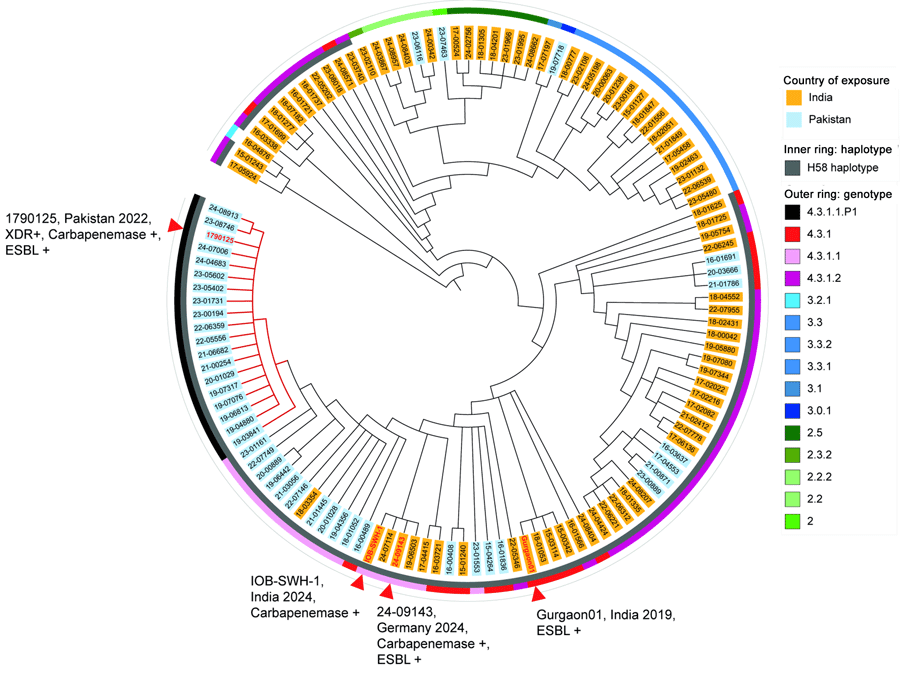
Figure. Phylogenetic structure of Salmonella enterica serovar Typhi strain 24-09143 from a traveler returning to Germany from India and maximum-likelihood tree based on 351 single-nucleotide polymorphisms and visualized with Interactive Tree Of Life ([https://itol.embl.de) showing phylogenetic structure of Salmonella Typhi isolates from Pakistan and India. Tree includes 168 isolates from the Salmonella Typhi surveillance program of Germany’s Reference Center for Salmonella and other Bacterial Enteric Pathogens with reported case exposure in India or Pakistan (2015–2024) and three selected published genomes of strains from these countries. Strain 24-09143 belongs to the H58 haplotype and is closely related to previously described blaNDM-5– or blaCTX-M-15–positive Salmonella Typhi strains from India, specifically strain IOB-SWH-1 from 2024 and strain Gurgaon01 from 2019. It is clearly distinguishable from the XDR H58 sublineage from Pakistan, such as blaNDM-5– and blaCTX-M-15–positive strain 1790125 from 2022. Isolate labels are colored according to the country of origin or exposure. Red type indicates branches corresponding to the XDR sublineage from Pakistan (genotype 4.3.1.1 P1). Inner ring shows the H58 haplotype in gray, and outer ring depicts the genotypes described by Wong et al. (10). Red arrowheads indicate carbapenemase- and ESBL- producing isolates referred to in the study and [[ANCHOR###T1###Table###Anchor]]. ESBL, extended-spectrum β-lactamase; XDR, extensively drug-resistant.
References
- Klemm EJ, Shakoor S, Page AJ, Qamar FN, Judge K, Saeed DK, et al. Emergence of an extensively drug-resistant Salmonella enterica serovar Typhi clone harboring a promiscuous plasmid encoding resistance to fluoroquinolones and third-generation cephalosporins. mBio. 2018;9:e00105–18.PubMedGoogle Scholar
- Ain Q, Tahir M, Sadaqat A, Ayub A, Awan AB, Wajid M, et al. First detection of extensively drug-resistant Salmonella Typhi isolates harboring VIM and GES genes for carbapenem resistance from Faisalabad, Pakistan. Microb Drug Resist. 2022;28:1087–98.PubMedGoogle Scholar
- Nizamuddin S, Khan EA, Chattaway MA, Godbole G. Case of carbapenem-resistant Salmonella Typhi infection, Pakistan, 2022. Emerg Infect Dis. 2023;29:2395–7.PubMedGoogle Scholar
- Vasanthaiah S, Takey P, Selvam PK, Mohan S, Kiran R, Roohi S, et al. Genomic perspectives on NDM Salmonella Typhi, and a case report from India. Infection. 2025;53:2053–9.PubMedGoogle Scholar
- Sah R, Donovan S, Seth-Smith HMB, Bloemberg G, Wüthrich D, Stephan R, et al. A novel lineage of ceftriaxone-resistant Salmonella Typhi from India that is closely related to XDR S. Typhi found in Pakistan. Clin Infect Dis. 2020;71:1327–30.PubMedGoogle Scholar
- Nair S, Chattaway M, Langridge GC, Gentle A, Day M, Ainsworth EV, et al. ESBL-producing strains isolated from imported cases of enteric fever in England and Wales reveal multiple chromosomal integrations of blaCTX-M-15 in XDR Salmonella Typhi. J Antimicrob Chemother. 2021;76:1459–66.PubMedGoogle Scholar
- Thirumoorthy TP, Jacob JJ, Velmurugan A, Teekaraman MP, Shah B, Iyer V, et al. Recent emergence of cephalosporin-resistant Salmonella Typhi in India due to the endemic clone acquiring IncFIB(K) plasmid encoding blaCTX-M-15 gene. Microbiol Spectr. 2025;13:
e0087524 .PubMedGoogle Scholar - Ramírez-Castillo FY, Guerrero-Barrera AL, Avelar-González FJ. An overview of carbapenem-resistant organisms from food-producing animals, seafood, aquaculture, companion animals, and wildlife. Front Vet Sci. 2023;10:
1158588 .PubMedGoogle Scholar - Wu Y, Jiang T, Bao D, Yue M, Jia H, Wu J, et al. Global population structure and genomic surveillance framework of carbapenem-resistant Salmonella enterica. Drug Resist Updat. 2023;68:
100953 .PubMedGoogle Scholar - Wong VK, Baker S, Connor TR, Pickard D, Page AJ, Dave J, et al.; International Typhoid Consortium. An extended genotyping framework for Salmonella enterica serovar Typhi, the cause of human typhoid. Nat Commun. 2016;7:12827.PubMedGoogle Scholar