Long-Term Illness in Adults Hospitalized for Respiratory Syncytial Virus Disease, United States, February 2022–September 2023
Aleda M. Leis

, Kelsey N. Womack, Courtney Maxcy, Ellen Caldwell, Caroline Cheng, Sydney A. Cornelison, Diya Surie, Fatimah S. Dawood, Sharon Saydah, Manjusha Gaglani, Cristie Columbus, Abhijit Duggal, Laurence W. Busse, Laurynn M. Giles, Ivana A. Vaughn, Ithan D. Peltan, David N. Hager, Amira Mohamed, Matthew C. Exline, Akram Khan, Jennifer G. Wilson, Jarrod S. Mosier, Steven Y. Chang, Adit A. Ginde, Nicholas M. Mohr, Christopher Mallow, Estelle S. Harris, Nicholas J. Johnson, Kevin W. Gibbs, Jennie H. Kwon, Basmah Safdar, Emily T. Martin, Wesley H. Self, Catherine L. Hough, Jin H. Han, and
for the Investigating Respiratory Viruses in the Acutely Ill (IVY) Network1
Author affiliation: University of Michigan School of Public Health, Ann Arbor, Michigan, USA (A.M. Leis, C. Cheng, E.T. Martin); Vanderbilt Institute for Clinical and Translational Research, Vanderbilt University Medical Center, Nashville, Tennessee, USA (K.N. Womack, W.H. Self); Oregon Health & Sciences University, Portland, Oregon, USA (C. Maxcy, E. Caldwell, A. Khan, C.L. Hough); Vanderbilt University Medical Center, Nashville (S.A. Cornelison, J.H. Han); Centers for Disease Control and Prevention, Atlanta, Georgia, USA (D. Surie, F.S. Dawood, S. Saydah); Baylor College of Medicine–Temple, Temple, Texas, USA (M. Gaglani); Baylor Scott & White Health, Dallas, Texas, USA (M. Gaglani, C. Columbus); Texas A&M University College of Medicine, Dallas (M. Gaglani, C. Columbus); Cleveland Clinic, Cleveland, Ohio, USA (A. Duggal); Emory University, Atlanta (L.W. Busse); Hennepin County Medical Center, Minneapolis, Minnesota, USA (L.M. Giles); Henry Ford Medical Center, Detroit, Michigan, USA (I.A. Vaughn); Intermountain Medical Center, Murray, Utah, USA (I.D. Peltan); University of Utah, Salt Lake City, Utah, USA (I.D. Peltan, E.S. Harris); Johns Hopkins University School of Medicine, Baltimore, Maryland, USA (D.N. Hager); Montefiore Medical Center, Albert Einstein College of Medicine, Bronx, New York, USA (A. Mohamed); The Ohio State University, Columbus, Ohio, USA (M.C. Exline); Stanford University School of Medicine, Stanford, California, USA (J.G. Wilson); University of Arizona, Tucson, Arizona, USA (J.S. Mosier); University of California, Los Angeles, California, USA (S.Y. Chang); University of Colorado School of Medicine, Aurora, Colorado, USA (A.A. Ginde); University of Iowa, Iowa City, Iowa, USA (N.M. Mohr); University of Miami, Miami, Florida, USA (C. Mallow); University of Washington, Seattle, Washington, USA (N.J. Johnson); Wake Forest School of Medicine, Winston-Salem, North Carolina, USA (K.W. Gibbs); Washington University, St. Louis, Missouri, USA (J.H. Kwon); Yale University, New Haven, Connecticut, USA (B. Safdar); Geriatric Research, Education, and Clinical Center, Tennessee Valley Healthcare System, Nashville (J.H. Han)
Main Article
Figure 1
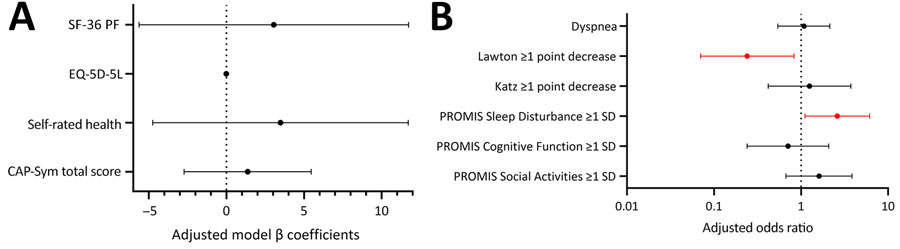
Figure 1. Multivariable model results for 6- to 12-month primary and secondary outcomes for patients hospitalized with respiratory syncytial virus by age in a study of long-term illness in adults hospitalized for respiratory syncytial virus disease or COVID-19, United States, February 2022–September 2023. Models compared persons <60 years of age to those >60 years of age. Results are presented separately for continuous (A) and binary or ordinal (dyspnea) (B) outcomes. The earliest completed survey from 6, 9, or 12 months was included. Models were additionally adjusted for sex, race/ethnicity, smoking status, baseline functional limitations, and number of organ systems affected by chronic disease. For outcome models with baseline data available (Katz, Lawton, and SF-36 PF), the matching retrospective baseline variable was included. Red indicates statistically significant effects. Error bars indicate 95% CIs. Vertical dotted lines indicate a null result value for that model type. Outcomes where higher values indicate worse illness for those <60 years of age: CAP-Sym total score, dyspnea, Lawton >1 point decrease, Katz >1 point decrease, and PROMIS Sleep Disturbance >1 SD. Details on each testing scale are provided in the text.
Main Article
Page created: August 25, 2025
Page updated: January 22, 2026
Page reviewed: January 22, 2026
The conclusions, findings, and opinions expressed by authors contributing to this journal do not necessarily reflect the official position of the U.S. Department of Health and Human Services, the Public Health Service, the Centers for Disease Control and Prevention, or the authors' affiliated institutions. Use of trade names is for identification only and does not imply endorsement by any of the groups named above.