Volume 32, Number 1—January 2026
Dispatch
Tularemia in New York, USA, 1993–2023
Dylan T. Gaber1, Melissa A. Prusinski1 , Ashley Hodge, Alexis White, Michael P. Santoriello, Christopher L. Romano, Scott R. Campbell, Zahra LaTerra, Melissa D’Amico, Michael Perry, and Jennifer L. White
, Ashley Hodge, Alexis White, Michael P. Santoriello, Christopher L. Romano, Scott R. Campbell, Zahra LaTerra, Melissa D’Amico, Michael Perry, and Jennifer L. White
Figure
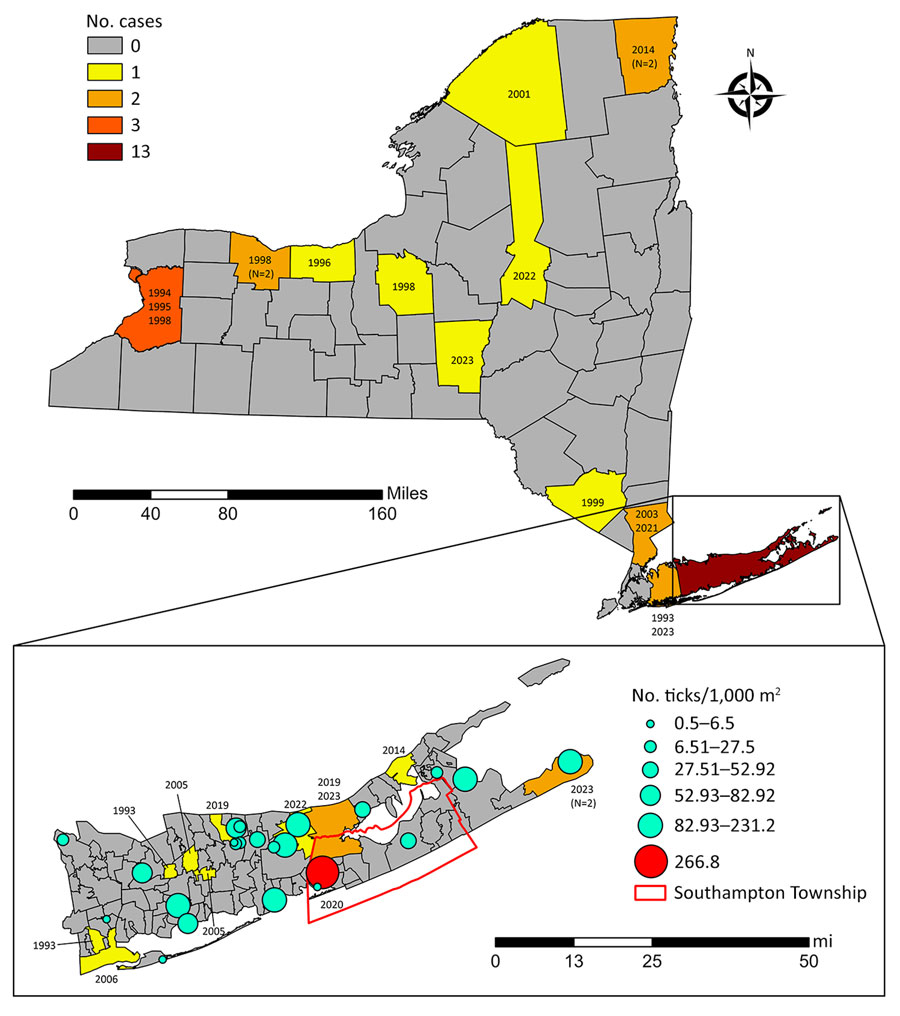
Figure. Human tularemia cases mapped by county of residence, New York, USA, 1993–2023. Year of case diagnosis shown. Inset displays tularemia cases by postal (ZIP) code tabulation area of residence, Suffolk County, New York, 1993–2023, overlaid with cumulative host-seeking tick density (2019–2023). Tick density expressed as ticks per 1,000 m2 sampled (nymphs and adults combined), cumulative over the surveillance period. Red marker indicates location of the Francisella tularensis–positive tick pool.
1These first authors contributed equally to this article.
Page created: January 16, 2026
Page updated: January 29, 2026
Page reviewed: January 29, 2026
The conclusions, findings, and opinions expressed by authors contributing to this journal do not necessarily reflect the official position of the U.S. Department of Health and Human Services, the Public Health Service, the Centers for Disease Control and Prevention, or the authors' affiliated institutions. Use of trade names is for identification only and does not imply endorsement by any of the groups named above.