Volume 32, Number 1—January 2026
Research Letter
Molecular Analysis of Emerging MT27 Macrolide-Resistant Bordetella pertussis, Kobe, Japan, 2025
 , Kousaku Matsubara, Yuui Inenaga, Masayuki Hori, Kiyo Shiotani, Rumi Morimoto, Chie Nantani, Yuki Muneta, and Nobuya Kusunoki
Cite This Article
Citation for Media
Abstract
We report the emergence and spread of multilocus variable-number tandem-repeat analysis type 27 (MT-27) macrolide-resistant Bordetella pertussis (MRBP) in Kobe, Japan, in 2025. Whole-genome sequencing revealed that MT27-MRBP did not originate from the widely circulating MT27 macrolide-sensitive B. pertussis in Japan but was closely related to MRBP in China.
Bordetella pertussis, a gram-negative, pathogenic bacterium of the genus Bordetella, is the causative agent of contagious respiratory illness and whooping cough (pertussis). Diphtheria-pertussis-tetanus (DPT) combination vaccines have substantially reduced pertussis-related illness and deaths, especially among infants (1). Macrolides represent mostly natural polyketide-class products containing a large macrocyclic lactone ring with potential attachment groups (e.g., deoxy sugars), with antibiotic or antifungal activities. Macrolides are popular pharmaceutical drugs, frequently used for pertussis treatment and prevention. Macrolide-resistant B. pertussis (MRBP), characterized by the A2047G mutation in a region critical for macrolide binding to the 23S rRNA gene, has recently emerged and spread worldwide (2). In China, the predominant MRBP genetic lineage has shifted in the pertussis toxin promoter region (ptxP) allele type from ptxP1 to ptxP3, and the prevalence of the ptxP3-carrying multilocus variable-number tandem-repeat analysis type (MT) 28 MRBP strain has increased rapidly (3).
In Japan, pertussis notifications, which decreased during the COVID-19 pandemic, have significantly increased since 2024 (4). MRBP was first documented in 2018 during the first isolation of ptxP1-MT195-MRBP (5). More recently, ptxP3-MRBP strains isolated from Tokyo and Okinawa have been described, demonstrating close genetic relation to the China strains (6,7).
MT27 is a single-locus MT28 variant, and this genotype, carrying the virulence-associated alleles ptxP3/ptxA1/prn2/fim3-1, became predominant among macrolide-susceptible B. pertussis (MSBP) strains in various countries, including Japan (8–10). In contrast, to date, just 1 MT27-MRBP strain has been reported in China in 2017 (8); no cases have been identified outside of China. In this study, we report 5 MT27-MRBP strains isolated during February–March 2025 from children with pertussis in 1 hospital and 2 private clinics in Kobe, Japan (Table). To investigate the molecular epidemiologic characteristics of these 5 MT27-MRBP isolates, we compared them to Japan MT27-MSBP strains isolated during 2010–2025, including 10 isolates from Kobe, and MRBP strains from China (3,6–8,10). This study was approved by the Kobe City Review Board (approval no. SenR3-10).
We collected 9 MT27 strains from patients 2 months through 12 years of age during January–March 2025 (Table). All 5 MT27-MRBP strains harbored the A2047G mutation in the 23S rRNA and exhibited MICs of >256 μg/mL for erythromycin, clarithromycin, and azithromycin. All MT27-MRBP–infected patients recovered without any sequelae. We used the BIGSdb-Pasteur platform (https://bigsdb.pasteur.fr/bordetella) to identify the MT27-MRBP virulence genotype, which yielded identical results for all strains: ptxP3/ptxA1/fhaB1/fim3–1/prn150. Among the 5 virulence-related genes, we observed a difference in the prn allele between the MT27-MSBP and MT27-MRBP strains isolated in Kobe (i.e., prn2 in MSBP and prn150 in MRBP) (Table). Of note, prn150 was identical to the allele in the globally prevalent MT28-MRBP strains (3).
Figure
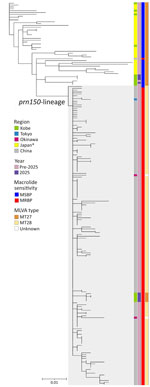
Figure. Phylogenetic tree based on single-nucleotide variants, showing 15 MT27 Bordetella pertussisstrains isolated in Kobe (green); 37 strains from Japan (yellow), including Tokyo (blue) and Okinawa (magenta); and 155...
To determine genetic relatedness, we performed phylogenetic analyses using whole-genome sequences of 6 MT27-MSBP isolates obtained in Kobe since 2013 (Table) and other publicly available genomes (Appendix Table). Our single-nucleotide variant–based phylogenetic analysis revealed that the 5 MT27-MRBP strains clustered within the prn150 lineage, which is genetically closely related to the MRBP strain from China and that clonal population (Figure). Furthermore, MT27-MRBP strains in Kobe were genetically distinct from the China MT27-MRBP (GenBank accession no. SRR16306222), as well as from the Japan MRBP strains, BP636 (GenBank accession no. DRR631445) in Tokyo and OkiPb01308 and OkiPb01309 (National Center for Biotechnology Information BioProject accession no. PRJDB20292) in Okinawa (Figure). The identification of genetically divergent strains across 3 geographically separated regions of Japan suggests multiple, epidemiologically independent introductions. In contrast, MT27-MSBP strains KBP0014, KBP0018, KBP0019, and KBP0025, isolated in 2025, belonged to a clade of currently prevalent strains in Japan. Taken together, our results suggest that MT27-MRBP does not originate from the currently circulating MT27-MSBP in Japan but could have been potentially introduced from China. Finally, 5 MT27-MRBP–infected patients resided in 3 different wards with no apparent temporal links, suggesting that this newly emergent strain might be spreading latently in Kobe.
In conclusion, we identified distinct genetic differences between the MT27-MSBP and MT27-MRBP strains collected during January–March 2025 in Kobe. Our study suggests that MT27-MRBP strains closely related to the China MRBP strains have emerged and spread in Kobe, Japan.
Ms. Komatsu is a research scientist at the Kobe Institute of Health, Hyogo, Japan. Her primary research interests are molecular epidemiology of bacterial infections of the respiratory tract, such as Bordetella pertussis and Legionella spp.
Acknowledgments
We thank the medical institutions in Kobe for submitting specimens as part of the surveillance program.
Raw sequencing data for the isolates from Kobe have been deposited in DDBJ/EMBL/GenBank (DRA accession numbers DRR698592–606). GenBank accession numbers for all genome sequences used for phylogenetic analysis are listed in the Appendix Table.
This work was supported by JSPS KAKENHI (grant no. JP25K24232).
References
- Sheng Y, Ma S, Zhou Q, Xu J. Pertussis resurgence: epidemiological trends, pathogenic mechanisms, and preventive strategies. Front Immunol. 2025;16:
1618883 .DOIPubMedGoogle Scholar - Ivaska L, Barkoff AM, Mertsola J, He Q. Macrolide resistance in Bordetella pertussis: current situation and future challenges. Antibiotics (Basel). 2022;11:1570.DOIPubMedGoogle Scholar
- Fu P, Yan G, Li Y, Xie L, Ke Y, Qiu S, et al. Pertussis upsurge, age shift and vaccine escape post-COVID-19 caused by ptxP3 macrolide-resistant Bordetella pertussis MT28 clone in China. Clin Microbiol Infect. 2024;30:1439–46.DOIPubMedGoogle Scholar
- Japan Institute for Health Security. Risk assessment: pertussis outbreak situation in Japan [cited May 18]. https://id-info.jihs.go.jp/diseases/ha/pertussis/020/250422_JIHS_Pertussis_en.pdf
- Koide K, Uchitani Y, Yamaguchi T, Otsuka N, Goto M, Kenri T, et al. Whole-genome comparison of two same-genotype macrolide-resistant Bordetella pertussis isolates collected in Japan. PLoS One. 2024;19:
e0298147 .DOIPubMedGoogle Scholar - Iwasaki T, Koide K, Kido T, Nakagawa S, Goto M, Kenri T, et al. Fatal case of macrolide-resistant Bordetella pertussis infection, Japan, 2024. J Infect Chemother. 2025;31:
102727 .DOIPubMedGoogle Scholar - Tsukahara H, Araki K, Cho Y, Fujiwara N, Matsuoka T, Kakita T, et al. Severe macrolide-resistant Bordetella pertussis (ptxP3) infection in Japanese infants: First report of cases requiring intensive care. Int J Infect Dis. 2025;158:
107960 .DOIPubMedGoogle Scholar - Wu X, Du Q, Li D, Yuan L, Meng Q, Fu Z, et al. A cross-sectional study revealing the emergence of erythromycin-resistant Bordetella pertussis carrying ptxP3 alleles in China. Front Microbiol. 2022;13:
901617 .DOIPubMedGoogle Scholar - Koide K, Yao S, Chiang CS, Thuy PTB, Nga DTT, Huong DT, et al. Genotyping and macrolide-resistant mutation of Bordetella pertussis in East and South-East Asia. J Glob Antimicrob Resist. 2022;31:263–9.DOIPubMedGoogle Scholar
- Kamachi K, Koide K, Otsuka N, Goto M, Kenri T. Whole-genome analysis of Bordetella pertussis MT27 isolates from school-associated outbreaks: single-nucleotide polymorphism diversity and threshold of the outbreak strains. Microbiol Spectr. 2023;11:
e0406522 .DOIPubMedGoogle Scholar
Figures
Table
Cite This ArticleOriginal Publication Date: January 21, 2026
Table of Contents – Volume 32, Number 1—January 2026
| EID Search Options |
|---|
 Advanced Article Search – Search articles by author and/or keyword.
|
 Articles by Country Search – Search articles by the topic country.
|
 Article Type Search – Search articles by article type and issue.
|
Please use the form below to submit correspondence to the authors or contact them at the following address:
Noriko Nakanishi, Health Research Department 2, Kobe Institute of Health, 4-6-5 Minatojima-nakamachi, Chuo-ku, Kobe, Hyogo 650-0046, Japan
Top