Volume 32, Number 1—January 2026
Dispatch
Evidence of Rat Hepatitis E Virus Circulation through Wastewater Surveillance, Central Argentina
 , María Emilia Lucero1, Guadalupe Di Cola, Anabella Fantilli, Alfonsina Roccia, Paola Sicilia, Liliana Luque, Ariana Cachi, María de los Ángeles Marinzalda, Gonzalo Castro, Gisela Masachessi, Viviana Ré, and María Belén Pisano
Figure 2
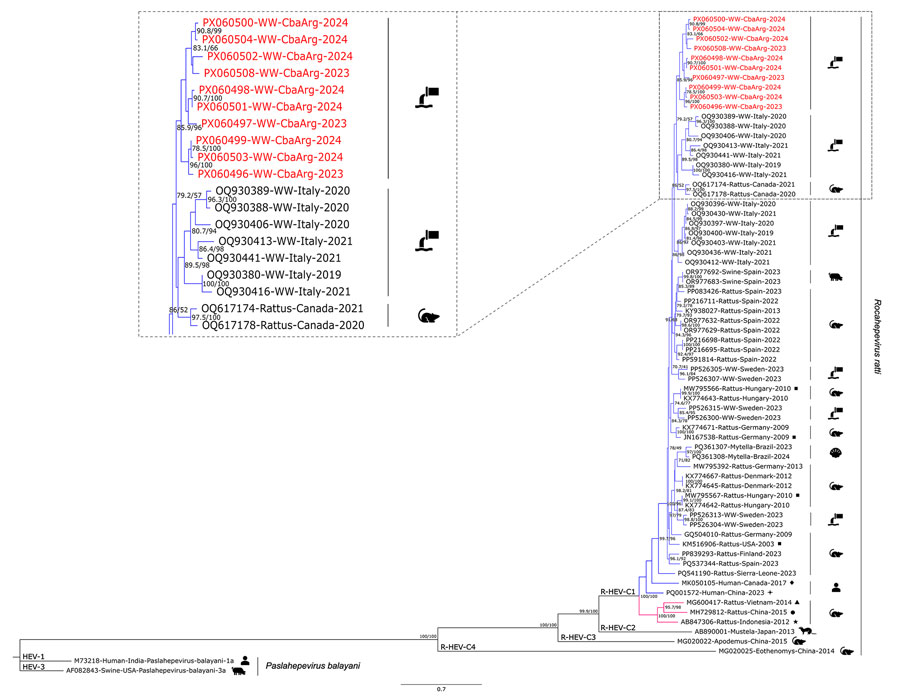
Figure 2. Maximum-likelihood phylogenetic tree on the basis of a 338 bp fragment of the open reading frame 1 genomic region of rat hepatitis E virus (R-HEV; Rocahepevirus ratti) from Argentina, 2023–2024. Red text indicates sequences obtained during this study. The tree includes representative sequences of each R-HEV genotype available in GenBank database, additional sequences of proposed clades (clade I in blue, clade II in pink) and subtypes a (square), b (circle), c (5-pointed star), d (4-pointed star), e (rhombus), and f (triangle) (13). Two hepatitis E virus (Paslahepevirus balayani) sequences (genotypes 1 and 3) were used as outgroups. Enlarged area shows sequences from this study and the first 10 most similar sequences from BLAST analysis (https://blast.ncbi.nlm.nih.gov). Statistical support values are indicated at nodes; only supports over 70/70 are shown. Scale bar represents the number of substitutions per site.
References
- Palombieri A, Di Profio F, Sarchese V, Fruci P, Suffredini E, Martella V, et al. Surveillance for rat hepatitis E in wastewater networks, Italy. Microbiol Spectr. 2023;11:
e0267523 . DOIPubMedGoogle Scholar - Porea D, Raileanu C, Crivei LA, Gotu V, Savuta G, Pavio N. First detection of hepatitis E virus (Rocahepevirus ratti genotype C1) in synanthropic Norway rats (Rattus norvegicus) in Romania. Viruses. 2023;15:1337. DOIPubMedGoogle Scholar
- Rivero-Juarez A, Frias M, Perez AB, Pineda JA, Reina G, Fuentes-Lopez A, et al.; HEPAVIR and GEHEP-014 Study Groups. Orthohepevirus C infection as an emerging cause of acute hepatitis in Spain: First report in Europe. J Hepatol. 2022;77:326–31. DOIPubMedGoogle Scholar
- Caballero-Gómez J, Casares-Jiménez M, Gallo-Marín M, Pereira-Pardo S, Beato-Benítez A, Poyato A, et al.; GEHEP-014 Study Group. Rat hepatitis E virus as an aetiological agent of acute hepatitis of unknown origin. J Hepatol. 2025;83:662–9. DOIPubMedGoogle Scholar
- Yadav KK, Boley PA, Lee CM, Khatiwada S, Jung K, Laocharoensuk T, et al. Rat hepatitis E virus cross-species infection and transmission in pigs. PNAS Nexus. 2024;3:pgae259. DOIGoogle Scholar
- Rios-Muñoz L, Gonzálvez M, Caballero-Gomez J, Castro-Scholten S, Casares-Jimenez M, Agulló-Ros I, et al. Detection of rat hepatitis E virus in pigs, Spain, 2023. Emerg Infect Dis. 2024;30:823–6. DOIPubMedGoogle Scholar
- Velavan TP, Pallerla SR, Johne R, Todt D, Steinmann E, Schemmerer M, et al. Hepatitis E: An update on One Health and clinical medicine. Liver Int. 2021;41:1462–73. DOIPubMedGoogle Scholar
- Fantilli AC, Masachessi G, Cola GD, Castro G, Sicilia P, Marinzalda MLA, et al. Integrated hepatitis e virus monitoring in central Argentina: a six-year analysis of clinical surveillance and wastewater-based epidemiology. Water Res. 2024;261:
122004 . DOIPubMedGoogle Scholar - Figueiredo AS, Negreiros IR, do Nascimento E Silva A, Salgado CRS, Dos Santos NL, Pinto MA, et al. Detection of Rocahepevirus ratti in bivalve mollusks from São Luís Island, Maranhão, Brazil: a potential transmission route of an emerging zoonotic pathogen? Food Environ Virol. 2025;17:11. DOIPubMedGoogle Scholar
- Sridhar S, Yip CCY, Wu S, Cai J, Zhang AJX, Leung KH, et al. Rat hepatitis E virus as cause of persistent hepatitis after liver transplant. Emerg Infect Dis. 2018;24:2241–50. DOIPubMedGoogle Scholar
- Drexler JF, Seelen A, Corman VM, Fumie Tateno A, Cottontail V, Melim Zerbinati R, et al. Bats worldwide carry hepatitis E virus-related viruses that form a putative novel genus within the family Hepeviridae. J Virol. 2012;86:9134–47. DOIPubMedGoogle Scholar
- Tamura K, Stecher G, Kumar S. MEGA11: molecular evolutionary genetics analysis version 11. Mol Biol Evol. 2021;38:3022–7. DOIPubMedGoogle Scholar
- Lo KH, Ho SS, Shun EH, Wu S, Yip CC, Situ J, et al. Enhanced surveillance, subtyping, and host adaptation analysis reveal genotype-wide zoonotic potential of rat hepatitis E virus. J Hepatol. 2026;84:51–61. DOIPubMedGoogle Scholar
- Rouba A, Ansmant T, Chaqroun A, Challant J, Josse T, Schvoerer E, et al. First detection of Hepatitis E virus (Rocahepevirus ratti) in French urban wastewater: Potential implications for human contamination. Sci Total Environ. 2024;954:
176805 . DOIPubMedGoogle Scholar - Robinson SJ, Borlang J, Himsworth CG, Pearl DL, Weese JS, Dibernardo A, et al. Rat hepatitis E virus in Norway rats, Ontario, Canada, 2018–2021. Emerg Infect Dis. 2023;29:1890–4. DOIPubMedGoogle Scholar
1These authors contributed equally to this article.