Volume 32, Number 1—January 2026
Dispatch
Dermacentor occidentalis Ticks and Link to Rickettsia lanei Infections, California, USA
Will S. Probert , Chantha Kath, Naomi Putirka, Megan E.M. Saunders, Brenda Bermudez, Matthew I. Cazas, Alex Espinosa, Hannah Romo, and Jill K. Hacker
, Chantha Kath, Naomi Putirka, Megan E.M. Saunders, Brenda Bermudez, Matthew I. Cazas, Alex Espinosa, Hannah Romo, and Jill K. Hacker
Figure
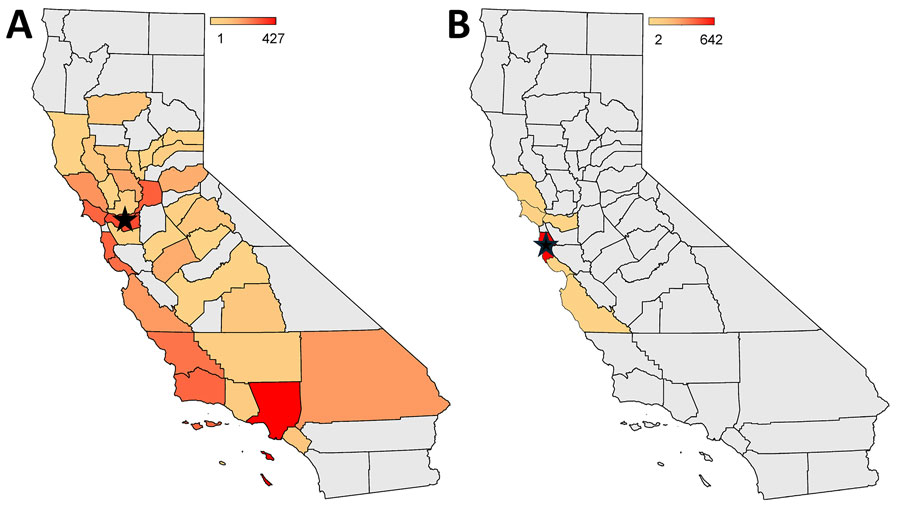
Figure. Heat maps displaying the number of Dermacentor occidentalis (A) and Haemaphysalis leporispalustris (B) ticks tested for spotted fever group Rickettsia in 2024, by county, in study of D. occidentalis ticks and link to Rickettsia lanei infections, California, USA. Color scale represents number of ticks. Black star represents the location of ticks testing positive by PCR for R. lanei: 1 D. occidentalis tick in Contra Costa County (A) and 2 H. leporispalustris ticks in San Mateo County (B). Gray shading indicates counties in which tick collection was not attempted or the tick species was not found.
Page created: December 13, 2025
Page updated: January 29, 2026
Page reviewed: January 29, 2026
The conclusions, findings, and opinions expressed by authors contributing to this journal do not necessarily reflect the official position of the U.S. Department of Health and Human Services, the Public Health Service, the Centers for Disease Control and Prevention, or the authors' affiliated institutions. Use of trade names is for identification only and does not imply endorsement by any of the groups named above.