Skip directly to site content Skip directly to page options Skip directly to A-Z link Skip directly to A-Z link Skip directly to A-Z link

Disclaimer: Early release articles are not considered as final versions. Any changes will be reflected in the online version in the month the article is officially released.

Volume 32, Number 10—October 2026

Dispatch

Emergence of Rabies in Cape Fur Seals, South Africa

Chuene Ernest Ngoepe1Comments to Author , Lesley van Helden1, Wonderful Shumba, Laura C. Roberts, Deon Kriel, Munangatire Mparamoto, and Claude Taurai Sabeta
Author affiliation: Agricultural Research Council–Onderstepoort Veterinary Research, Pretoria, South Africa (C.E. Ngoepe, M. Mparamoto, C.T. Sabeta); Western Cape Department of Agriculture, Elsenburg, South Africa (L. van Helden, L.C Roberts); Northern Cape Department of Agriculture, Environmental Affairs, Rural Development and Land Reform, Kimberley, South Africa (W. Shumba, D. Kriel); University of Pretoria, Pretoria (C.T. Sabeta)

Main Article

Figure 2

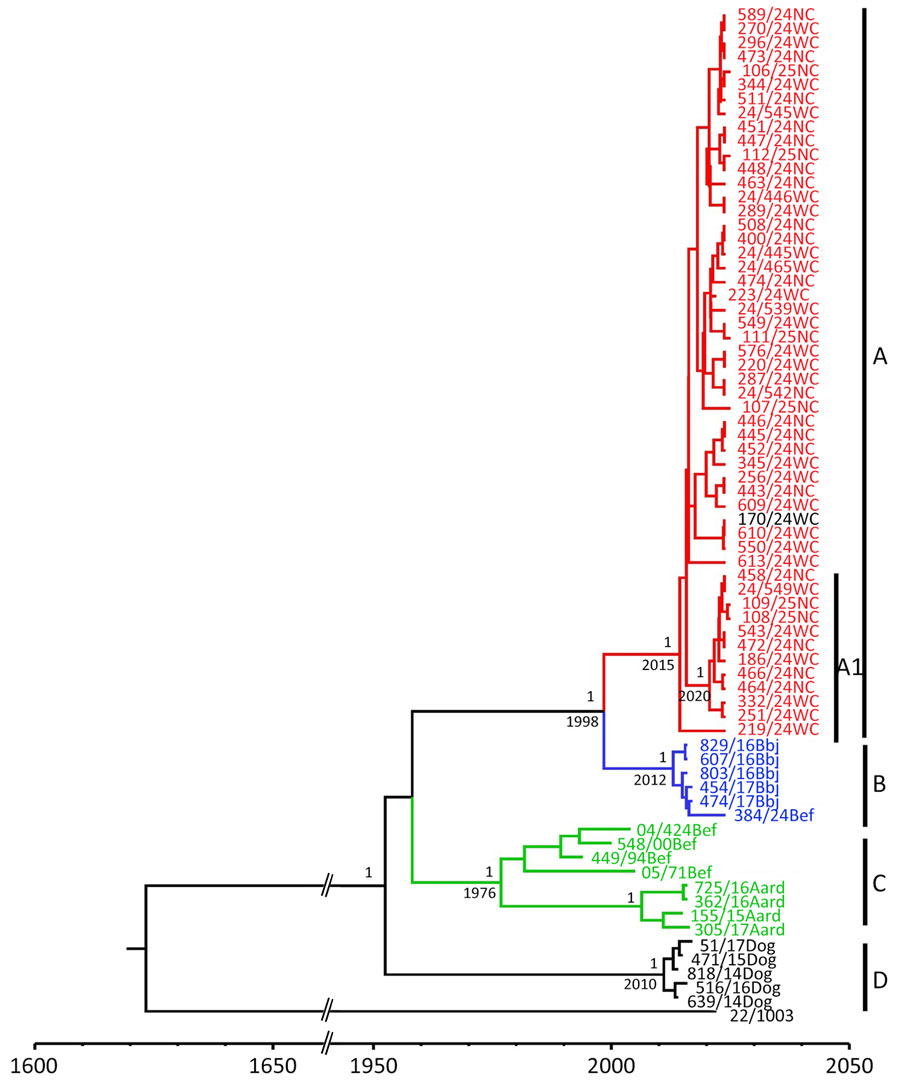
Timescale phylogenetic analysis for study of emergence of rabies in Cape fur seals, South Africa. Red font indicates sequences from Cape fur seals from this study, including retrospective samples; black text among seal samples indicates sample from a domestic dog (170/24WC) likely infected by contact with a seal. Green text indicates sequences from bat eared foxes (Bef) and aardwolves (Aard); blue text indicates sequences from black-backed jackals (Bbj) and one from bat eared fox; black text at bottom of tree indicates sequences from domestic dogs retrieved from GenBank.

Figure 2. Timescale phylogenetic analysis for study of emergence of rabies in Cape fur seals, South Africa. Red font indicates sequences from Cape fur seals from this study, including retrospective samples; black text among seal samples indicates sample from a domestic dog (170/24WC) likely infected by contact with a seal. Green text indicates sequences from bat eared foxes (Bef) and aardwolves (Aard); blue text indicates sequences from black-backed jackals (Bbj) and one from bat eared fox; black text at bottom of tree indicates sequences from domestic dogs retrieved from GenBank.

Main Article

1These authors contributed equally to this article.

Page created: July 21, 2026
Page updated: July 27, 2026
Page reviewed: July 27, 2026
The conclusions, findings, and opinions expressed by authors contributing to this journal do not necessarily reflect the official position of the U.S. Department of Health and Human Services, the Public Health Service, the Centers for Disease Control and Prevention, or the authors' affiliated institutions. Use of trade names is for identification only and does not imply endorsement by any of the groups named above.
file_external