 Podcasts
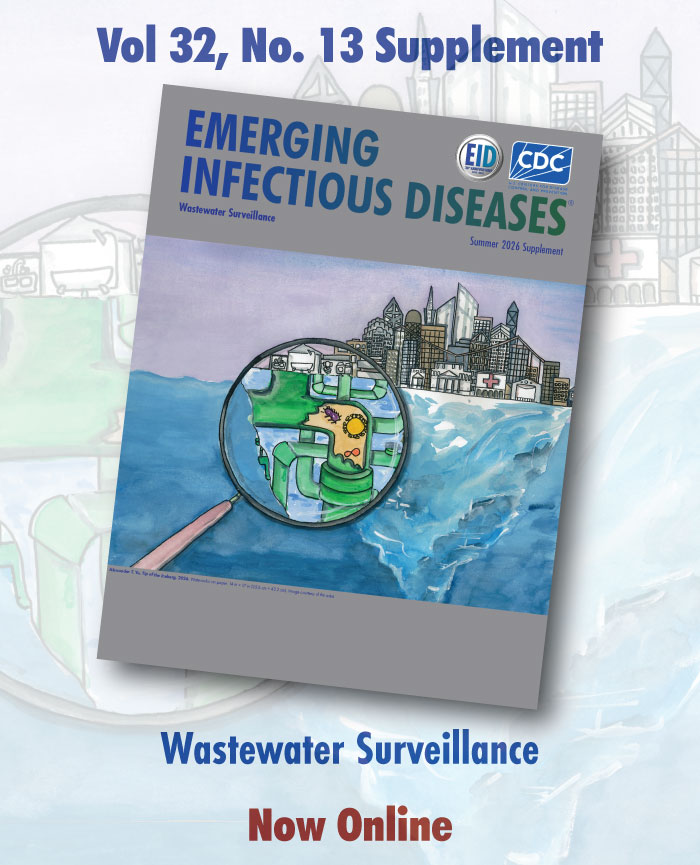
Supplement
Building National Wastewater Surveillance for Infectious Diseases in the United States [PDF - 235 KB - 2 pages]
| EID | Yoder JS, Fehrenbach N, Yu A, Larsen DA, Santibanez S, Honein MA. Building National Wastewater Surveillance for Infectious Diseases in the United States. Emerg Infect Dis. 2026;32(13):1-2. https://doi.org/10.3201/eid3213.260301 |
|---|---|
| AMA | Yoder JS, Fehrenbach N, Yu A, et al. Building National Wastewater Surveillance for Infectious Diseases in the United States. Emerging Infectious Diseases. 2026;32(13):1-2. doi:10.3201/eid3213.260301. |
| APA | Yoder, J. S., Fehrenbach, N., Yu, A., Larsen, D. A., Santibanez, S., & Honein, M. A. (2026). Building National Wastewater Surveillance for Infectious Diseases in the United States. Emerging Infectious Diseases, 32(13), 1-2. https://doi.org/10.3201/eid3213.260301. |
Progress and Expansion of the National Wastewater Surveillance System, United States, 2020–2024 [PDF - 2.92 MB - 11 pages]
Wastewater surveillance in the United States has evolved from an emergency response initiative into a valuable component of public health infrastructure. During its first 4 years, the Centers for Disease Control and Prevention’s National Wastewater Surveillance System (NWSS) expanded its national testing coverage, suite of pathogen targets, analytics capabilities, data visualizations, and laboratory methods. Collaborations across public, private, and academic sectors continue to drive progress toward standardization of practices, interpretation of wastewater signals, and translation of wastewater surveillance into public health action. This article describes the evolution of NWSS from late 2020 through 2024, highlighting its integration into public health practice and its demonstrated adaptability and scalability as a surveillance system supporting timely, data-driven decision-making to address community-level public health threats.
| EID | Mark-Carew M, Bias M, Reckling S, Madhobi K, Cornforth D, Volkov I, et al. Progress and Expansion of the National Wastewater Surveillance System, United States, 2020–2024. Emerg Infect Dis. 2026;32(13):3-13. https://doi.org/10.3201/eid3213.261118 |
|---|---|
| AMA | Mark-Carew M, Bias M, Reckling S, et al. Progress and Expansion of the National Wastewater Surveillance System, United States, 2020–2024. Emerging Infectious Diseases. 2026;32(13):3-13. doi:10.3201/eid3213.261118. |
| APA | Mark-Carew, M., Bias, M., Reckling, S., Madhobi, K., Cornforth, D., Volkov, I....Yoder, J. (2026). Progress and Expansion of the National Wastewater Surveillance System, United States, 2020–2024. Emerging Infectious Diseases, 32(13), 3-13. https://doi.org/10.3201/eid3213.261118. |
A Multi-Partner Effort to Launch and Sustain Wastewater Surveillance, United States [PDF - 1.16 MB - 5 pages]
The National Wastewater Surveillance System represents a groundbreaking initiative aimed at enhancing public health surveillance for infectious diseases through wastewater analyses. We have outlined current and planned collaborative efforts between the Centers for Disease Control and Prevention and key partners, including academic institutions, utilities, jurisdictions, and public health partner networks, to develop, implement, and sustain wastewater surveillance for infectious diseases to inform public health activities. By addressing critical challenges in assay development, community and clinician engagement, governance structures, public health ethics, data system development and integration, and innovation fostering, those partnerships lay the groundwork for a robust public health surveillance framework. Establishing this novel public health surveillance capability required developing new partnerships and skills, incorporating basic principles of public health surveillance, validating assays, and envisioning a system to meet current and future public health challenges. This capability will foster improved public health responses nationwide.
| EID | Yoder J, Fehrenbach N, Raziano A, Kanter J, Galan D, Rainey R, et al. A Multi-Partner Effort to Launch and Sustain Wastewater Surveillance, United States. Emerg Infect Dis. 2026;32(13):14-18. https://doi.org/10.3201/eid3213.260221 |
|---|---|
| AMA | Yoder J, Fehrenbach N, Raziano A, et al. A Multi-Partner Effort to Launch and Sustain Wastewater Surveillance, United States. Emerging Infectious Diseases. 2026;32(13):14-18. doi:10.3201/eid3213.260221. |
| APA | Yoder, J., Fehrenbach, N., Raziano, A., Kanter, J., Galan, D., Rainey, R....Honein, M. A. (2026). A Multi-Partner Effort to Launch and Sustain Wastewater Surveillance, United States. Emerging Infectious Diseases, 32(13), 14-18. https://doi.org/10.3201/eid3213.260221. |
Implementation and Early Outcomes of Laboratory Proficiency Testing Program for the National Wastewater Surveillance System, United States, 2024 [PDF - 1.07 MB - 7 pages]
Underlying the core goals of the Centers for Disease Control and Prevention National Wastewater Surveillance System (NWSS) in the United States is the need for robust and reliable pathogen data. The rapid build-out of the NWSS network and participation of many laboratories with varying expertise in environmental molecular methods has resulted in a lack of method standardization and poor data comparability. Proficiency testing is a powerful strategy to address this challenge. We describe preliminary outcomes from 2 proficiency testing rounds with 38 total participating laboratories, where reported respiratory virus concentrations from replicate samples spanned roughly 2 orders of magnitude; the program identified key opportunities for improvement. Although still in its infancy, this program proved an effective tool for quantifying variability across the network, offering preliminary insights on method performance, and improving data quality through laboratory support. Our results suggest that wastewater proficiency testing for disease surveillance will improve data quality and strengthen the NWSS.
| EID | Dutcher H, Antkiewicz DS, Roguet AJ, Shafer MM. Implementation and Early Outcomes of Laboratory Proficiency Testing Program for the National Wastewater Surveillance System, United States, 2024. Emerg Infect Dis. 2026;32(13):19-25. https://doi.org/10.3201/eid3213.251612 |
|---|---|
| AMA | Dutcher H, Antkiewicz DS, Roguet AJ, et al. Implementation and Early Outcomes of Laboratory Proficiency Testing Program for the National Wastewater Surveillance System, United States, 2024. Emerging Infectious Diseases. 2026;32(13):19-25. doi:10.3201/eid3213.251612. |
| APA | Dutcher, H., Antkiewicz, D. S., Roguet, A. J., & Shafer, M. M. (2026). Implementation and Early Outcomes of Laboratory Proficiency Testing Program for the National Wastewater Surveillance System, United States, 2024. Emerging Infectious Diseases, 32(13), 19-25. https://doi.org/10.3201/eid3213.251612. |
Targeted Wastewater Surveillance during the World Athletics Championship, Oregon, USA, 2022 [PDF - 2.32 MB - 6 pages]
Targeted wastewater surveillance during the 18th World Athletics Championships in Eugene, Oregon, USA, in 2022 detected influenza A virus, SARS-CoV-2, and hepatitis A virus. Poliovirus detections were inconclusive. Influenza B, hepatitis E, and measles viruses and Middle East respiratory syndrome coronavirus were not detected. Wastewater surveillance augments traditional surveillance to mitigate risks associated with large multinational gatherings.
| EID | Falender R, Kaya D, Harry M, Hachimi O, Radniecki T, Kelly C, et al. Targeted Wastewater Surveillance during the World Athletics Championship, Oregon, USA, 2022. Emerg Infect Dis. 2026;32(13):26-31. https://doi.org/10.3201/eid3213.260537 |
|---|---|
| AMA | Falender R, Kaya D, Harry M, et al. Targeted Wastewater Surveillance during the World Athletics Championship, Oregon, USA, 2022. Emerging Infectious Diseases. 2026;32(13):26-31. doi:10.3201/eid3213.260537. |
| APA | Falender, R., Kaya, D., Harry, M., Hachimi, O., Radniecki, T., Kelly, C....Sutton, M. (2026). Targeted Wastewater Surveillance during the World Athletics Championship, Oregon, USA, 2022. Emerging Infectious Diseases, 32(13), 26-31. https://doi.org/10.3201/eid3213.260537. |
Evaluation of Detection Methods for Wastewater Surveillance of Antimicrobial-Resistant Bacteria from Healthcare Facilities [PDF - 2.14 MB - 11 pages]
Carbapenem resistance in bacteria is an urgent public health threat. Wastewater surveillance could support antimicrobial resistance monitoring at long-term care facilities. We assessed feasibility of wastewater sampling at such facilities for carbapenemase genes (blaKPC, blaVIM, blaOXA-48-like, blaNDM, and blaIMP) detected by quantitative PCR or GeneXpert Carba-R (Cepheid, https://www.cepheid.com) over 16 months and compared those findings with those for clinical infections. The blaKPC, blaOXA-48-like, and blaVIM genes were routinely detected in composite wastewater samples, passive samples, and sewer biofilm swab specimens. Wastewater and sewer biofilm resistomes differed, but both contained blaKPC, blaVIM, and blaIMP. Wastewater surveillance for carbapenemases shows promise, but few clinical infections during the study period and contributions from sewer biofilms complicate correlations between wastewater measurements and clinical incidence, underscoring the need for further research.
| EID | Warren E, VanDerslice J, Benson L, Brazelton WJ, Tanner W, Lyons AK, et al. Evaluation of Detection Methods for Wastewater Surveillance of Antimicrobial-Resistant Bacteria from Healthcare Facilities. Emerg Infect Dis. 2026;32(13):32-42. https://doi.org/10.3201/eid3213.251490 |
|---|---|
| AMA | Warren E, VanDerslice J, Benson L, et al. Evaluation of Detection Methods for Wastewater Surveillance of Antimicrobial-Resistant Bacteria from Healthcare Facilities. Emerging Infectious Diseases. 2026;32(13):32-42. doi:10.3201/eid3213.251490. |
| APA | Warren, E., VanDerslice, J., Benson, L., Brazelton, W. J., Tanner, W., Lyons, A. K....Weidhaas, J. (2026). Evaluation of Detection Methods for Wastewater Surveillance of Antimicrobial-Resistant Bacteria from Healthcare Facilities. Emerging Infectious Diseases, 32(13), 32-42. https://doi.org/10.3201/eid3213.251490. |
Temporal Alignment of Wastewater Signals with Clinical Indicators of Respiratory Illness Postpandemic, Texas, USA [PDF - 3.45 MB - 10 pages]
In the COVID-19 postpandemic era, declining clinical testing for SARS-CoV-2 has led to the exploration of complementary early detection methods. We evaluated metagenomic wastewater-based epidemiology (WBE) in Texas, USA, by comparing viral signals with the National Syndromic Surveillance Program tracked emergency department visits and Texas All-Payer Claims Database insurance claims across several Texas counties during 2022–2024. By analyzing SARS-CoV-2, influenza, and respiratory syncytial virus, we found moderate-to-strong temporal correlations between wastewater and clinical indicators. Influenza showed the most stable associations (r<0.98), whereas SARS-CoV-2 signals generally preceded clinical metrics. Respiratory syncytial virus exhibited higher geographic and temporal heterogeneity, reflecting differences in clinical data capture. Despite sampling frequency and geographic alignment challenges, metagenomic WBE consistently tracked community trends. Our findings suggest WBE can offer valuable situational awareness and a resilient complement to clinical surveillance, supporting public health preparedness in an evolving respiratory disease landscape.
| EID | Bi K, Sandoval M, Nguyen T, Perez I, Ghosh L, Krause T, et al. Temporal Alignment of Wastewater Signals with Clinical Indicators of Respiratory Illness Postpandemic, Texas, USA. Emerg Infect Dis. 2026;32(13):43-52. https://doi.org/10.3201/eid3213.260141 |
|---|---|
| AMA | Bi K, Sandoval M, Nguyen T, et al. Temporal Alignment of Wastewater Signals with Clinical Indicators of Respiratory Illness Postpandemic, Texas, USA. Emerging Infectious Diseases. 2026;32(13):43-52. doi:10.3201/eid3213.260141. |
| APA | Bi, K., Sandoval, M., Nguyen, T., Perez, I., Ghosh, L., Krause, T....Bauer, C. (2026). Temporal Alignment of Wastewater Signals with Clinical Indicators of Respiratory Illness Postpandemic, Texas, USA. Emerging Infectious Diseases, 32(13), 43-52. https://doi.org/10.3201/eid3213.260141. |
Correlations between Wastewater Concentrations of Influenza A and Respiratory Syncytial Viruses and Clinical Laboratory Testing and Hospitalization Data, California, USA [PDF - 4.84 MB - 13 pages]
We evaluated correlations between influenza A virus and respiratory syncytial virus (RSV) wastewater concentrations in California, USA, and 3 clinical laboratory–based disease surveillance datasets: sentinel laboratory surveillance, mandatory electronic laboratory reporting data, and laboratory-confirmed influenza hospitalizations. We evaluated data from 10 counties and 18 wastewater treatment plants in California during July 2022–March 2024. We observed strong, positive, and statistically significant correlations between individual sewershed-level wastewater concentrations and county-aggregated wastewater concentrations of influenza A and RSV and clinical laboratory–based surveillance datasets (median Kendall τ 0.62 [range 0.40–0.78]; p<0.05). A lead–lag analysis did not show consistent evidence of wastewater leading other surveillance datasets across all counties and wastewater treatment plants (influenza A –16 to 22 days; RSV –8 to 35 days). Wastewater surveillance can augment other disease surveillance modalities and improve situational awareness of influenza A and RSV transmission in communities.
| EID | Burnor E, Rane MS, Donnelly M, White LA, Hoover C, Sun M, et al. Correlations between Wastewater Concentrations of Influenza A and Respiratory Syncytial Viruses and Clinical Laboratory Testing and Hospitalization Data, California, USA. Emerg Infect Dis. 2026;32(13):53-65. https://doi.org/10.3201/eid3213.260306 |
|---|---|
| AMA | Burnor E, Rane MS, Donnelly M, et al. Correlations between Wastewater Concentrations of Influenza A and Respiratory Syncytial Viruses and Clinical Laboratory Testing and Hospitalization Data, California, USA. Emerging Infectious Diseases. 2026;32(13):53-65. doi:10.3201/eid3213.260306. |
| APA | Burnor, E., Rane, M. S., Donnelly, M., White, L. A., Hoover, C., Sun, M....Yu, A. T. (2026). Correlations between Wastewater Concentrations of Influenza A and Respiratory Syncytial Viruses and Clinical Laboratory Testing and Hospitalization Data, California, USA. Emerging Infectious Diseases, 32(13), 53-65. https://doi.org/10.3201/eid3213.260306. |
Early-Season Detection of Influenza A(H3N2) Subclade K in Wastewater, Colorado, USA, 2025–2026 [PDF - 1.95 MB - 5 pages]
We assessed the value of wastewater sequencing for monitoring influenza circulation in Colorado, USA, focusing on the emergence of influenza A(H3N2) subclade K. We detected subclade K in wastewater 31 days before clinical detection. Our results demonstrated that wastewater sequencing can provide real-time situational awareness for public health officials.
| EID | Hetherington-Rauth MC, Nguyen V, Washeleski E, Vital K, Lequia G, Aragon D, et al. Early-Season Detection of Influenza A(H3N2) Subclade K in Wastewater, Colorado, USA, 2025–2026. Emerg Infect Dis. 2026;32(13):66-70. https://doi.org/10.3201/eid3213.260431 |
|---|---|
| AMA | Hetherington-Rauth MC, Nguyen V, Washeleski E, et al. Early-Season Detection of Influenza A(H3N2) Subclade K in Wastewater, Colorado, USA, 2025–2026. Emerging Infectious Diseases. 2026;32(13):66-70. doi:10.3201/eid3213.260431. |
| APA | Hetherington-Rauth, M. C., Nguyen, V., Washeleski, E., Vital, K., Lequia, G., Aragon, D....Matzinger, S. R. (2026). Early-Season Detection of Influenza A(H3N2) Subclade K in Wastewater, Colorado, USA, 2025–2026. Emerging Infectious Diseases, 32(13), 66-70. https://doi.org/10.3201/eid3213.260431. |
Wastewater Respiratory Virus Surveillance in Remote Community, Alaska, USA, 2022–2024 [PDF - 1.76 MB - 9 pages]
Wastewater surveillance (WS) is underused in rural communities. We evaluated WS performance in the remote, subarctic, mostly Indigenous, community of Bethel, Alaska, USA, during October 2022–May 2024. Wastewater was collected >3 times weekly and underwent on-site PCR testing for SARS-CoV-2, respiratory syncytial virus (RSV), and influenza A and B viruses. We compared WS virus detection with local clinical data by using results from 318 wastewater samples and 7,392 clinical tests. We detected SARS-CoV-2 in 265 (83.3%) wastewater samples, influenza A virus in 128 (40.3%), RSV in 78 (24.5%), and influenza B virus in 29 (9.1%). Wastewater signals correlated with clinical results for influenza B virus (Spearman ρ = 0.85), influenza A virus (ρ = 0.62), RSV (ρ = 0.60), and SARS-CoV-2 (ρ = 0.59), providing corroborating data that informed the timing of seasonal respiratory virus immunization campaigns. Our findings show that WS is feasible and useful for disease surveillance in rural Alaska.
| EID | Lefferts B, Leary A, Bruden D, Blake I, Richman C, Sixberry S, et al. Wastewater Respiratory Virus Surveillance in Remote Community, Alaska, USA, 2022–2024. Emerg Infect Dis. 2026;32(13):71-79. https://doi.org/10.3201/eid3213.260709 |
|---|---|
| AMA | Lefferts B, Leary A, Bruden D, et al. Wastewater Respiratory Virus Surveillance in Remote Community, Alaska, USA, 2022–2024. Emerging Infectious Diseases. 2026;32(13):71-79. doi:10.3201/eid3213.260709. |
| APA | Lefferts, B., Leary, A., Bruden, D., Blake, I., Richman, C., Sixberry, S....Keck, J. W. (2026). Wastewater Respiratory Virus Surveillance in Remote Community, Alaska, USA, 2022–2024. Emerging Infectious Diseases, 32(13), 71-79. https://doi.org/10.3201/eid3213.260709. |
Correlation of Norovirus in Wastewater with Gastroenteritis-Related Hospitalizations, New York, USA, 2022–2024 [PDF - 4.56 MB - 13 pages]
Norovirus is a substantial public health burden, yet surveillance is challenging because infections are underreported. Wastewater surveillance offers a complementary approach. We quantified norovirus genogroups GI and GII from 2,823 wastewater samples collected in New York, USA, during September 2022–July 2024. Across 4 counties in New York, we detected norovirus GI in 100% of samples and GII in 92%–100%. Both genogroups exhibited strong seasonal trends. During the study period, 499 norovirus-specific and 50,004 all-cause acute gastroenteritis hospitalizations occurred. Weekly correlations between GII concentrations and norovirus-specific hospitalizations showed moderate positive relationships (ρ = 0.23–0.28); GI concentrations showed weak correlations (ρ = −0.18 to 0.06). Correlations between norovirus in wastewater and all-cause acute gastroenteritis hospitalizations were weaker. Although wastewater surveillance reliably detects seasonal norovirus circulation in the population, correlations with hospitalizations were moderate. GII showed stronger associations with clinical outcomes than GI, supporting the importance of genogroup-specific monitoring.
| EID | Nwabor OF, Bryant P, Hill D, Alazawi M, Schoultz L, Jadhav A, et al. Correlation of Norovirus in Wastewater with Gastroenteritis-Related Hospitalizations, New York, USA, 2022–2024. Emerg Infect Dis. 2026;32(13):80-92. https://doi.org/10.3201/eid3213.260472 |
|---|---|
| AMA | Nwabor OF, Bryant P, Hill D, et al. Correlation of Norovirus in Wastewater with Gastroenteritis-Related Hospitalizations, New York, USA, 2022–2024. Emerging Infectious Diseases. 2026;32(13):80-92. doi:10.3201/eid3213.260472. |
| APA | Nwabor, O. F., Bryant, P., Hill, D., Alazawi, M., Schoultz, L., Jadhav, A....Larsen, D. A. (2026). Correlation of Norovirus in Wastewater with Gastroenteritis-Related Hospitalizations, New York, USA, 2022–2024. Emerging Infectious Diseases, 32(13), 80-92. https://doi.org/10.3201/eid3213.260472. |
Monkeypox Virus Surveillance in Wastewater, North Carolina, USA, October 2023–May 2025 [PDF - 1.47 MB - 7 pages]
In September 2023, the North Carolina Department of Health and Human Services identified a new case of mpox clade II 5 months after the last previous report. To assess possible unrecognized transmission, nonvariola orthopoxvirus testing was implemented at select wastewater sites. During October 29, 2023–May 2025, a total of 801 samples were collected across 16 treatment plants serving ≈2 million residents. We analyzed wastewater detections (n = 47) and clinical cases (n = 45) using a +17-day window. Overall sensitivity of identifying the presence of >1 temporally aligned mpox case within a sewershed was 10.6% (95% CI 6.5%–16.7%); specificity was 95.1% (95% CI 93.2%–96.5%), positive predictive value was 31.9% (95% CI 20.4%–46.2%), and negative predictive value was 83.2% (95% CI 80.3%–85.7%). Restricting detections above the limit of detection reduced sensitivity but increased specificity. Overall, wastewater surveillance showed low sensitivity but provided complementary awareness for public health response.
| EID | Snyder NL, Clerkin T, Koenigsberg SH, Tate MB, Lautenschlager TL, Albertson J, et al. Monkeypox Virus Surveillance in Wastewater, North Carolina, USA, October 2023–May 2025. Emerg Infect Dis. 2026;32(13):93-99. https://doi.org/10.3201/eid3213.260414 |
|---|---|
| AMA | Snyder NL, Clerkin T, Koenigsberg SH, et al. Monkeypox Virus Surveillance in Wastewater, North Carolina, USA, October 2023–May 2025. Emerging Infectious Diseases. 2026;32(13):93-99. doi:10.3201/eid3213.260414. |
| APA | Snyder, N. L., Clerkin, T., Koenigsberg, S. H., Tate, M. B., Lautenschlager, T. L., Albertson, J....Christensen, A. R. (2026). Monkeypox Virus Surveillance in Wastewater, North Carolina, USA, October 2023–May 2025. Emerging Infectious Diseases, 32(13), 93-99. https://doi.org/10.3201/eid3213.260414. |
Laboratory Assessment of Wastewater as Surveillance Tool for West Nile Virus, United States [PDF - 1.16 MB - 8 pages]
West Nile virus (WNV) is the most common cause of domestic human arboviral infection in the contiguous United States. WNV surveillance across the United States is not comprehensive and is limited. Nonclinical WNV surveillance is variable, and WNV surveillance in humans is limited by the percentage of symptomatic human infections and time it takes to seek healthcare and diagnosis. Wastewater surveillance has been used to detect viruses shed from asymptomatic and symptomatic persons; therefore, we assessed wastewater as a surveillance tool for WNV tracking. We tested archived RNA and raw wastewater from 6 states with documented human illness during the 2023 WNV transmission season for WNV RNA. WNV RNA was detected in 18% (n = 29/158) of samples from Arizona, California, Colorado, Illinois, Indiana, and Nebraska. Our results highlight the ability to detect WNV in wastewater and the potential of wastewater surveillance to augment current surveillance data.
| EID | Spring J, Long A, Davis E, Matzinger SR, Wheeler A, Lyons SL, et al. Laboratory Assessment of Wastewater as Surveillance Tool for West Nile Virus, United States. Emerg Infect Dis. 2026;32(13):100-107. https://doi.org/10.3201/eid3213.260616 |
|---|---|
| AMA | Spring J, Long A, Davis E, et al. Laboratory Assessment of Wastewater as Surveillance Tool for West Nile Virus, United States. Emerging Infectious Diseases. 2026;32(13):100-107. doi:10.3201/eid3213.260616. |
| APA | Spring, J., Long, A., Davis, E., Matzinger, S. R., Wheeler, A., Lyons, S. L....Hughes, H. R. (2026). Laboratory Assessment of Wastewater as Surveillance Tool for West Nile Virus, United States. Emerging Infectious Diseases, 32(13), 100-107. https://doi.org/10.3201/eid3213.260616. |
Implications of Wastewater Surveillance for Clinical Care among Infectious Disease Physicians, United States, 2024 [PDF - 553 KB - 3 pages]
We analyzed 192 responses from a 2024 survey of Emerging Infections Network members in the United States regarding how wastewater surveillance can affect clinical practice. Four themes emerged: situational awareness, patient counseling, infection control, and diagnostic support. Enhanced collaboration between public health officials and clinicians might optimize utility of such surveillance in clinical practice.
| EID | Jones SL, Blackwell AD, Adams C, Polgreen PM, Beekmann SE, Gridley-Smith C, et al. Implications of Wastewater Surveillance for Clinical Care among Infectious Disease Physicians, United States, 2024. Emerg Infect Dis. 2026;32(13):108-110. https://doi.org/10.3201/eid3213.260203 |
|---|---|
| AMA | Jones SL, Blackwell AD, Adams C, et al. Implications of Wastewater Surveillance for Clinical Care among Infectious Disease Physicians, United States, 2024. Emerging Infectious Diseases. 2026;32(13):108-110. doi:10.3201/eid3213.260203. |
| APA | Jones, S. L., Blackwell, A. D., Adams, C., Polgreen, P. M., Beekmann, S. E., Gridley-Smith, C....Santibañez, S. (2026). Implications of Wastewater Surveillance for Clinical Care among Infectious Disease Physicians, United States, 2024. Emerging Infectious Diseases, 32(13), 108-110. https://doi.org/10.3201/eid3213.260203. |
Public Understanding of Wastewater Surveillance, United States, August 2025 [PDF - 543 KB - 4 pages]
We examined public understanding of wastewater surveillance (WS) data and perceptions of its importance by using a nationwide cross-sectional survey. Approximately half of participants were aware of WS, and 79.0% responded that WS information about viruses was important, highlighting the need for community engagement about WS use and value.
| EID | Soelaeman RH, Valencia D, Losch J, Kleven D, Moore J, Santibañez S. Public Understanding of Wastewater Surveillance, United States, August 2025. Emerg Infect Dis. 2026;32(13):111-114. https://doi.org/10.3201/eid3213.260559 |
|---|---|
| AMA | Soelaeman RH, Valencia D, Losch J, et al. Public Understanding of Wastewater Surveillance, United States, August 2025. Emerging Infectious Diseases. 2026;32(13):111-114. doi:10.3201/eid3213.260559. |
| APA | Soelaeman, R. H., Valencia, D., Losch, J., Kleven, D., Moore, J., & Santibañez, S. (2026). Public Understanding of Wastewater Surveillance, United States, August 2025. Emerging Infectious Diseases, 32(13), 111-114. https://doi.org/10.3201/eid3213.260559. |
Exploration of Public Perceptions of Wastewater Surveillance, United States, June 2024 [PDF - 700 KB - 4 pages]
Community wastewater surveillance (WS) is a valuable tool for informing public health action, but its effects on individual health behaviors rely on public understanding and awareness. We analyzed 2,024 free text responses from a national survey on perceptions of WS conducted during June 19–23, 2024, to gain insights into public perceptions of WS. Primary themes among 1,181 detailed responses included varying levels of trust in government and authorities, the need for more information about the effectiveness and accuracy of monitoring, desire to understand public health implications, and the need for more education and communication. Those findings could help inform community engagement strategies as WS continues to evolve.
| EID | Moore JT, Rose-McCully K, Valencia D, Turner H, Tatti K, Kaur M, et al. Exploration of Public Perceptions of Wastewater Surveillance, United States, June 2024. Emerg Infect Dis. 2026;32(13):115-118. https://doi.org/10.3201/eid3213.251494 |
|---|---|
| AMA | Moore JT, Rose-McCully K, Valencia D, et al. Exploration of Public Perceptions of Wastewater Surveillance, United States, June 2024. Emerging Infectious Diseases. 2026;32(13):115-118. doi:10.3201/eid3213.251494. |
| APA | Moore, J. T., Rose-McCully, K., Valencia, D., Turner, H., Tatti, K., Kaur, M....Santibanez, S. (2026). Exploration of Public Perceptions of Wastewater Surveillance, United States, June 2024. Emerging Infectious Diseases, 32(13), 115-118. https://doi.org/10.3201/eid3213.251494. |
About the Cover
Under the Iceberg [PDF - 1.53 MB - 2 pages]
| EID | Yu AT. Under the Iceberg. Emerg Infect Dis. 2026;32(13). https://doi.org/10.3201/eid3213.ac3213 |
|---|---|
| AMA | Yu AT. Under the Iceberg. Emerging Infectious Diseases. 2026;32(13). doi:10.3201/eid3213.ac3213. |
| APA | Yu, A. T. (2026). Under the Iceberg. Emerging Infectious Diseases, 32(13). https://doi.org/10.3201/eid3213.ac3213. |