Volume 32, Number 10—October 2026
Research Letter
Human Papillomavirus Condylomas of Extragenital Site in Immunocompetent Man, New York, USA, 2025

Cite This Article
Citation for Media
Abstract
Human papillomavirus types 6 and 11 are associated with mucosal condylomata acuminata, with rare reports of extragenital manifestations. We report a case of condyloma localized to the neck of an immunocompetent heterosexual man, without concurrent anogenital lesions. Our findings challenge theories of the site-specific tropism of these human papillomavirus types.
Human papillomavirus (HPV) types 6 and 11 have long been associated with condylomata acuminata, accounting for 90% of warts affecting the anogenital region (1). History of immunosuppression, both primary or secondary, is associated with HPV-related diseases, making affected patients susceptible to development of cutaneous and mucosal warts (2). Reports of extragenital manifestations of condylomas are rare, with previous cases being associated with pediatric populations, men who have sex with men, and persons with a history of HIV. We report a case of HPV types 6 and 11–positive condylomas localized to the lateral neck of an immunocompetent heterosexual man without concurrent anogenital involvement.
Figure
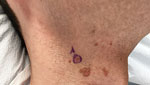
Figure. Image from a case report of condylomas caused by human papillomavirus on extragenital cutaneous site in immunocompetent man, New York, USA, 2025. Brown, clustered, verrucous-to-mamillated papules are shown on the...
In 2025, a heterosexual man in his 40s with an unremarkable medical history sought treatment for a growth on the right side of his neck present for 1 year prior, with reported increase in size. On examination, we noted 6 clustered verrucous-to-mamillated brown papules distributed along the right lateral neck (Figure). Our initial differential diagnosis included inflamed seborrheic keratoses and verruca vulgaris. We treated the lesions with cryotherapy, which provided temporary resolution. The patient returned to our clinic 11 months later for recurrence. We performed a shave biopsy, which showed papillated epidermal hyperplasia with hypergranulosis, compact orthokeratosis, and dilated blood vessels in the papillary dermis. HPV testing by in situ hybridization was positive for HPV types 6 and 11. Screening tests for sexually transmitted infections revealed negative results for gonorrhea, chlamydia, syphilis, and HIV. Complete blood count testing and a comprehensive metabolic panel also yielded results that were within reference limits. Immunologic screening revealed a positive antinuclear antibody titer of 1:80 (reference <1:40) but unremarkable levels of IgA, IgG, and IgM.
Our case report challenges the traditional paradigm of HPV types 6 and 11 tropism to mucosal skin (3). Although reports do exist describing condylomas at extragenital cutaneous sites, those reports have largely involved children, patients with immunosuppression, or persons with concurrent genital involvement (4–6). One report described a patient with extragenital cutaneous HPV type 6 without genital involvement; however, the patient had a history of HIV (6). Although reports of extragenital condylomas and cutaneous HPV types 6 infection exist, cases of HPV types 6 and 11–positive extragenital cutaneous lesions in immunocompetent adults without concurrent anogenital disease are rare.
HPV is known to affect mucosal tissue, particularly of the head and neck, with HPV types 16 accounting for most oropharyngeal squamous cell carcinomas (7). Of interest, HPV types 6 and 11 can be co-transmitted with higher-risk types of HPV in genital skin (8,9). Hypotheses for transmission to this area of the neck include autoinoculation, fomites, skin-to-skin contact with mucosal skin, or even vertical transmission (10). A limitation in our case report was the inability to distinguish between HPV types 6 and 11 based on laboratory in situ hybridization technique. Nonetheless, this case highlights the possibility of condylomas in nonanogenital cutaneous sites in immunocompetent hosts, emphasizing that practitioners should consider biopsy with HPV typing in atypical verrucous lesions on cutaneous sites.
Ms. Fong is a research fellow at New York University Grossman School of Medicine. Her research interests include dermatology, infectious diseases, and artificial intelligence applications in medicine.
Dr. Zampella is an associate professor of dermatology at New York University Grossman School of Medicine and a board-certified dermatologist at New York University Langone’s Preston Robert Tisch Center for Men’s Health. His clinical and academic interests include medical, surgical, and cosmetic dermatology, with particular focus on men’s health, LGBTQ+ dermatology, and complex inflammatory skin disease.
References
- Leslie SW, Sajjad H. Condylomata acuminata (genital warts). In: Kumar S, editor. StatPearls. Treasure Island (FL): StatPearls Publishing; 2025.
- Hewavisenti RV, Arena J, Ahlenstiel CL, Sasson SC. Human papillomavirus in the setting of immunodeficiency: pathogenesis and the emergence of next-generation therapies to reduce the high associated cancer risk. Front Immunol. 2023;14:
1112513 . DOIPubMedGoogle Scholar - Egawa N, Egawa K, Griffin H, Doorbar J. Human papillomaviruses; epithelial tropisms, and the development of neoplasia. Viruses. 2015;7:3863–90. DOIPubMedGoogle Scholar
- Blauvelt A, Duarte AM, Pruksachatkunakorn C, Leonardi CL, Schachner LA. Human papillomavirus type 6 infection involving cutaneous nongenital sites. J Am Acad Dermatol. 1992;27:876–9. DOIPubMedGoogle Scholar
- Achdiat PA, Septharina R, Rowawi R, Dharmadji HP, Puspitosari D, Usman HA, et al. A review and case study of genital and extragenital human papillomavirus type 6 and 11 infections in men who have sex with men accompanied by human immunodeficiency virus infection. HIV AIDS (Auckl). 2024;16:175–82. DOIPubMedGoogle Scholar
- Achdiat PA, Larasati R, Hidayah RMN, Avriyanti E, Usman HA, Maharani RH. Atypical HPV typing: detection of genital-associated HPV type 6 in verruca vulgaris of the hands and feet in an HIV-positive patient. Int Med Case Rep J. 2025;18:67–74. DOIPubMedGoogle Scholar
- Marur S, D’Souza G, Westra WH, Forastiere AA. HPV-associated head and neck cancer: a virus-related cancer epidemic. Lancet Oncol. 2010;11:781–9. DOIPubMedGoogle Scholar
- Chaturvedi AK, Katki HA, Hildesheim A, Rodríguez AC, Quint W, Schiffman M, et al. CVT Group. Human papillomavirus infection with multiple types: pattern of coinfection and risk of cervical disease. J Infect Dis. 2011;203:910–20. DOIPubMedGoogle Scholar
- Wei X, Zhang J, Mei Y, Dai Q, Yang X, Wang X. Prevalence and genotype distribution of HPV6/11/16/18 infections among 180,276 outpatient females from a Women’s and Children’s Central Hospital, 2015–2021, Chengdu, China. Sci Rep. 2023;13:22249. DOIPubMedGoogle Scholar
- Ardekani A, Taherifard E, Mollalo A, Hemadi E, Roshanshad A, Fereidooni R, et al. Human papillomavirus infection during pregnancy and childhood: a comprehensive review. Microorganisms. 2022;10:1932. DOIPubMedGoogle Scholar
Figure
Cite This ArticleOriginal Publication Date: September 21, 2026
Table of Contents – Volume 32, Number 10—October 2026
| EID Search Options |
|---|
 Advanced Article Search – Search articles by author and/or keyword.
|
 Articles by Country Search – Search articles by the topic country.
|
 Article Type Search – Search articles by article type and issue.
|
Please use the form below to submit correspondence to the authors or contact them at the following address:
John G. Zampella, New York University Grossman School of Medicine, 550 1st Ave, New York, NY 10016, USA
Top