Disclaimer: Early release articles are not considered as final versions. Any changes will be reflected in the online version in the month the article is officially released.
Volume 32, Number 10—October 2026
Research Letter
Estimated Transmissibility and Case Fatality Rate of Bundibugyo Virus, Uganda, 2007

Suggested citation for this article
Abstract
Because the epidemiology of Bundibugyo virus remains unclear, we reanalyzed the first recognized outbreak (Uganda, 2007). Adjusting for case under-ascertainment and the effect of control measures, we estimated the effective reproduction number (1.55, falling to <1 after intervention) and case-fatality rate (31%, declining to 25%). The underascertainment rate was 15%.
Bundibugyo virus (BDBV) is 1 of 6 orthoebolaviruses (genus Orthoebolavirus), constituting the species Orthoebolavirus bundibugyoense (1) and causes rare but severe disease in humans (2). Two other orthoebolaviruses, Ebola virus (EBOV) and Sudan virus, have caused the largest outbreaks and are highly lethal; case-fatality rates (CFRs) average ≈50% (2). BDBV is considered less lethal; CFRs are reported to be 30%–40%, and it has historically caused only small outbreaks (3). The ongoing 2026 outbreak in the Democratic Republic of the Congo and Uganda shows a different pattern: first reports in late May 2026 recorded >600 suspected cases, and >2,000 cases were projected within 3 months (4). Despite this potential for large outbreaks, the transmissibility and severity of BDBV remain poorly characterized.
Control measures, such as case isolation, active case finding, infection control in hospitals and isolation wards, and safe burial practices, are key to curbing Ebola outbreaks, in part by limiting superspreading and lowering mortality rates (5). However, those measures also alter the epidemiologic parameters used to characterize an outbreak: the desirable reduction in the reproduction number can be accompanied by improved case ascertainment and reduced mortality rates. Failing to account for the effect of control measures can bias estimates of transmissibility and severity, whereas adjusting for them yields values closer to the natural history of the virus. In this study, we reanalyzed the first reported BDBV outbreak (Bundibugyo, Uganda, 2007) (6) to obtain robust estimates of transmission potential and CFR adjusted for both case underascertainment and the effect of control measures.
We digitized weekly counts of confirmed and probable cases from a 2010 study (6), retaining 110 cases (37 deaths) with a known week of symptom onset. We excluded 6 additional cases (2 deaths) lacking onset dates. Those data are consistent with 116 confirmed and probable cases and 39 deaths (crude CFR 34%) reported for the outbreak (6). Control measures were initiated in week 48, which we used to define preintervention and postintervention periods. We estimated transmission with a renewal process incorporating intrinsic back-projection to the time of infection (7), informed by the incubation period and time from onset to transmission, the latter adapted from EBOV (8). That linked the effective reproduction number (Rt) to the time of infection rather than to symptom onset. We modeled the intervention as a step reduction at week 48 in Rt and in case under-ascertainment, together with a multiplicative reduction in the CFR. We assumed that deaths were fully recorded throughout the outbreak, whereas nonfatal cases that occurred before the intervention could have been missed (9). We fitted the model in a Bayesian framework and report posterior means with 95% credible intervals (CrIs) (Appendix).
Figure
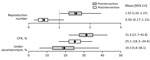
Figure. Estimates of epidemiologic parameters from study of transmissibility and case fatality rate of Bundibugyo virus estimated from first outbreak, Uganda, 2007. Estimates are stratified by preintervention and postintervention periods. Each...
Before the intervention, BDBV was capable of sustained transmission of Rt of 1.55 (95% CrI 1.02–2.36). The Rt markedly declined to 0.50 (95% CrI 0.17–1.15) after the intervention (Figure; Appendix Figure 1). We estimated that ≈15% (95% CrI 2.7%–31.7%) of cases were under ascertained, corresponding to 20 (95% CrI 3–51) cases predicted to be missed. After adjusting for under-ascertainment, the preintervention CFR was 31.4% (95% CrI 21.8%–42.8%), which then decreased to 25.1% (95% CrI 16.3%–34.6%), which translated to an odds ratio of death (postintervention vs. preintervention) of 0.75 (95% CrI 0.40–0.99). Those estimates were robust to the time variation in case-ascertainment during the preintervention period, and posteriors deviated substantially from the priors (Appendix Figures 2–5).
Our findings suggest that BDBV is moderately transmissible; its preintervention reproduction number was ≈1.5 and its CFR ≈31%. That finding places BDBV within the range of other orthoebolaviruses, although with a lower CFR than typical EBOV outbreaks. The Rt fell to <1 after the outbreak response, and the fatality risk also declined (the 95% CrI of the odds ratio excluded 1). A reduction in transmission of ≈35% sufficed to bring the Rt to <1 and was achieved by nonpharmaceutical interventions alone in 2007. Such control measures remain operationally demanding, as the 2026 outbreak shows. A serosurvey among close contacts of survivors conducted 29 months after the 2007 outbreak identified 13 symptomatic infections that had not been recorded (10), implying that 21.0% of symptomatic infections were unascertained. That lies within the CrI of our estimate of ≈15% of missed cases, though above our point estimate.
The primary limitation of our study is that it was based on a single small outbreak and used counts digitized from a previously published article, and no BDBV-specific epidemiologic intervals were available. Estimates depended on the assumed time from onset to transmission, the transmission-model structure, and assumptions about death ascertainment. Some CrIs were wide, particularly for the postintervention Rt and the under-ascertainment rate, reflecting the small number of postintervention weeks and the limited information on unascertained cases. Our model also did not reproduce the peak in week 48, which could reflect superspreading (Appendix). Given the scarcity of epidemiologic data on BDBV, our estimates provide a basis for future modeling. Nonetheless, more accurate BDBV-specific estimates of the epidemiologic time intervals and transmission parameters are still needed.
Ms. de Padua is a graduate of the Global Health Program, College of Public Health, National Taiwan University. Her research interests include modeling of infectious diseases and data analysis. Dr. Akhmetzhanov is an associate professor at National Taiwan University. His research interests include the epidemiology and prevention of infectious disease outbreaks.
Acknowledgment
This work was supported by the National Science and Technology Council, Taiwan (NSTC 113-2314-B-002-181-MY3) and National Taiwan University (project no. 115L7869).
References
- Biedenkopf N, Bukreyev A, Chandran K, Di Paola N, Formenty PBH, Griffiths A, et al. Renaming of genera Ebolavirus and Marburgvirus to Orthoebolavirus and Orthomarburgvirus, respectively, and introduction of binomial species names within family Filoviridae. Arch Virol. 2023;168:220. DOIPubMedGoogle Scholar
- Towner JS, Sealy TK, Khristova ML, Albariño CG, Conlan S, Reeder SA, et al. Newly discovered Ebola virus associated with hemorrhagic fever outbreak in Uganda. PLoS Pathog. 2008;4:
e1000212 . DOIPubMedGoogle Scholar - MacNeil A, Farnon EC, Wamala J, Okware S, Cannon DL, Reed Z, et al. Proportion of deaths and clinical features in Bundibugyo Ebola virus infection, Uganda. Emerg Infect Dis. 2010;16:1969–72. DOIPubMedGoogle Scholar
- Mooring EQ, Koval WT, Routledge I, Holmdahl I, Hudson K, España G, et al. Modeled scenario projections for the Ebola disease outbreak caused by Bundibugyo virus, 2026. MMWR Morb Mortal Wkly Rep. 2026;75:285–9. DOIPubMedGoogle Scholar
- Osterholm MT, Moore KA, Kelley NS, Brosseau LM, Wong G, Murphy FA, et al. Transmission of Ebola viruses: what we know and what we do not know. MBio. 2015;6:
e00137 . DOIPubMedGoogle Scholar - Wamala JF, Lukwago L, Malimbo M, Nguku P, Yoti Z, Musenero M, et al. Ebola hemorrhagic fever associated with novel virus strain, Uganda, 2007–2008. Emerg Infect Dis. 2010;16:1087–92. DOIPubMedGoogle Scholar
- Nakajo K, Nishiura H. Estimation of R(t) based on illness onset data: an analysis of 1907–1908 smallpox epidemic in Tokyo. Epidemics. 2022;38:
100545 . DOIPubMedGoogle Scholar - Yamin D, Gertler S, Ndeffo-Mbah ML, Skrip LA, Fallah M, Nyenswah TG, et al. Effect of Ebola progression on transmission and control in Liberia. Ann Intern Med. 2015;162:11–7. DOIPubMedGoogle Scholar
- Asai Y, Nishiura H. Joint estimation of the transmissibility and severity of Ebola virus disease in real time. J Biol Syst. 2017;25:587–603. DOIGoogle Scholar
- Clark DV, Kibuuka H, Millard M, Wakabi S, Lukwago L, Taylor A, et al. Long-term sequelae after Ebola virus disease in Bundibugyo, Uganda: a retrospective cohort study. Lancet Infect Dis. 2015;15:905–12. DOIPubMedGoogle Scholar
Figures
Suggested citation for this article: de Padua B, Akhmetzhanov AR. Estimated transmissibility and case fatality rate of Bundibugyo virus, Uganda, 2007. Emerg Infect Dis. 2026 Oct [date cited]. https://doi.org/10.3201/eid3210.261175
Original Publication Date: September 16, 2026
Table of Contents – Volume 32, Number 10—October 2026
| EID Search Options |
|---|
 Advanced Article Search – Search articles by author and/or keyword.
|
 Articles by Country Search – Search articles by the topic country.
|
 Article Type Search – Search articles by article type and issue.
|
Please use the form below to submit correspondence to the authors or contact them at the following address:
Andrei R. Akhmetzhanov, Global Health Program & Institute of Epidemiology and Preventive Medicine, College of Public Health, National Taiwan University, No.17 Xuzhou Rd., Zhongzheng District, Taipei 10055, Taiwan
Top