Disclaimer: Early release articles are not considered as final versions. Any changes will be reflected in the online version in the month the article is officially released.
Global Genomic Surveillance of Middle East Respiratory Syndrome Coronavirus
James Richard Otieno, Ahmed Mohammed Albarraq, Francis Amirtharaj Selvaraj, Amna Omair Al Mehairi, Esam Ibraheem Azhar, Christopher Ruis, Hasan Zackaria Ali Ishaq, Asma Abi Mohamed Shah, Zelalem Tadesse, Qiu Yu, Ihab El Masry, Hala Abou El Naja, Belinda L. Herring, Amal Barakat, Maria Van Kerkhove, Sophie von Dobschuetz, and Lorenzo Subissi

Author affiliation: World Health Organization, Geneva, Switzerland (J.R. Otieno, M. Van Kerkhove, S. von Dobschuetz, L. Subissi); Public Health Authority, Riyadh, Saudi Arabia (A.M. Albarraq); PureLab, Sheikh Khalifa Medical City, Abu Dhabi, United Arab Emirates (F.A. Selvaraj, A.O. Al Mehairi); Khalifa University, Abu Dhabi (F.A. Selvaraj); King Fahd Medical Research Center and Department of Medical Laboratory Sciences, King Abdulaziz University, Jeddah, Saudi Arabia (E.I. Azhar); University of Cambridge, Cambridge, UK (C. Ruis); Abu Dhabi Agriculture and Food Safety Authority, Abu Dhabi (H.Z.A. Ishaq, A.A.M. Shah); Food and Agriculture Organization of the United Nations, Rome, Italy (Z. Tadesse, Q. Yu, I. El Masry); World Health Organization, Cairo, Egypt (H.A. El Naja, A. Barakat); World Health Organization, Manila, the Philippines (B.L. Herring).
Main Article
Figure 8
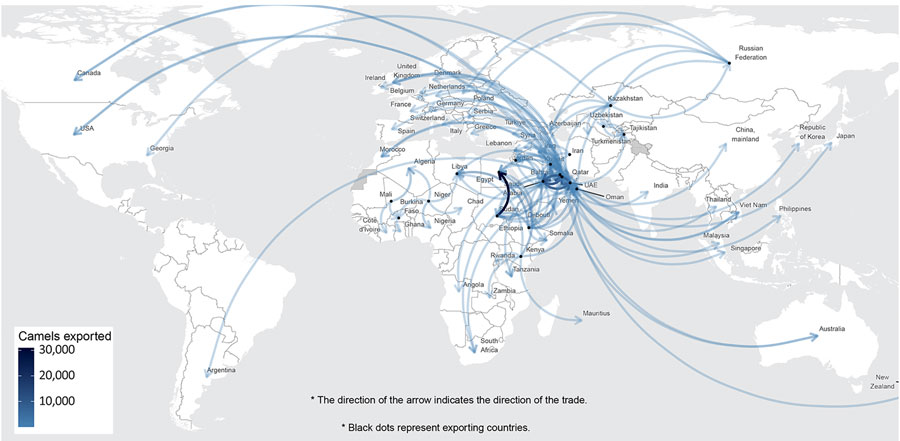
Figure 8. Live camel exports between countries described during global genomic surveillance, 2013–2024. The arrow tail represents the source country and the arrowhead represents destination country. The color of the arrow represents the number of camel exports. Trade flows are contextual indicators of animal movement connectivity and do not provide evidence of Middle East respiratory syndrome coronavirus infection, infected-animal movement, viral introduction, or viral circulation. The Australia-directed flows represent 6 animals in total, 5 in 2015 and 1 in 2021, and should be interpreted accordingly. Map provided by the World Health Organization Health Emergencies Programme using data from the Food and Agriculture Organization of the United Nations statistics database.
Main Article
Page created: September 19, 2026
Page updated: October 13, 2026
Page reviewed: October 13, 2026
The conclusions, findings, and opinions expressed by authors contributing to this journal do not necessarily reflect the official position of the U.S. Department of Health and Human Services, the Public Health Service, the Centers for Disease Control and Prevention, or the authors' affiliated institutions. Use of trade names is for identification only and does not imply endorsement by any of the groups named above.