Disclaimer: Early release articles are not considered as final versions. Any changes will be reflected in the online version in the month the article is officially released.
Volume 32, Number 12—December 2026
Dispatch
Wild Mice and Shrews as Natural Reservoirs of Emerging Tickborne Yezo Virus, Hokkaido, Japan, 2023–2025

Figure 2
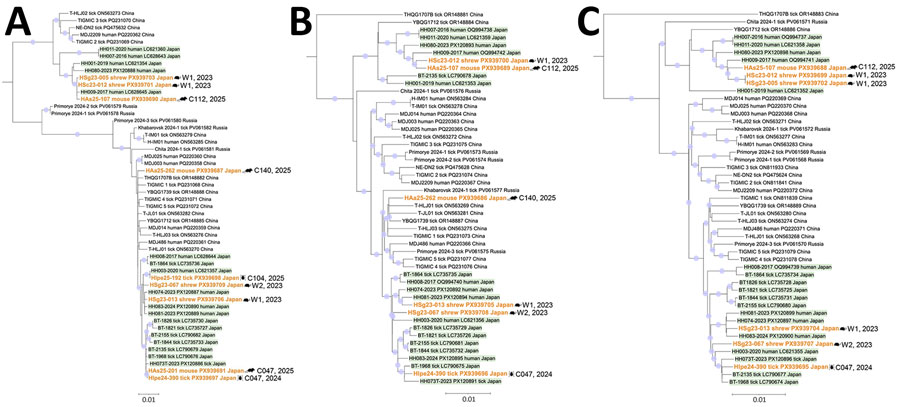
Figure 2. Phylogenetic tree of Yezo virus from study of wild mice and shrews as natural reservoirs of emerging tickborne Yezo virus, Hokkaido, Japan, 2023–2025. Tree was constructed based on the nucleotide sequence of the open reading frame of each segment. A) Small segment; B) medium segment; C) large segment. Sequences were aligned using the MUSCLE algorithm in Geneious Prime (https://www.geneious.com). Maximum-likelihood trees were constructed using the RAxML method with the general time-reversible with gamma rate categories and invariable sites. Bootstrap support value was calculated with 1,000 replicates. Yezo virus isolate T30T31, which was reported from western Russia (15), was used as the outgroup to determine the root but is not shown. Orange bold text indicates isolates obtained in this study, which are labeled by host species icons, collection site identification, and collection year. Green shading indicates the isolates from Japan from previous studies (1,4,9). Blue circles indicate nodes with >70% bootstrap values. Scale bars indicate nucleotide substitutions per site.
References
- Kodama F, Yamaguchi H, Park E, Tatemoto K, Sashika M, Nakao R, et al. A novel nairovirus associated with acute febrile illness in Hokkaido, Japan. Nat Commun. 2021;12:5539. DOIPubMedGoogle Scholar
- Zhang MZ, Bian C, Ye RZ, Cui XM, Yao NN, Yang JH, et al. A series of patients infected with the emerging tick-borne Yezo virus in China: an active surveillance and genomic analysis. Lancet Infect Dis. 2025;25:390–8. DOIPubMedGoogle Scholar
- Ogata Y, Sato T, Kato K, Kikuchi K, Mitsuhashi K, Watari K, et al. A case of tick-borne Yezo virus infection: concurrent detection in the patient and tick. Int J Infect Dis. 2024;143:
107038 . DOIPubMedGoogle Scholar - Yamaguchi H, Mizuma K, Watari K, Ohari Y, Mitsuhashi K, Tamiya K, et al. Epidemiological, clinical, and virological characterizations of Yezo virus infections, an emerging tick-borne orthonairovirus disease in Japan. J Infect Dis. 2026;233:1036–45. DOIPubMedGoogle Scholar
- Epik YO, Sycheva KA, Karan LS, Mokretsova EV, Dragomeretskaya AG, Trotsenko OE, et al. Yezo virus diversity in tick bite patients and ticks, Russia. Emerg Infect Dis. 2026;32:759–62. DOIPubMedGoogle Scholar
- Ito M, Minamikawa M, Kovba A, Numata H, Itoh T, Katada Y, et al. Environmental and host factors underlying tick infestation in invasive raccoons (Procyon lotor) in Hokkaido, Japan. Ticks Tick Borne Dis. 2024;15:
102389 . DOIPubMedGoogle Scholar - Ito M, Minamikawa M, Kovba A, Numata H, Itoh T, Ariizumi T, et al. Environmental and host factors underlying tick-borne virus infection in wild animals: investigation of the emerging Yezo virus in Hokkaido, Japan. Ticks Tick Borne Dis. 2024;15:
102419 . DOIPubMedGoogle Scholar - Ito M, Ohari Y, Kishimoto M, Matsuno K. Spatial distribution of ticks and tick-borne pathogens in central Hokkaido, Japan and associated ecological factors revealed by intensive short-term survey in 2024. PLoS One. 2026;21:
e0349386 . DOIPubMedGoogle Scholar - Nishino A, Tatemoto K, Ishijima K, Inoue Y, Park ES, Yamamoto T, et al. Transboundary movement of Yezo virus via ticks on migratory birds, Japan, 2020–2021. Emerg Infect Dis. 2024;30:2674–8. DOIPubMedGoogle Scholar
- Yamaguti N, Tipton V, Keegan H, Toshioka S. Ticks of Japan, Korea, and the Ryukyu Islands. Brigham Young University Science Bulletin. Biological Series. 1971;15:1.
- Ohdachi DS, Ishibashi Y, Iwasa AM, Fukui D, Saitoh T. The wild mammals of Japan, 2nd edition. Kyoto: Shoukadoh Book Sellers; 2015.
- The American Society of Mammalogists. The mammal diversity database [cited 2026 Jan 14]. https://www.mammaldiversity.org/index.html
- Ohdachi S. Home ranges of sympatric soricine shrews in Hokkaido, Japan. Acta Theriol (Warsz). 1992;37:91–101. DOIGoogle Scholar
- Munderloh UG, Kurtti TJ. Formulation of medium for tick cell culture. Exp Appl Acarol. 1989;7:219–29. DOIPubMedGoogle Scholar
- Apanasevich M, Dubovitskiy N, Derko A, Khozyainova A, Tarasov A, Kokhanenko A, et al. Genomic characterization of a novel Yezo virus revealed in Ixodes pavlovskyi tick virome in western Siberia. Viruses. 2025;17:1362. DOIPubMedGoogle Scholar
1Current affiliation: Okayama University of Science Faculty of Veterinary Medicine, Imabari, Japan.
2Current affiliation: Tokyo University, Tokyo, Japan.
3Current affiliation: Umeå University, Umeå, Sweden.