Volume 32, Number 2—February 2026
Research Letter
Severe Respiratory Diphtheria-Like Illness Caused by Toxigenic Corynebacterium ulcerans
Rita Helleren, Hans Kristian Fløystad, Odd Alexander Tellefsen, Miroslav Boskovic, Terje Skraastad, Anne Torunn Mengshoel, Kristian Alfsnes, and Vegard Skogen
Figure
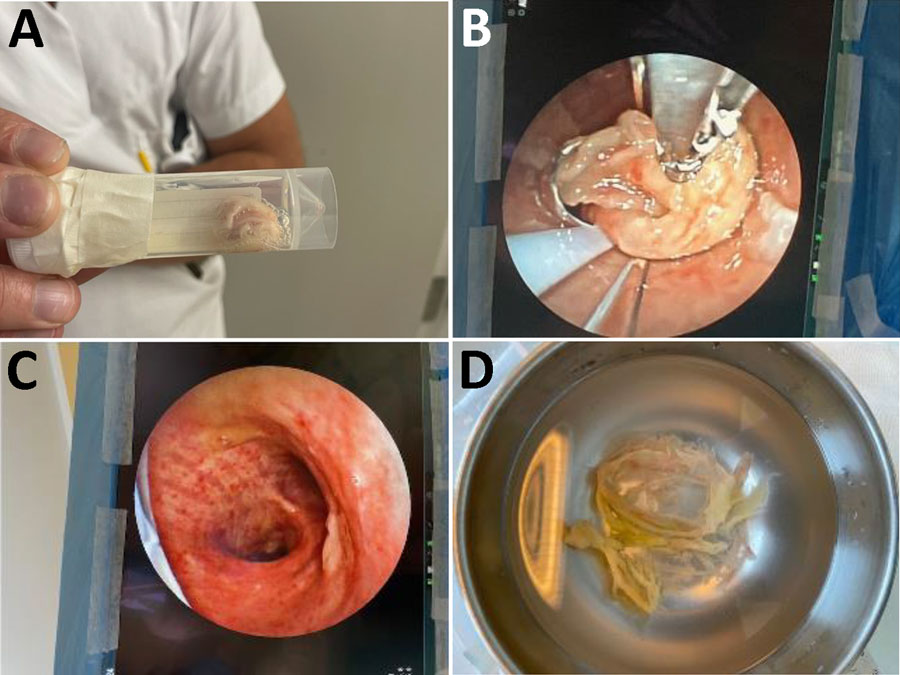
Figure. Clinical findings from a case of severe respiratory diphtheria-like illness caused by toxigenic Corynebacterium ulcerans, Norway. A) Pseudomembranes coughed up by the patient on day 1 of hospitalization. B) Pseudomembranes removed by bronchoscopy on day 4 of hospitalization. C) Trachea and carina after bronchoscopy on day 4 of hospitalization. D) Pseudomembranes removed from lower airways via bronchoscopy on day 4 of hospitalization.
Page created: January 21, 2026
Page updated: February 20, 2026
Page reviewed: February 20, 2026
The conclusions, findings, and opinions expressed by authors contributing to this journal do not necessarily reflect the official position of the U.S. Department of Health and Human Services, the Public Health Service, the Centers for Disease Control and Prevention, or the authors' affiliated institutions. Use of trade names is for identification only and does not imply endorsement by any of the groups named above.