Skip directly to site content Skip directly to page options Skip directly to A-Z link Skip directly to A-Z link Skip directly to A-Z link

Disclaimer: Early release articles are not considered as final versions. Any changes will be reflected in the online version in the month the article is officially released.

Volume 32, Number 2—February 2026

Dispatch

Donor-Derived West Nile Virus Infection in Kidney Transplant Recipients, France, 2025

Aurélie TruffotComments to Author , Anne-Sophie Montcuquet, Gilda Grard, Laura Pezzi, Raphaelle Klitting, Gabriel Clavel, Sylvain Trincal, Paolo Malvezzi, Lionel Rostaing, Lara Meyer, Stéphanie Dieterle, Sophie Lucas Samuel, Vincent Foulongne, Laura Le Fleur, Patricia Pavese, Gaël Pradel, Florian Franke, Syria Laperche, Julien Lupo, Anne Signori-Schmuck, Raphaële Germi, and Patrice Morand
Author affiliation: Université Grenoble Alpes, CNRS, CEA, IRIG IBS, Laboratoire de virologie, Grenoble, France (A. Truffot, J. Lupo, A. Signori-Schmuck, R. Germi, P. Morand); Université Grenoble Alpes, CHU Grenoble Alpes, Service de néphrologie, Grenoble (A.-S. Montcuquet, G. Clavel, S. Trincal, P. Malvezzi, L. Rostaing); Centre National de Référence des Arbovirus, Inserm-IRBA, Marseille, France (G. Grard, L. Pezzi, R. Klitting); Unité des Virus Émergents, Aix-Marseille Université, Universita di Corsica, IRD, Inserm, Marseille (G. Grard, L. Pezzi, R. Klitting); Service de Néphrologie, Montpellier, France (L. Meyer); Direction Générale Médicale et Scientifique, Agence de la Biomédecine, Saint-Denis, France (S. Dieterle, S.L. Samuel); Centre Hospitalier Universitaire de Montpellier, Montpellier (V. Foulongne, L. Le Fleur); Grenoble-Alpes University Hospital, La Tronche, France (P. Pavese); Centre Hospitalier d’Avignon Henri Duffaut, Avignon, France (G. Pradel); Santé Publique France, Marseille (F. Franke); Etablissement Français du Sang, Saint-Denis (S. Laperche)

Main Article

Figure 2

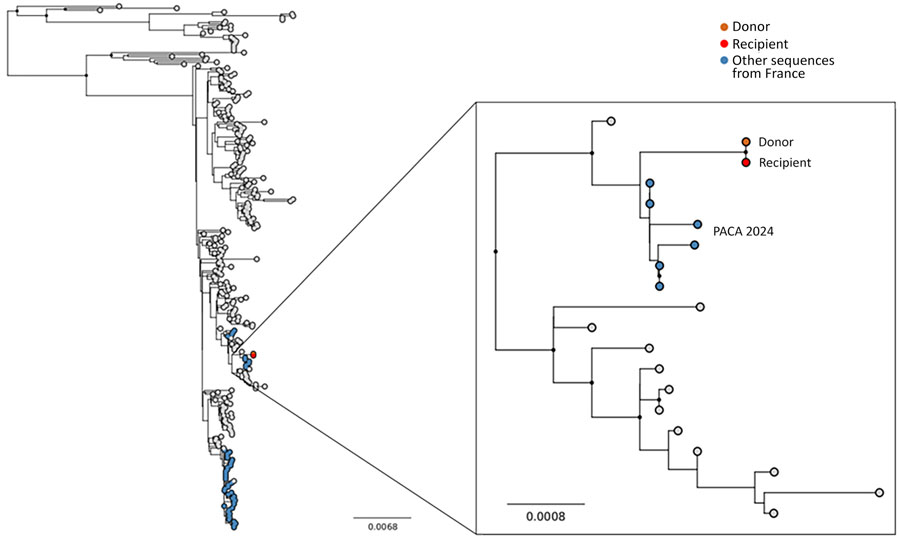
Phylogeny of West Nile virus lineage 2 highlighting sequences from the infected donor and recipient in case of donor-derived West Nile virus infection in kidney transplant recipients, France, 2025. Maximum-likelihood phylogeny was reconstructed with IQ-TREE version 1.6.12 (https://iqtree.github.io/release/v1.6.12). The best-fit nucleotide substitution model was selected using ModelFinder (https://iqtree.github.io/ModelFinder), and branch support was evaluated with ultrafast bootstrap approximation using 1,000 replicates. We used 226 sequences representative of the phylogenetic diversity within lineage 2 (subsampled from a comprehensive set of public sequences from GenBank accessed via Pathoplexus, https://doi.org/10.62599/PP_SS_67.1), including those from the donor and recipient produced in this study, as well as other sequences from France, including those from Provence-Alpes Côte d’Azur (PACA) region. The length of the branches is proportional to the degree of divergence.

Figure 2. Phylogeny of West Nile virus lineage 2 highlighting sequences from the infected donor and recipient in case of donor-derived West Nile virus infection in kidney transplant recipients, France, 2025. Maximum-likelihood phylogeny was reconstructed with IQ-TREE version 1.6.12 (https://iqtree.github.io/release/v1.6.12). The best-fit nucleotide substitution model was selected using ModelFinder (https://iqtree.github.io/ModelFinder), and branch support was evaluated with ultrafast bootstrap approximation using 1,000 replicates. We used 226 sequences representative of the phylogenetic diversity within lineage 2 (subsampled from a comprehensive set of public sequences from GenBank accessed via Pathoplexus, https://doi.org/10.62599/PP_SS_67.1), including those from the donor and recipient produced in this study, as well as other sequences from France, including those from Provence-Alpes Côte d’Azur (PACA) region. The length of the branches is proportional to the degree of divergence.

Main Article

Page created: January 17, 2026
Page updated: February 15, 2026
Page reviewed: February 15, 2026
The conclusions, findings, and opinions expressed by authors contributing to this journal do not necessarily reflect the official position of the U.S. Department of Health and Human Services, the Public Health Service, the Centers for Disease Control and Prevention, or the authors' affiliated institutions. Use of trade names is for identification only and does not imply endorsement by any of the groups named above.
file_external