Skip directly to site content Skip directly to page options Skip directly to A-Z link Skip directly to A-Z link Skip directly to A-Z link

Disclaimer: Early release articles are not considered as final versions. Any changes will be reflected in the online version in the month the article is officially released.

Volume 32, Number 4—April 2026

Dispatch

Treatment of Severe Ocular Mpox with Cidofovir and Tecovirimat

Xavier BrousseComments to Author , Rayan Kreidie, Eugénie Mourgues, Luna Fraysse, Marin Lahouati, Vincent Servant, Sonia Burrel, Valentine Saunier, and Charles Cazanave
Author affiliation: Bordeaux University Hospital, Bordeaux, France (X. Brousse, R. Kreidie, E. Mourgues, L. Fraysse, M. Lahouati, V. Servant, S. Burrel, V. Saunier, C. Cazanave); Bordeaux University, Inserm, UMR1034, Pessac, France (M. Lahouati); CNRS UMR 5234, Bordeaux University, Bordeaux (S. Burrel, C. Cazanave)

Main Article

Figure

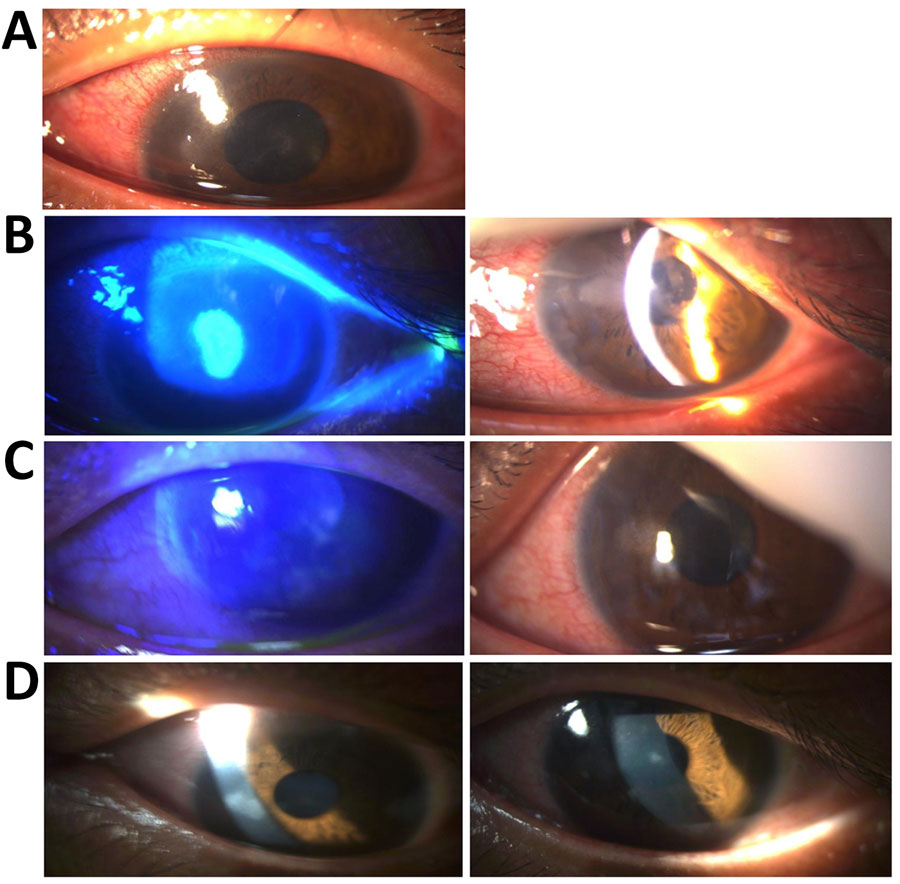
Ophthalmologic evaluation of patient with severe ocular mpox treated with cidofovir and tecovirimat. Images are of patient’s left eye over course of diagnosis and treatment. A) Slit-lamp examination at day 0, showing corneal edema, a pseudodendritic ulcer, and conjunctival hyperemia characteristic of disciform kerititis. B) On day 5, before first-line treatment with valaciclovir, fluorescein (left) showing and slit-lamp examination (right) showing persistent keratitis and formation of new corneal infiltrates. C) On day 21, seven days after initiation of second-line antiviral drug treatment with cidofovir and tecovirimat, fluorescein (left) and slit-lamp examination (right) showing marked clinical improvement and reduction in infiltrates. D) On day 29, fourteen days after treatment with second-line antiviral drug treatment with cidofovir and tecovirimat, left and right images are of slit-lamp examination showing complete resolution of corneal edema, conjunctival hyperemia, and inflammatory signs.

Figure. Ophthalmologic evaluation of patient with severe ocular mpox treated with cidofovir and tecovirimat. Images are of patient’s left eye over course of diagnosis and treatment. A) Slit-lamp examination at day 0, showing corneal edema, a pseudodendritic ulcer, and conjunctival hyperemia characteristic of disciform kerititis. B) On day 5, before first-line treatment with valaciclovir, fluorescein (left) showing and slit-lamp examination (right) showing persistent keratitis and formation of new corneal infiltrates. C) On day 21, seven days after initiation of second-line antiviral drug treatment with cidofovir and tecovirimat, fluorescein (left) and slit-lamp examination (right) showing marked clinical improvement and reduction in infiltrates. D) On day 29, fourteen days after treatment with second-line antiviral drug treatment with cidofovir and tecovirimat, left and right images are of slit-lamp examination showing complete resolution of corneal edema, conjunctival hyperemia, and inflammatory signs.

Main Article

Page created: March 11, 2026
Page updated: April 10, 2026
Page reviewed: April 10, 2026
The conclusions, findings, and opinions expressed by authors contributing to this journal do not necessarily reflect the official position of the U.S. Department of Health and Human Services, the Public Health Service, the Centers for Disease Control and Prevention, or the authors' affiliated institutions. Use of trade names is for identification only and does not imply endorsement by any of the groups named above.
file_external