Skip directly to site content Skip directly to page options Skip directly to A-Z link Skip directly to A-Z link Skip directly to A-Z link

Volume 32, Number 4—April 2026

Dispatch

Whole-Genome Analysis of Treponema pallidum Subspecies endemicum among Men Who Have Sex with Men, Japan, 2020–2023

Yuki OhamaComments to Author , Kazuo Imai, Yuto Kotaka, Kenichi Lee, Ichiro Itoda, Shu-ichi Nakayama, Makoto Ohnishi, and Yukihiro Akeda
Author affiliation: National Institute of Infectious Diseases, Tokyo, Japan (Y. Ohama, Y. Kotaka, K. Lee, S. Nakayama, M. Ohnishi, Y. Akeda); Saitama Medical University, Saitama, Japan (K. Imai); Tokyo Metropolitan University, Tokyo (Y. Kotaka); Shirakaba Clinic, Tokyo (I. Itoda)

Main Article

Figure

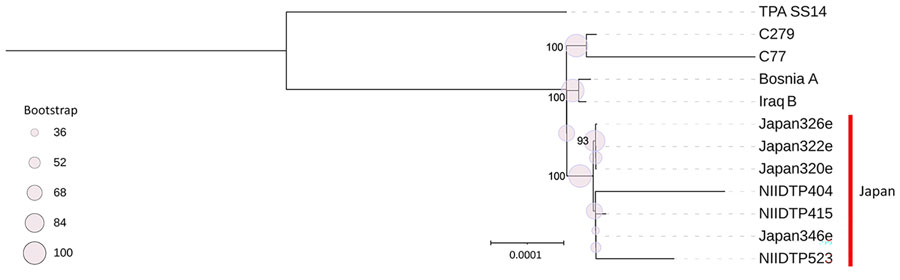
Phylogenetic analysis of isolates from a study of whole-genome analysis of Treponema pallidum subspecies endemicum among men who have sex with men, Japan, 2020–2023. Open reading frames annotated from de novo assembled contigs using Bakta version 1.7.0 (https://bakta.computational.bio), and corresponding GFF3 annotation files processed with Panaroo version 1.2.3 (https://zenodo.org/records/3945497) to define core genomes across isolates. Multiple alignments of core gene sequences generated by Panaroo were used for phylogenetic reconstruction. T. pallidum subsp. pallidum SS14 (GenBank accession no. NC_021508) was used as a reference strain. IQ-TREE version 2.2.0 (http://www.iqtree.org) was used to infer maximum-likelihood phylogenies, incorporating 1,000 ultrafast bootstrap replicates to assess nodal support. Phylogenetic tree was visualized by using Interactive Tree of Life (iTOL; https://itol.embl.de). The T. pallidum subsp. endemicum strains isolated in Japan formed a clade distinct from classic endemic strains, including Iraq B and strains from Cuba (C77 and C279). Scale bar indicates nucleotide substitutions per site.

Figure. Phylogenetic analysis of isolates from a study of whole-genome analysis of Treponema pallidum subspecies endemicum among men who have sex with men, Japan, 2020–2023. Open reading frames annotated from de novo assembled contigs using Bakta version 1.7.0 (https://bakta.computational.bio), and corresponding GFF3 annotation files processed with Panaroo version 1.2.3 (https://zenodo.org/records/3945497) to define core genomes across isolates. Multiple alignments of core gene sequences generated by Panaroo were used for phylogenetic reconstruction. T. pallidum subsp. pallidum SS14 (GenBank accession no. NC_021508) was used as a reference strain. IQ-TREE version 2.2.0 (http://www.iqtree.org) was used to infer maximum-likelihood phylogenies, incorporating 1,000 ultrafast bootstrap replicates to assess nodal support. Phylogenetic tree was visualized by using Interactive Tree of Life (iTOL; https://itol.embl.de). The T. pallidum subsp. endemicum strains isolated in Japan formed a clade distinct from classic endemic strains, including Iraq B and strains from Cuba (C77 and C279). Scale bar indicates nucleotide substitutions per site.

Main Article

Page created: March 20, 2026
Page updated: April 15, 2026
Page reviewed: April 15, 2026
The conclusions, findings, and opinions expressed by authors contributing to this journal do not necessarily reflect the official position of the U.S. Department of Health and Human Services, the Public Health Service, the Centers for Disease Control and Prevention, or the authors' affiliated institutions. Use of trade names is for identification only and does not imply endorsement by any of the groups named above.
file_external