Skip directly to site content Skip directly to page options Skip directly to A-Z link Skip directly to A-Z link Skip directly to A-Z link

Disclaimer: Early release articles are not considered as final versions. Any changes will be reflected in the online version in the month the article is officially released.

Volume 32, Number 4—April 2026

Dispatch

Chronic Wasting Disease in Farmed Cervids, South Korea, 2001–2024

Young Pyo Choi, Yu-Ran Lee, Hoo Chang Park, Yoon Hee Lee, Gordon Mitchell, In-Soon RohComments to Author , and Hyun-Joo SohnComments to Author 
Author affiliation: Korea Brain Research Institute, Daegu, South Korea (Y.P. Choi); World Organisation for Animal Health Reference Laboratory for Chronic Wasting Disease, Gimcheon, South Korea (Y.-R. Lee, H.C. Park, Y.H. Lee, I.-S. Roh, H.-J. Sohn); National and World Organisation for Animal Health Reference Laboratory for Scrapie and Chronic Wasting Disease, Canadian Food Inspection Agency, Ottawa, Ontario, Canada (G. Mitchell)

Main Article

Figure 1

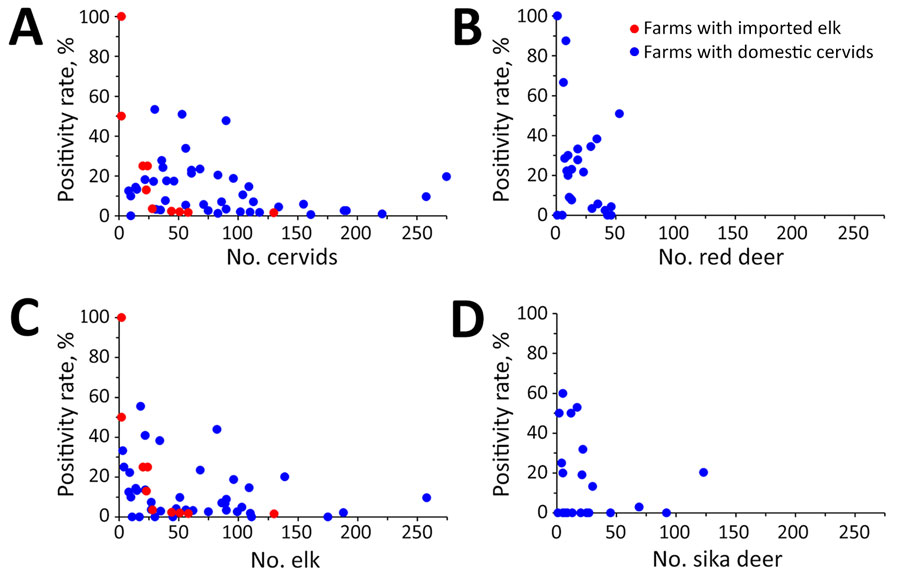
Chronic wasting disease positivity rates in farmed cervids, South Korea, 2001–2024. A) All farmed cervids; B) red deer; C) elk; D) sika deer. Each dot represents a single farm. Positivity rates were calculated as no. animals testing positive/no. animals tested on each farm. Dots reflect the farm’s cervid population because all farmed cervids were culled and tested on farms with positive cases. For species-specific analyses, each cervid species on each farm was assessed separately.

Figure 1. Chronic wasting disease positivity rates in farmed cervids, South Korea, 2001–2024. A) All farmed cervids; B) red deer; C) elk; D) sika deer. Each dot represents a single farm. Positivity rates were calculated as no. animals testing positive/no. animals tested on each farm. Dots reflect the farm’s cervid population because all farmed cervids were culled and tested on farms with positive cases. For species-specific analyses, each cervid species on each farm was assessed separately.

Main Article

Page created: February 20, 2026
Page updated: April 09, 2026
Page reviewed: April 09, 2026
The conclusions, findings, and opinions expressed by authors contributing to this journal do not necessarily reflect the official position of the U.S. Department of Health and Human Services, the Public Health Service, the Centers for Disease Control and Prevention, or the authors' affiliated institutions. Use of trade names is for identification only and does not imply endorsement by any of the groups named above.
file_external